Wisdom · The Virtue Series, Part Three
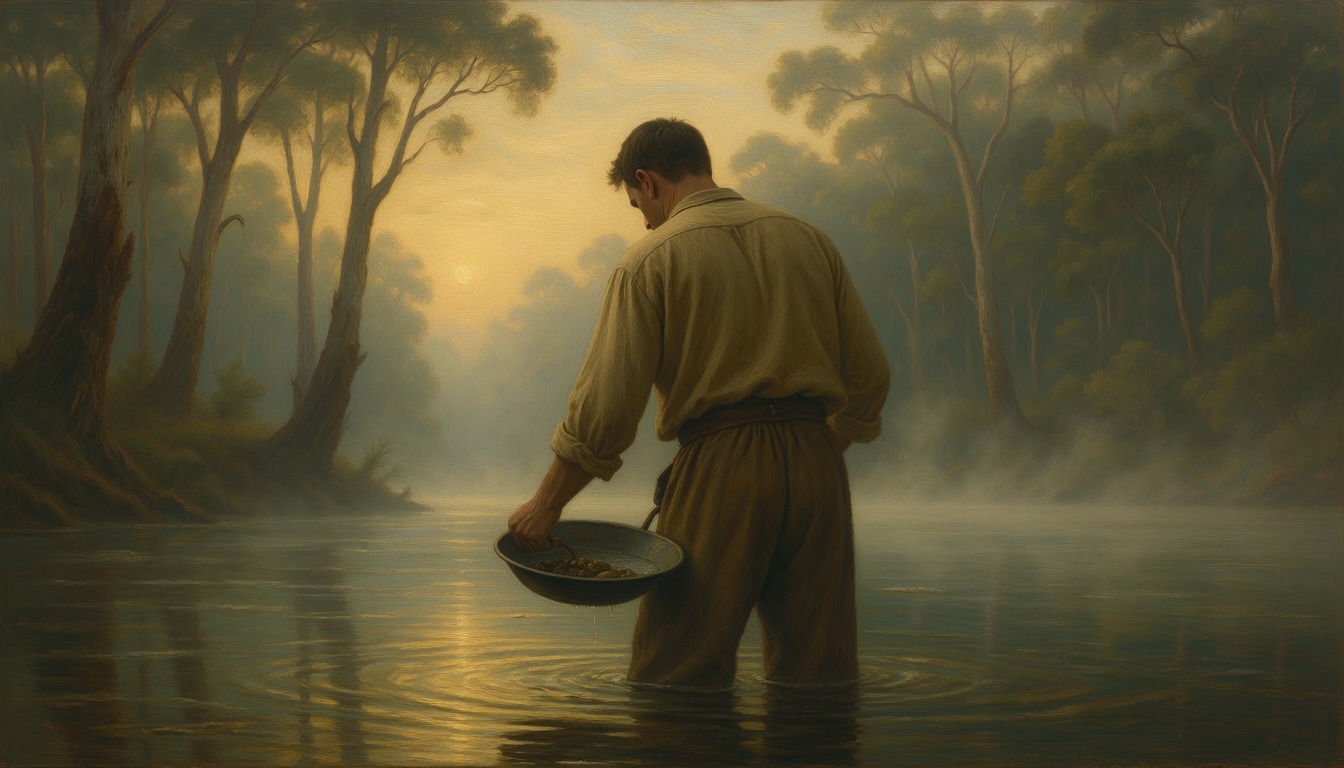
Imagine you are standing knee-deep in a river.
The water is cold, cold enough that you stopped feeling your feet twenty minutes ago. The current pushes against your shins with a steady, indifferent pressure. Your back aches from bending. Your hands are raw. The pan in your grip is heavy with sediment: dirt, grit, small stones, and water that has the colour of milky tea.
This is not glamorous. This is not the version of gold panning you see in the movies, the triumphant moment, the glinting nugget, the shout of discovery. This is the real thing. And the real thing is mostly mud.
You swirl the pan. Slowly. With a rhythm you didn’t learn from a book but from the ache in your wrists and the failure of the first fifty attempts. The heavy stuff sinks. The light stuff washes over the edge. And you watch, not for a flash, not for a nugget, for something subtler than that. A colour change at the bottom of the pan. A weight that doesn’t belong to the sediment. A glint so small you’d miss it if you were looking for something bigger.
Most of the time, you find nothing. Most pans come up empty. You pour out the mud, scoop another load, and start again. That is the work. Not the finding. The looking. The willingness to stand in the cold water with raw hands and believe that the gold is there, even when the evidence says otherwise.
And then, once in a while, there it is. At the bottom of the pan. So small it barely catches the light. But real. Unmistakably real. Gold that was there all along, hidden in the mud, waiting for someone patient enough to find it.
That is Wisdom.
Not the wisdom of the library or the lecture hall. Not the wisdom of the person who has read all the right books and can quote the right philosophers. The wisdom of the person who has stood in the river, in the cold, in the mud, in the long hours of finding nothing, and learned to tell the difference between sediment and gold.
Wisdom is not what you know. It is what you’ve learned to see: in the mud, in the mess, in the moments nobody else thought were worth examining.
The Two Kinds of Knowing
There is something the Greeks understood about wisdom that the modern world has almost completely forgotten.
They had two words for knowledge. Not one. Two. And the difference between them is the difference between reading a recipe and feeding your family on a Tuesday night with whatever is left in the fridge.
The first they called episteme. It means knowledge you can write down. Facts. Theories. Information. The capital of France. The boiling point of water. The name of the third Roman emperor. This is the knowledge that fills textbooks and wins quiz nights and makes you sound intelligent at dinner parties. It is real. It is useful. And it will not save you when your life falls apart.
The second they called phronesis. Practical wisdom. The kind you cannot learn from a book because it doesn’t live in books. It lives in the scar tissue of your decisions, the ones that worked and the ones that didn’t. It is the knowledge of what to do when the textbook has nothing to say. When the situation is messy and unclear and no one is coming to help and you have to decide, right now, with incomplete information, what the right thing is.
Episteme tells you that grief has five stages. Phronesis is holding your friend’s hand in the hospital car park and knowing, without being told, without reading it anywhere, that this is not a moment for words. This is a moment for silence and presence and the hand that doesn’t let go.
Episteme tells you that communication is important in a relationship. Phronesis is knowing that right now, at 10pm on a Thursday, after the day your partner has had, the most loving thing you can do is not talk. Is not ask how they’re feeling. Is to make the tea, put it down beside them, and sit in the room without requiring anything.
Episteme can be googled. Phronesis can only be earned.
Socrates, who spent his entire life asking questions that made powerful people uncomfortable, understood the relationship between these two kinds of knowing better than anyone. The lesson that has echoed down from him through every century since is that wisdom begins with admitting how little you know.
That is not false modesty. That is the most practically wise thing a human being can say. Because the moment you believe you know enough, the moment you stop standing in the river, stop swirling the pan, stop looking for gold in the mud, is the moment you stop learning. And a person who has stopped learning has mistaken episteme for phronesis. They have confused the map for the territory. And the territory will teach them otherwise, the hard way, at the worst possible time.
What It Actually Looks Like
Wisdom, when you see it in a person, is quieter than you expect.
It is not the person with all the answers. It is the person who asks the question that makes everyone else in the room go silent, not because it is clever, but because it is true. The question nobody wanted to ask. The one that was sitting in the corner of the conversation, obvious and invisible, waiting for someone brave enough to say it.
It looks like a grandmother sitting at the kitchen table while her adult granddaughter pours out the details of a relationship that is clearly, to everyone except the granddaughter, already over. The grandmother has seen this before. She has lived this before. She knows how this story ends; she could tell her in four sentences and save her six months of pain. But she doesn’t. She listens. She nods. She asks one question, not the fixing question, not the advice question, but the question that opens a door the granddaughter didn’t know was there: “What do you think you deserve?” And then she waits. Because wisdom is not always knowing what to say. Sometimes it is knowing what not to say, and how long to wait, and which question will do more work than any answer.
It looks like a man standing in his doctor’s office, holding a piece of paper with a result on it that has just rearranged the furniture of his entire future. He is terrified. But something in him, something that was built in previous rooms, in earlier storms, in the accumulated weight of every hard thing he has survived and examined with open eyes, allows him to take one breath and ask: what do I need to know, and what do I need to do? Not why me. Not this isn’t fair. Those feelings will come later, and they will be real, and he will honour them. But right now, in this moment, phronesis is speaking. The practical wisdom that says: feel the mud. But look for the gold. What can I learn here? What can I carry forward?
It looks like a mother watching her son make a decision she disagrees with. She has the experience. She has the hindsight. She could intervene, and she would be right. But wisdom tells her something that rightness can’t: this is how he learns. This is his river. This is his mud. And the gold he finds at the bottom of this pan will belong to him in a way that her advice never could. So she stands at the bank. She watches. She stays close enough to catch him if the current takes him. And she lets him learn.
T.S. Eliot captured something essential about this kind of wisdom, the kind that comes not from accumulating knowledge, but from having the courage to keep exploring:
“We shall not cease from exploration, and the end of all our exploring will be to arrive where we started and know the place for the first time.” (T.S. Eliot, Little Gidding)
Know the place for the first time. That is what phronesis does. It takes you back to the same river, the same relationships, the same problems you’ve been standing in for years, and suddenly you see gold that was always there. Not because anything changed in the river. Because something changed in you.
The Mud Is the Point
This is the part that nobody wants to hear, and the part that makes this virtue different from all the others.
You cannot skip the mud.
The gold is in it. Not beside it. Not underneath it. Not waiting for you on a clean, dry bank where you can pick it up without getting your hands dirty. The gold is inside the mud itself. And the only way to find it is to stand in the river, fill the pan, and do the slow, unglamorous, repetitive work of sorting.
There is no shortcut. There is no hack. There is no five-step process that extracts the lessons of your life without requiring you to actually live them.
The failed business taught you something no MBA could. The marriage that ended taught you something about love that the one that lasted never would have. The year you were lost, the one you don’t put on the CV, the one you sometimes pretend didn’t happen, taught you more about yourself than the years of success on either side of it.
There is a line often attributed to the Persian poet Rumi, who understood the relationship between suffering and growth better than almost anyone who has ever written:
“The wound is the place where the Light enters you.”
The wound. Not the library. Not the degree. Not the podcast or the self-help book or the thirty-day challenge. The wound. The thing you didn’t choose. The season that was done to you, not by you. The mud you would never have volunteered for, and the gold that was hiding inside it the whole time.
That is why the symbol of Wisdom in The Arete Path is not a book, or a scroll, or a temple. It is a gold pan and a journal. The pan for the finding. The journal for the recording. Because wisdom that isn’t captured, wisdom that isn’t written down, reflected on, turned over in the hand like a stone, is just experience. And experience without reflection is not wisdom. It is just survival.
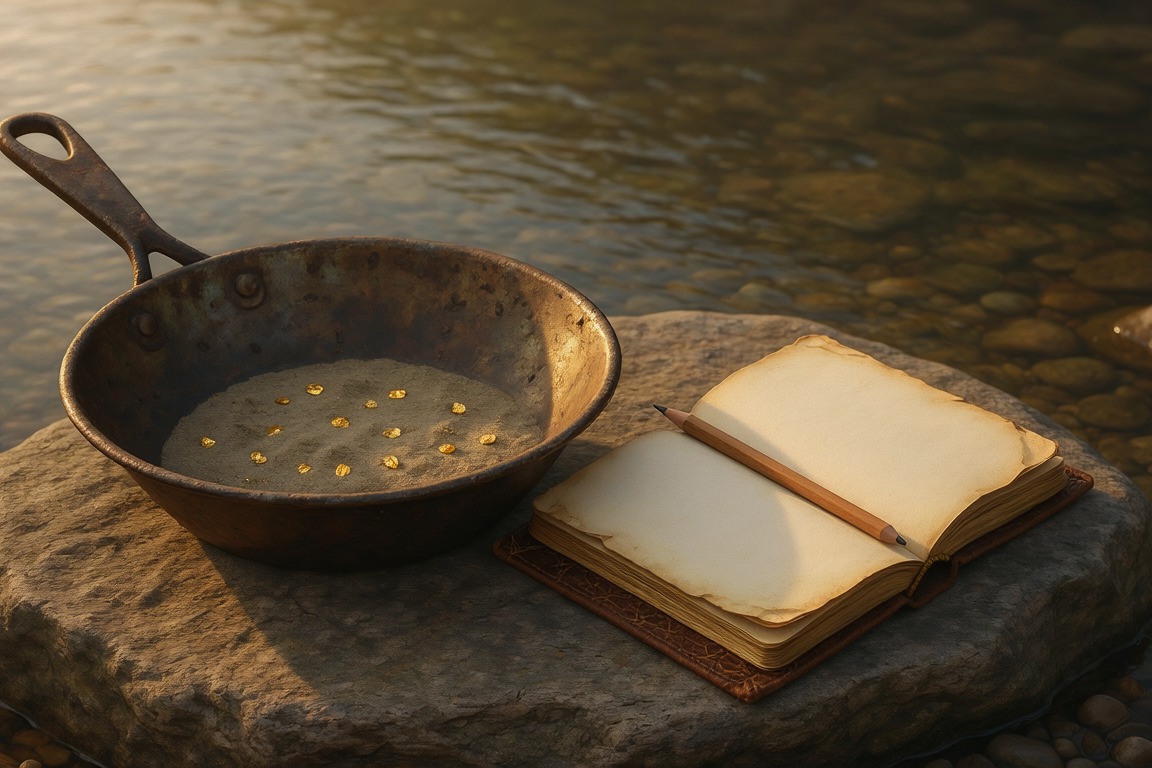
Acknowledge the mud. Record the gold. That is the practice. Not once. Every time you stand in the river.
The Journal
Marcus Aurelius, who walks through so much of this writing, did something that almost no powerful person in history has done. He wrote himself honest.
His Meditations were not written for publication. They were not philosophy for an audience. They were the private journal of a man trying to make sense of his own mud: the wars, the betrayals, the loneliness of leadership, the weight of decisions that affected millions of lives. He wrote to himself the way you talk to yourself at 3am when nobody is listening and there is nothing left but the truth.
“Our life is what our thoughts make it.” (Marcus Aurelius, Meditations)
That line is from his journal. Written to himself. It is not advice for other people. It is a man in the mud, panning for gold, and recording what he found.
That is the practice of wisdom. Not reading other people’s journals. Writing your own. Not consuming other people’s insights. Standing in your own river, with your own pan, and doing the slow work of asking: what is the gold in this? What did this teach me? What do I know now that I didn’t know before, not in my head, but in my bones?
Epictetus, who knew suffering more intimately than Aurelius ever did, taught his students something that sounds simple and is one of the hardest things a person can do:
“First say to yourself what you would be; and then do what you have to do.” (Epictetus, Discourses)
First say to yourself what you would be. That is the journal. The moment you sit down, alone, and ask: who am I becoming? What have I learned? What is the mud I am standing in right now, and what is the gold I am not yet able to see? That practice, daily, honest, unglamorous, is the difference between a person who has lived forty years and a person who has lived one year forty times.
The Hardest Thing About Wisdom
The hardest thing about wisdom is not finding it. It is admitting what it shows you.
Because sometimes the gold at the bottom of the pan is not what you wanted to find. Sometimes the honest answer to what did I learn? is: I was wrong. I am the one who needs to change. This situation is my responsibility. The pattern I keep blaming on other people is a pattern I keep creating.
Brené Brown, who has spent her career studying the intersection of vulnerability and courage, calls this the reckoning. The moment you stop telling yourself the easy story and confront the real one. It is not comfortable. It is not pleasant. And it is the only door that leads to actual growth.
Rilke told a young poet to live the questions now, and that is what wisdom asks of us: not to know all the answers, but to have the courage to live the questions.
Live the questions. Not answer them. Not solve them. Live them. Sit in the mud of them. Let them do their slow work on you. Trust that the gold is forming even when you cannot see it.
This is why wisdom leans on two other virtues.
It requires Fortitude, because standing in the river when the water is cold and the pan keeps coming up empty takes roots. It takes the willingness to endure the not-knowing, the not-finding, the long stretches of mud before the gold appears.
It requires Temperance, because wisdom is not learned by cramming. It is learned in rhythm. In the balance between seeking and sitting. Between reading and reflecting. Between the day’s noise and the evening’s quiet. The conductor must create space for the quiet instrument to play, and wisdom is always the quiet instrument.
Together, the three virtues form a progression that mirrors the gold panner’s practice: stand firm in the river (Fortitude), find your rhythm (Temperance), and look for the gold (Wisdom). Roots. Rhythm. Recognition.
Tonight
There is mud in your life right now. You know where it is. You might be standing in it as you read this, knee-deep, cold, tired, wondering whether there is any gold left in this river.
There is.
It may not look like what you expected. It may not be the lesson you wanted. It may be a truth about yourself that is uncomfortable to hold, something you need to change, something you need to release, something you need to accept. But it is gold. Real gold. The kind that only forms under pressure, only appears in the mud, and only belongs to the person who did the work of finding it.
So tonight, I want to invite you to do the oldest practice in philosophy and the simplest one in this series.
Sit down. Open a journal, or a blank page, or the notes app on your phone, or the back of an envelope, it doesn’t matter. And ask yourself two questions:
What is the mud I am standing in right now? And what is the gold?
Don’t rush the answer. Let it come. The pan needs to be swirled slowly. The heavy things sink. The light things wash away. And what remains, at the very bottom, after everything else has been cleared, is the thing worth keeping.
Acknowledge the mud. Record the gold.
That is Wisdom. Not a destination. A practice. A daily return to the river with the willingness to get your hands dirty and the faith that something precious is hiding in the silt.
The smartest people you know are not the ones with the most answers. They are the ones who are still asking. Still panning. Still standing in the cold water with raw hands and open eyes.
Be one of those people.
The gold is there. It has always been there.
It was just waiting for you to look.
Meditate with Arete
A Sculptor's Pause Before the next thing, rest here a while. Meditate with Arete is a quiet room: a two-minute sitting, one breath at a time, with nothing asked of you. Sit with Arete
About the author
Marcus J Emsley · The Guide
Marcus spent seventeen years as a welfare officer in the Royal Australian Air Force, at home and on operations overseas, sitting with people in grief, trauma and the mornings they did not want to rise. He is the founder of Arete Estate in the Barossa Valley, South Australia, the creator of The Sculptor's Journey and Wisdom & Wonder, and the author of the debut novel Wisdom & Wine. He is the son of a primary school teacher who coached footy, cricket and life, and a palliative care nurse who showed him what kindness at the hardest door looks like. He has stood in the dark himself, and he writes from the far side of it.
What we are building at Arete Estate
Arete is excellence becoming. It is the highest expression of who you were always meant to be, not the finished version, but the version that keeps reaching. It is not built. It is revealed.
Arete Estate exists to help people reveal, not construct, the highest version of themselves. We do this through six virtues drawn from the world's wisdom traditions, taught through stories, walked through daily practice, and offered to anyone who is ready to begin: the parent raising a child, the leader carrying a team, the soldier returning from service, the school shaping the next generation, the person sitting alone in the early hours of the morning wondering if there is a path through.
Our work is to make that path visible. To stand as a lighthouse for the seekers, the grieving, and the broken. To remind every person we reach that excellence is not built, it is revealed by storms, and that they are not alone in the storm.
We do not chase. We shine. The Sculptor's Journey (The Doorway, The Walked Path, The Guided Path), An Hour with the Guide, Meditate with Arete, Wisdom & Wonder and The Sculptor's Library are the rooms of that house.
Six virtues. One journey. Your highest self.
www.areteestate.com.au · info@areteestate.com.au · Instagram @areteestate
If this essay touched something raw
Some of what is written here is heavy. If it has stirred something you are carrying, please do not carry it alone tonight.
Lifeline 13 11 14 · Open Arms (veterans and families) 1800 011 046 · 1800RESPECT 1800 737 732 · Kids Helpline 1800 55 1800 · In an emergency, call 000.
Reaching out is not weakness. It is all six virtues at once: the Fortitude to stay, the Wisdom to know you need a hand, the Love to let someone in, the Courage to ask, the Temperance to set the weight down, and the Gratitude for the one who answers.

Responses