Love · My mother eased suffering at death’s door. My father built strength for life’s journey. The origin story of Arete Estate, and why excellence is revealed by storms, not despite them.
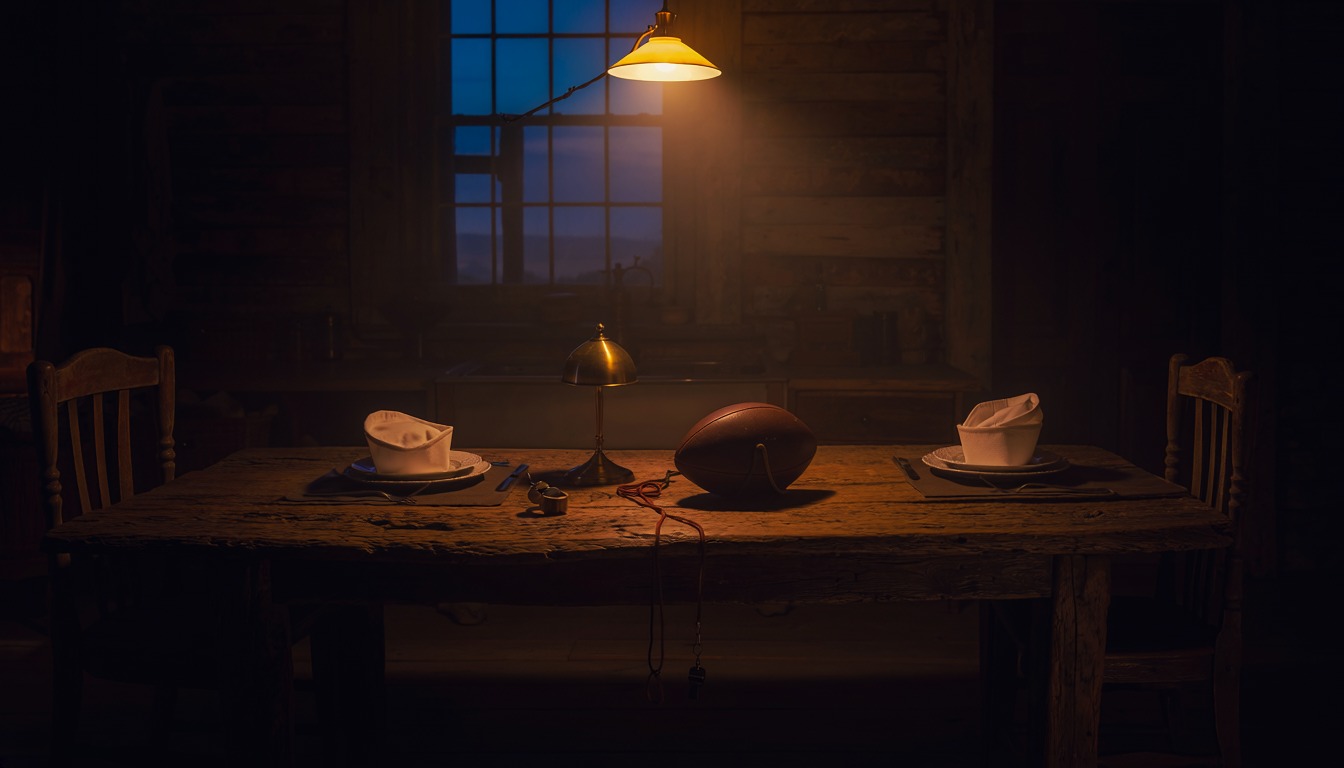
I grew up in a house where death was discussed at the dinner table.
Not morbidly. Not with dread. But with the same matter-of-factness that other families might discuss the weather or weekend plans. My mother was a palliative care nurse. She spent her days, and many of her nights, with people who were dying.
She would come home carrying invisible weight. Sometimes she’d be quiet. Sometimes she’d share stories, always with names changed, about the sacred space of someone’s final days. About what people say when pretence falls away. About what matters when everything else is stripped back.
I didn’t understand it then. I was a child, more interested in sport and mates and whatever children are interested in. But something was seeping in. A comfort with mortality that I wouldn’t recognise until much later. An understanding that death isn’t the opposite of life; it’s part of it.
My mother was teaching me, without either of us knowing it, the ancient truth the Stoics called memento mori: remember that you will die. She didn’t just remember it; she witnessed it daily. And what she brought home to us was that awareness of death doesn’t diminish life. It clarifies it. It burns away the trivial. It reveals what actually matters.
My father was a different force entirely.
He was a teacher and a coach. Where my mother sat with endings, my father was obsessed with beginnings: with potential, with what a person could become if they committed to the work.
He believed in discipline. In showing up when you didn’t feel like it. In the slow accumulation of small efforts that eventually produce something extraordinary. He coached young athletes not just in technique but in character. He saw sport as a forge for the soul.
Dad embodied amor fati, love your fate. Whatever life throws at you, meet it. Build yourself strong enough to embrace it all, the victories and the defeats, the joy and the grief. Don’t just endure your fate. Love it. Because it’s yours, and it’s making you.
Where Mum taught me that suffering could be eased, Dad taught me that strength could be built. Where she showed me how to sit with someone in their darkest hour, he showed me how to prepare for that hour long before it arrived.
Two philosophies. Two callings. One dinner table.
I didn’t know it then, but I was learning the architecture of a soul.
The ancient Greeks had a word for what my parents were teaching me: arete.
In the modern world, we’ve reduced “excellence” to a metric. We measure it in likes, in bank balances, in the relentless pursuit of “more”. But to the ancients, arete was not a destination or a trophy. It was a state of being. It was the act of a thing fulfilling its highest purpose.
When a knife is sharp, it has arete. When an eagle soars with precision, it has arete. When a human being aligns their actions with their deepest values, even in the face of total collapse, they have found their arete.
My mother had arete. Not despite the darkness of her work, but revealed through it. Her excellence wasn’t found in easy moments. It was found at bedsides, in the small hours, holding hands across the threshold.
My father had arete. His wasn’t revealed in sunny victories but in the discipline of showing up, day after day, building young people into something more than they knew they could be.
The genius of arete lies in its relationship with adversity. The Greeks didn’t believe excellence happened in spite of the storm; they believed it was revealed by the storm.
Think of a lighthouse. Its arete is not found on a sunny afternoon when the water is glass. Its true excellence is only visible when the sky turns black and the waves threaten to swallow the coast. It is in that moment of maximum pressure that the light proves its worth.
I grew up watching two lighthouses shine through different storms.
I joined the Australian Defence Force at eighteen.
Seventeen years I served, eventually specialising in welfare, grief and trauma support. Looking back, the path seems inevitable. Who else would gravitate toward holding space for sailors, soldiers and aviators facing the worst moments of their lives? Who else would understand that the same person might need comfort and challenge, softness and steel?
I learned to sit with suffering. I learned to help people find reserves of strength they didn’t know they had. I did funerals for fallen mates. I coached others back from the edge.
And I began to see the pattern everywhere: the people who navigated trauma best weren’t the ones who avoided the storm. They were the ones who had built something unshakeable inside themselves before the storm arrived. An inner lighthouse. A foundation of character that the waves couldn’t wash away.
My mother’s son. My father’s son. Both.
When I left the Defence Force, I knew I had to build something that honoured both callings. Something that eased suffering and built strength. Something ancient dressed in modern clothes.
I called it Arete Estate.
The name isn’t accidental. Arete because excellence is the point: not perfection, but the full expression of human potential. Estate because this is about legacy, about what you cultivate and what you leave behind.
The premise is simple: excellence is revealed by storms, not despite them.
I dedicate my time now to learning philosophical techniques and sharing them with others. I coach people through transitions, through grief, through the slow work of building a life worth living. Sometimes all of this for the same person, at different chapters of their story.
People sometimes ask how I can do both: celebrate love at its brightest and hold space for loss at its darkest. They seem like opposite skill sets.
They’re not. They’re the same skill set. Presence. Witnessing. Holding what’s sacred. Speaking truth when truth is needed. My mother knew this. My father knew this. They just practised it in different rooms.
Over time, I developed what I call The Arete Path, a framework for this ancient excellence, expressed through six virtues and six pictures for a modern, stronger life.
Fortitude is the Lighthouse: the unshakeable stance when waves crash, the light that shines regardless of the storm. My mother, holding vigil through the long nights.
Temperance is the Conductor: the art of balance, of knowing when to bring forth the strings and when to silence the brass. My father, teaching that discipline isn’t rigidity, it’s rhythm.
Wisdom is the Gold Pan: the patient work of sifting through mud to find what’s valuable. Both my parents, discerning what mattered when everything else fell away.
Love is Kintsugi, the Japanese art of repairing broken pottery with gold. The cracks don’t diminish the bowl; they become its most beautiful feature. My mother understood this: we are all broken, and the breaking can be the making.
Courage is the Windmill. It doesn’t flee the wind; it faces into it and turns resistance into power. My father, teaching that the obstacles are the way.
Gratitude is the Eagle: the wide view from above, seeing the whole landscape, not just the immediate struggle but everything that sustains you. The perspective that keeps you from drowning in the momentary.
There’s a concept at the heart of my work: you are both the sculptor and the marble.
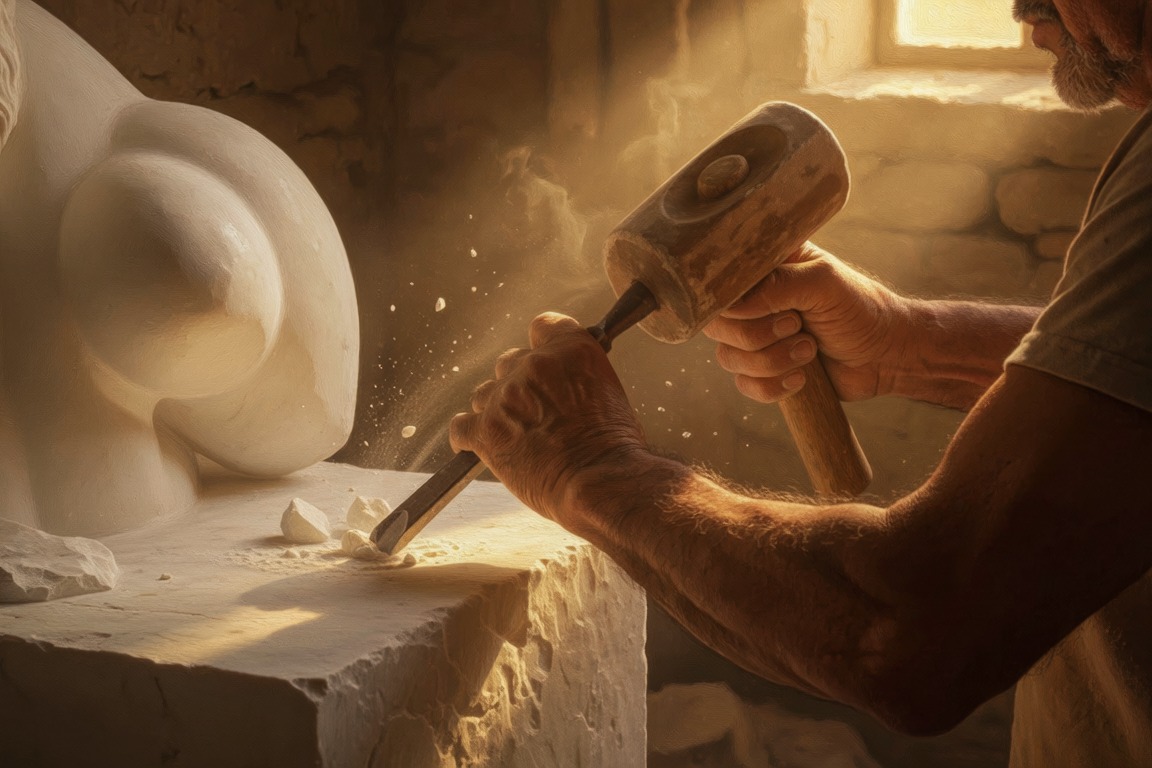
There is a line attributed to Michelangelo: “I saw the angel in the marble, and carved until I set him free.”
You are the sculptor, actively shaping who you become through every choice, every discipline, every act of courage. And you are the marble, being shaped by forces beyond your control: loss, circumstance, the chisel strikes of fate.
My father taught me to be the sculptor. To pick up the tools. To do the work. To build.
My mother taught me to be the marble. To accept the strikes. To let them reveal something beautiful in me rather than just shattering me.
I am both because I learned both. At the same dinner table. From two people who understood that life requires both hands: one to build, one to release. One to fight, one to surrender. One to create, one to grieve.
Every challenge is a strike of the chisel. Every setback is an opportunity to refine the edge. This is what arete asks of us: not that we avoid the blows, but that we let them make us into something more.
I think about my parents often now.
Mum no longer works in palliative care; the weight of all those goodbyes eventually required her own release. Dad has slowed down, though his belief in human potential hasn’t dimmed.
What they gave me wasn’t a career path. It was a philosophy. A way of understanding what human excellence actually looks like.
Suffering can be eased. Not eliminated, eased. Held. Witnessed. Walked through with someone who isn’t afraid to be present.
Strength can be built. Not all at once, slowly. Through discipline. Through showing up. Through the ten thousand small choices that eventually forge an unshakeable character.
And the deepest wisdom: these are not separate pursuits. The person who can ease suffering is strong. The person who builds strength will face suffering. Life requires both capacities. The question is whether you’ll develop them before you need them.
Marcus Aurelius wrote his private journal while camped in military tents at the edge of the Roman Empire. He was fighting wars, burying friends, facing plague. He was also becoming one of the wisest human beings who ever lived.
I don’t know what echoes in eternity. But I know that what my mother and father did echoes in me. Their callings, so different in appearance, so unified in essence, became my calling. Became Arete Estate. Became The Arete Path.
I ease suffering. I build strength. I stand at death’s door and at life’s threshold. I hold space for endings and prepare people for beginnings.
I learned both.
And if there’s one thing I’ve discovered, it’s this: arete doesn’t ask you to choose between soft and strong. The lighthouse stands firm and shines gentle light to guide the lost home. The sculptor wields the chisel with force and reveals beauty in the process.
Excellence is not an act, but a habit. It is the decision to stand, to shine, and to serve, no matter which way the wind is blowing.
My mother showed me the door. My father handed me the tools. The rest has been learning to use both, in every room I enter, for the rest of my days.
That’s why I built Arete Estate. That’s the architecture of a soul.
About the author
Marcus J Emsley · The Guide
Marcus spent seventeen years as a welfare officer in the Royal Australian Air Force, at home and on operations overseas, sitting with people in grief, trauma and the mornings they did not want to rise. He is the founder of Arete Estate in the Barossa Valley, South Australia, the creator of The Sculptor's Journey and Wisdom & Wonder, and the author of the debut novel Wisdom & Wine. He is the son of a primary school teacher who coached footy, cricket and life, and a palliative care nurse who showed him what kindness at the hardest door looks like. He has stood in the dark himself, and he writes from the far side of it.
What we are building at Arete Estate
Arete is excellence becoming. It is the highest expression of who you were always meant to be, not the finished version, but the version that keeps reaching. It is not built. It is revealed.
Arete Estate exists to help people reveal, not construct, the highest version of themselves. We do this through six virtues drawn from the world's wisdom traditions, taught through stories, walked through daily practice, and offered to anyone who is ready to begin: the parent raising a child, the leader carrying a team, the soldier returning from service, the school shaping the next generation, the person sitting alone in the early hours of the morning wondering if there is a path through.
Our work is to make that path visible. To stand as a lighthouse for the seekers, the grieving, and the broken. To remind every person we reach that excellence is not built, it is revealed by storms, and that they are not alone in the storm.
We do not chase. We shine. The Sculptor's Journey (The Doorway, The Walked Path, The Guided Path), An Hour with the Guide, Meditate with Arete, Wisdom & Wonder and The Sculptor's Library are the rooms of that house.
Six virtues. One journey. Your highest self.
www.areteestate.com.au · info@areteestate.com.au · Instagram @areteestate
If this essay touched something raw
Some of what is written here is heavy. If it has stirred something you are carrying, please do not carry it alone tonight.
Lifeline 13 11 14 · Open Arms (veterans and families) 1800 011 046 · 1800RESPECT 1800 737 732 · Kids Helpline 1800 55 1800 · In an emergency, call 000.
Reaching out is not weakness. It is all six virtues at once: the Fortitude to stay, the Wisdom to know you need a hand, the Love to let someone in, the Courage to ask, the Temperance to set the weight down, and the Gratitude for the one who answers.

Responses