
The story of Anthony Koutoufides — and the ancient pursuit of excellence.
THE ARETE HEROES SERIES · PART I
Modern lives that embody the ancient pursuit of excellence
Where did all the heroes go?
Ask your father. Ask your grandfather. Ask the men who built the country you stand on.
They had them. Men whose lives said “this is possible” without ever having to sell you anything. Men who came home from wars and said very little. Men who went to work in the dark and came home in the dark and never once asked to be noticed. Men who carried themselves with such a quiet dignity that just standing near them made a boy walk straighter.
They were not perfect. They were not rich. Most of them were never written about.
But we knew them when we saw them.
Now — scroll.
Scroll past the thirty-second highlight. Scroll past the man selling confidence. Scroll past the influencer whose whole personality is their ring light.
Somewhere along the way, we stopped raising heroes and started manufacturing them.
And a generation is starving.
Starving for men and women whose excellence is not a product. Whose virtue is not a brand. Whose character was not curated for a camera, but carved, slowly, quietly, painfully, by a life actually lived.
The Greeks Knew
Long before the algorithm, the Greeks understood something we have forgotten.
They did not just tell stories for entertainment. They built heroes deliberately. They knew what a culture without them becomes.
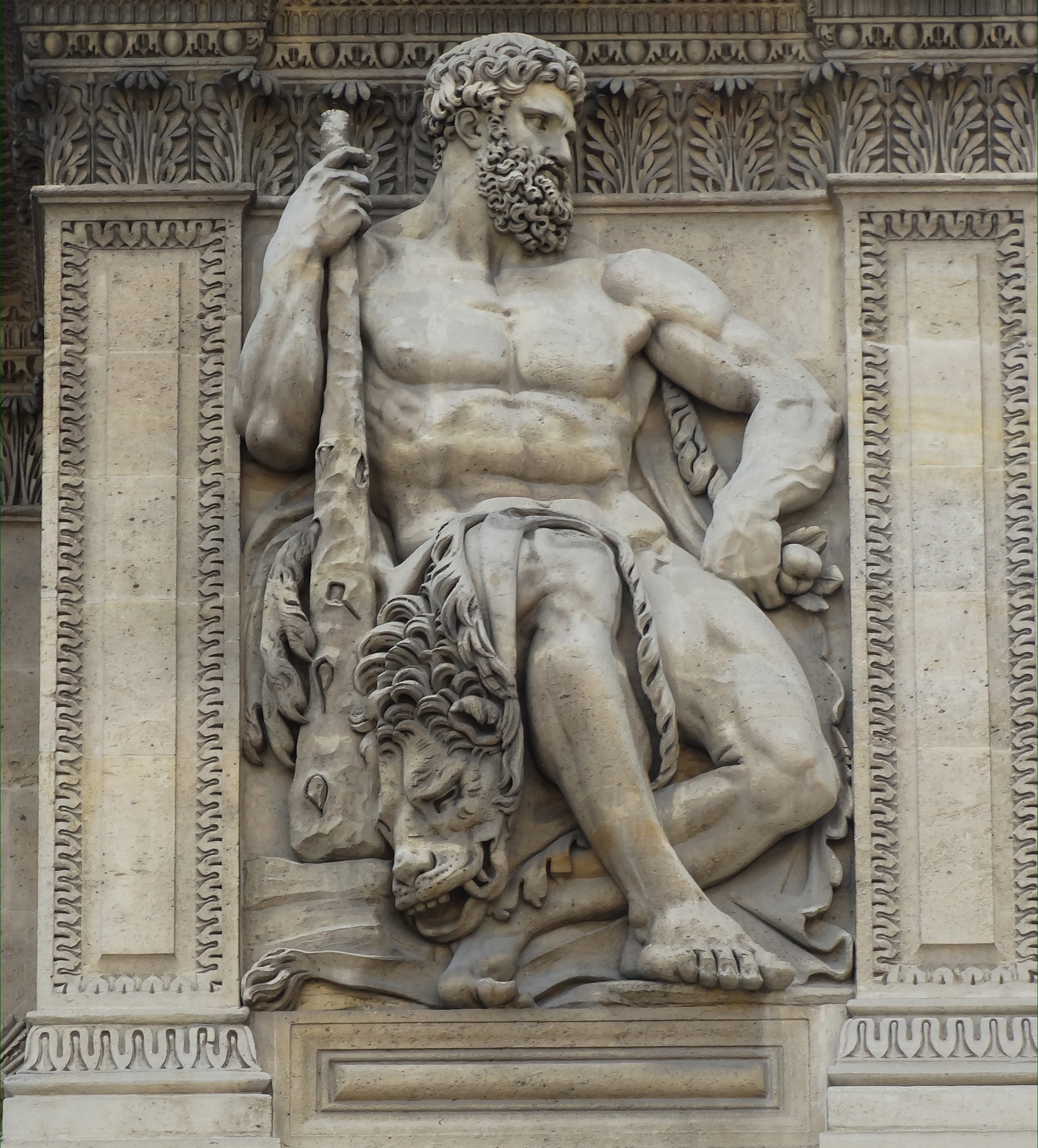
And above them all — Heracles (Greek), Hercules (Roman).
Not born a god. Born with a burden.
Twelve impossible labours were laid at his feet. Not because he wanted them. Because life does what life does. The lion came. The hydra came. The mountain came. The descent into the dark came.
And labour by labour, something in him was revealed that no calm life could have ever drawn out.
Character is not claimed. It is revealed.
Not in the sunshine. In the storm. Not by announcement. By labour.
The Greeks had a word for what Hercules became. Arete. The fullest expression of what a human being could become. Not victory. Not fame. Excellence of soul, hammered out under pressure, one labour at a time.
We have replaced myth with metrics. Revelation with branding. But the old fire is still in us.
We just need to see it burn in someone real.
Have you ever?
Have you ever witnessed a moment of greatness that will last forever?
Not the highlight-reel kind. The quieter kind. The kind that sits under your ribs for thirty years and still moves you when you tell your son about it.
The kind where you weren’t watching a game, or an artist, or an act of courage, you were watching a human being become, for one astonishing instant, fully what they were made for.
That is what the Greeks meant.
That is arete.
And this is The Arete Heroes Series — stories of modern lives touched by ancient fire. Men and women whose character was revealed, not constructed. Lives that remind us the hero is not dead. He has just been buried under noise.
Our first labour is to dig him back up.
The Boy From Lalor
Some names carry more than a man. Anthony Koutoufides is one of them.
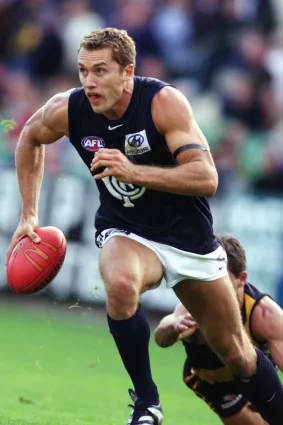
To a generation of Blues supporters, he was a chant before he was a player. Kou-ta. Kou-ta. Three syllables that came up from the concrete terraces of Princes Park and rolled across the MCG like thunder. The number 43 on his back — worn, we will come to see, for his mother — became, over seventeen seasons, something close to myth.
But the guernsey and the glory are only the surface of the story.
Beneath them, something older. Something Hercules himself would have recognised.
Six virtues, woven into one life. And a storm that never stopped coming.
The Soil
Before the roar of 91,000, before the chant, before 43, there was a boy from Lalor, standing between two worlds.
His father Jim was a Greek-Cypriot born in Egypt, who fled his country alone when a new government seized power. His family scattered across three continents, South Africa, Greece, Australia. Jim came here by himself and started from nothing.
His mother Anna came from Northern Italy. By twenty-two, she had lost both her parents. She crossed the world to join a brother, intending to return. Then she met Jim. And they stayed.
Two broken histories. One act of faith: to plant a life in foreign soil they might never see bloom.
Years later, their son would say something that, if you listen closely, tells you everything about what he became:
“They couldn’t give me more, but I felt like I had everything because they gave me love.”
And there it is. The first virtue, already in the ground. Gratitude — not a feeling, but a practice. Planting what you won’t harvest, and tending what you didn’t plant. Jim and Anna planted a garden they knew they might never walk through. And their son spent his entire career walking through it for them, not because anyone asked him to, but because gratitude was already in the soil.
You cannot teach this. You can only be raised in it.
Every hero begins in a garden someone else planted.
And then there is the matter of the number.
When the call came, when the boy from Lalor was promoted to Carlton’s senior squad and could choose any guernsey still available, Anthony did not hesitate.
He chose 43.
For two reasons. It was the number worn by a childhood hero. And 1943 was the year his mother Anna was born.
Seventeen seasons. Two hundred and seventy-eight games. The most any man has ever worn that guernsey in the history of the league. And for every one of them, stitched across the shoulders of a boy from Lalor, was the year his migrant mother came into the world.
The Greeks built temples to honour their mothers. Kouta built a career.
The Choice
He was not supposed to be a footballer.
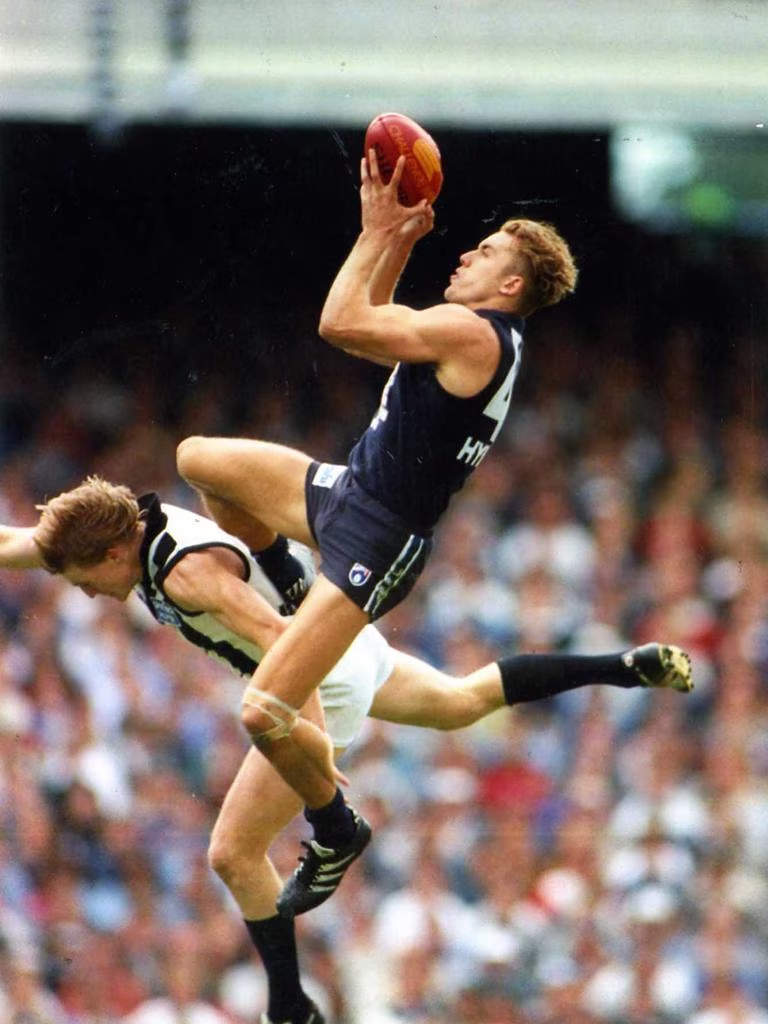
He was a track athlete, a promising one, all angles and speed and the kind of spring in his legs that coaches notice from a long way off. The path was clear. The ribbons were already starting to come.
But Carlton came knocking.
And this is the moment where most stories of talent quietly end. Because talent, without a choice, is nothing. Talent is the marble. The sculptor is the one who decides.
Kouta chose the harder path.
Not the glory path, the apprenticeship. Fifty games in the reserves before anyone knew his name. Fifty games of showing up on cold Melbourne mornings, of being unnoticed, of doing the unglamorous work while boys with half his gift were already being written about.
He asked, during those silent years, to be moved into the midfield. He asked to be tested. Nobody was listening. He kept asking anyway.
This is courage in its earliest form, and the form the Greeks respected most. Not the roar of the crowd. Not the dramatic moment. The windmill before the storm. A hundred unseen mornings that earn the right to stand in the wind when it finally comes.
Fear tells you the stakes. Courage says “noted” — and begins anyway.
Fifty games in the reserves is not a setback. It is a hero being forged.
The Fire
The storm came, as it always does.
In 1998, Jim, the man who had crossed the world with nothing, died. And something in the football world shifted. Anthony Koutoufides did not retreat. He played.
He played through grief the way men of that era were supposed to, in silence. He played with a knee that should have been operated on. He played for a club that was beginning its long, slow collapse.
And then came the night.
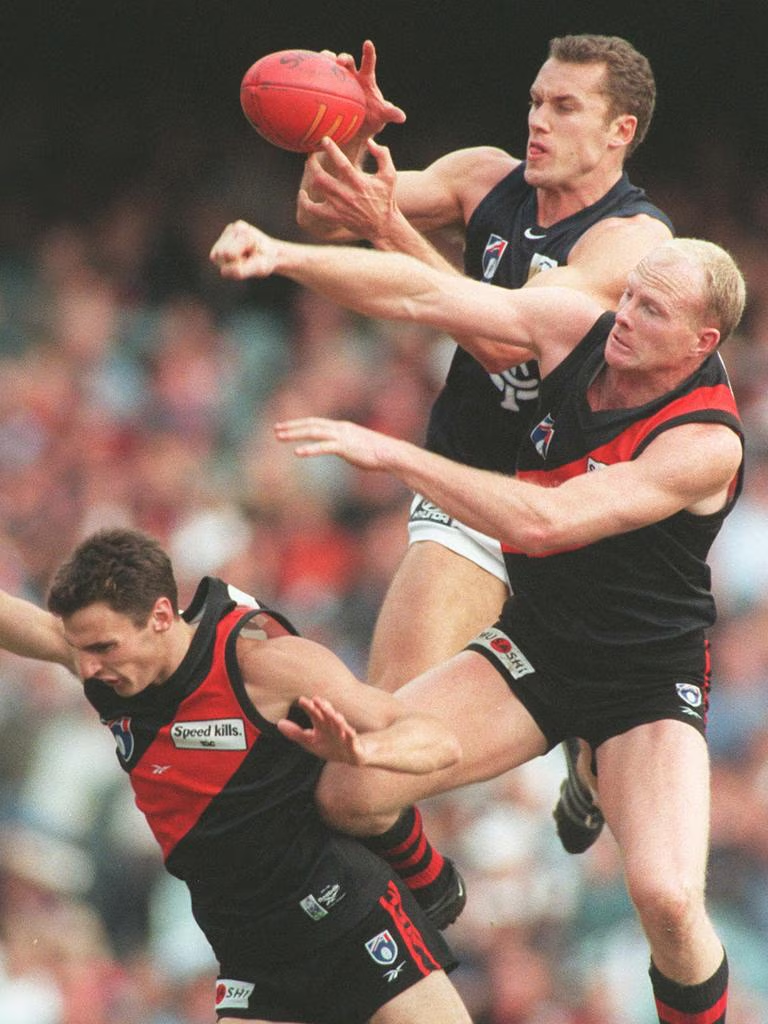
1999. Preliminary Final. Essendon. The MCG.
For three quarters, the Bombers were the better side. The Blues were hanging on. The season was slipping away. And then, in the fourth quarter, something happened that old Carlton men still describe in reverent tones. Kouta — exhausted, injured, grieving — took the game in his hands.
It was not a moment. It was a revelation.
He dragged his team across the line. One impossible contest after another. One mark, one tackle, one clearance at a time. The match was not won by tactics. It was won by a man who had decided, long before that night, what kind of man he would be when the storm finally arrived.
This is fortitude — the lighthouse. Stand firm and shine, even when the storm is inside you.
That night, the storm was inside him. Grief. Injury. Exhaustion. The weight of a whole club on his back.
And he stood. And he shone.
The Greeks would have recognised it. The boy from Lalor had met his lion. And he had not run.
The Time Hercules Wore Navy.
Mens Sana in Corpore Sano
A sound mind in a sound body.
A pause now, for the men reading this.
There is a quieter storm than the one Kouta played through. It does not come with a roar. It does not announce itself in front of 91,000 at the MCG. It comes, for so many men, in the lonely hours, at 3am in the car, at the kitchen table after everyone has gone to bed, on the drive home from work when the radio is the only thing keeping you company.
The old model taught men to face that storm the same way they faced every other one: alone. In silence. With teeth gritted. The lighthouse, held by one man, in the dark.
The ancients knew better.
They carved Mens Sana in Corpore Sano into the walls of their world. A sound mind in a sound body. They did not separate the two. They understood that a man who has only hardened his body has built half a fortress. And half a fortress falls.
The fortitude we honour in Anthony Koutoufides was not the silent kind. He grieved. He leant on the men around him when his own legs could not carry him. He played through pain, but he did not play through it alone.
That is the hero our boys need to see now. Not the man who suffers in silence.
The man who stands firm — and asks for help.
The windmill does not turn alone. It turns with the wind. The lighthouse does not shine in isolation, it was built by many hands, and it is kept by many more.
If this finds a man in that quieter storm: the hero is not the one who holds it all. The hero is the one who lets a friend in.
The Harmony
The spotlight was happy to take him. A Brownlow was there for him more than once. He could have become the story. He never did.
Because Koutoufides, across seventeen seasons, refused the easy pull of stardom. He could be fierce without being cruel. Relentless without being reckless. Decorated without being diminished by the decorations.
Just because you can, doesn’t mean you should.
This is the rarest virtue in modern life.
Temperance is the conductor. All instruments in harmony. Not the silencing of the drums, the tuning of them. The man who can play with fury and come home gentle. The man who can be worshipped at five o’clock on Saturday and be just a father by seven.
Kouta was that man.
And when the sport asked him to be more, when Carlton, broken and adrift in the early 2000s, handed him the captaincy during the worst years in the club’s history, he did not flinch.
He led a club through the wooden spoon. He led it through the pain of being last. He led it not because he was guaranteed a flag at the end, but because leading was what the moment required.
This is wisdom — the gold pan. Acknowledge the mud. Record the gold. Choose what you carry forward.
There was mud in those years. A lot of it. But Kouta panned it every week, found what was worth carrying, and kept walking. The captaincy of a losing side is a labour Heracles would have respected. Nobody erects statues to the man who held the line in the dark years.
But without him, there are no statues to anyone at all.
The Harvest
A career ends. The boots come off. The chant fades.
And what is left is what matters most.
What Kouta left, and continues to leave, is not a trophy cabinet. It is a standard. A way of carrying yourself. A memory passed from father to son, from mother to daughter: you can be fierce and fair. You can be great and grateful. You can be a champion without ever becoming cruel.
This is love — not a feeling, but a choice, made daily. You don’t fall in love. You choose it. The fall is choosing it again tomorrow.
Kouta chose his family. He chose the club that chose him. He chose the game even when it stopped choosing him back. He chose the standard, on the days when nobody was watching and the crowd had gone home.
That is the final labour of the hero. Not victory. Not fame.
Love — chosen every morning, for a lifetime.
Six Labours. One Life.
Stand back from the career, and look at the life.
Gratitude in the soil he grew from.
Courage in the path he chose.
Fortitude in the storms he stood through.
Temperance in the fire he refused to let consume him.
Wisdom in the leadership he offered when leadership was costly.
Love in everything he chose, again, tomorrow.
This is the anatomy of a hero. Not one virtue, dominant. Six virtues, woven. And they were not dropped on him by talent. They were revealed, labour by labour, by a life that refused to run.
Arete. The Greek word for what he became.
The boy from Lalor, standing between two worlds, carried both. And wore his mother’s number while he did it.
To Those Who Remember
You were there. Or you were listening on 3AW with your old man. Or you watched it on a grainy TV with your mates and spilled your beer when Whitnall’s kick swung back through the posts.
You remember the chant. Kou-ta. Kou-ta. You remember what it felt like, not just the football, but the man. The way he carried himself. The way he made you believe it was possible to be fierce and fair at the same time. That you could play the game at full throttle and still look your kids in the eye on Monday morning.
Send this to your son. Send it to your daughter. Send it to the kid you coach who has all the talent in the world but hasn’t yet learned that talent is just the marble.
Tell them about the man who wore his mother’s number.
And ask them what they want the storm to find, when it comes for them.
To the Young Person Reading This
You might have the talent. You probably already know that.
But talent is just the marble. Uncut. Unformed. Waiting.
Anthony Koutoufides played fifty games in the reserves before anyone knew his name. He asked to be moved into the midfield when no one was listening. He played through grief his father’s death carved into him. He led a broken club through the worst years of its life. And he did it all without once losing the quiet decency that made him worth following.
He didn’t chase the spotlight. He became the lighthouse.
You don’t get to choose whether the storm comes. You only get to choose what it finds when it arrives.
So here is the only question that matters:
When the storm hits, what will it reveal?
Build something worth uncovering.
Stand firm. Shine anyway.
Your arete is waiting. Go and earn it.
To Those Who Wear the Navy Now
A final word, not to the past, but to the present.
The house of Carlton is in a storm.
Not the kind that comes once and leaves. The kind that presses on every wall, every beam, every man inside the doors. The kind the old clubs all face, eventually, when the game decides to test the character underneath the colours.
A house built from strength and fortitude cannot fall. No matter how hard the wind blows. No matter how many panels rattle. No matter how loud the voices outside grow.
But it is not the wind that brings a house down. It is the cracks.
The cracks that form when men turn on each other inside the walls. The cracks that form when leadership looks for someone to blame instead of someone to carry. The cracks that form when the pressure outside becomes louder than the purpose inside.
To the board. To the executives. To the coaches who hold the clipboards. To the medical staff who carry the quiet weight. To the players who lace the boots.
And to Patrick Cripps — Crippa to the faithful, wearing the armband now, the way Kouta wore it once.
You are the current carriers of a great old house.
You did not choose the storm. You only get to choose what it reveals.
Stand firm. Not silent — firm.
Care for the men inside the doors before you care for the noise outside them. Protect the boys wearing the guernsey. Lift the ones who are struggling. Tell each other the truth. Hold each other to the standard.
Do not crack.
Because a lighthouse is built by many hands, and kept by many more. And the Blues faithful are already standing with you. We were there the night Kouta dragged the team across the line in 1999. We are here now.
Now more than ever.
Stand firm. Shine anyway.
Excellence is not revealed in easy seasons. Excellence is revealed in storms.
Over to you, Carlton.
Crack — or stand tall.

THE ARETE HEROES SERIES
A fortnightly portrait of lives that embody the six virtues of Arete Estate — Fortitude, Wisdom, Love, Courage, Temperance, Gratitude. These are not profiles of perfection. They are stories of people whose Arete, their highest character, was revealed by the storms they refused to run from.
A Note to Anthony
Anthony, when this reaches you — thank you. Not for what you did on the field. For the way you carried yourself while you did it. You will continue to inspire others. Thank you for your time and guidance. I hope this article has done justice to your continued legacy. — Marcus
Written by Marcus J Emsley, The Guide, at Arete Estate in the Barossa Valley. First published 23 April 2026.
Excellence revealed by storms.

Responses