
Love · On sacred design, inner order, and the god who broke himself to write
There is a bronze figure on my desk.
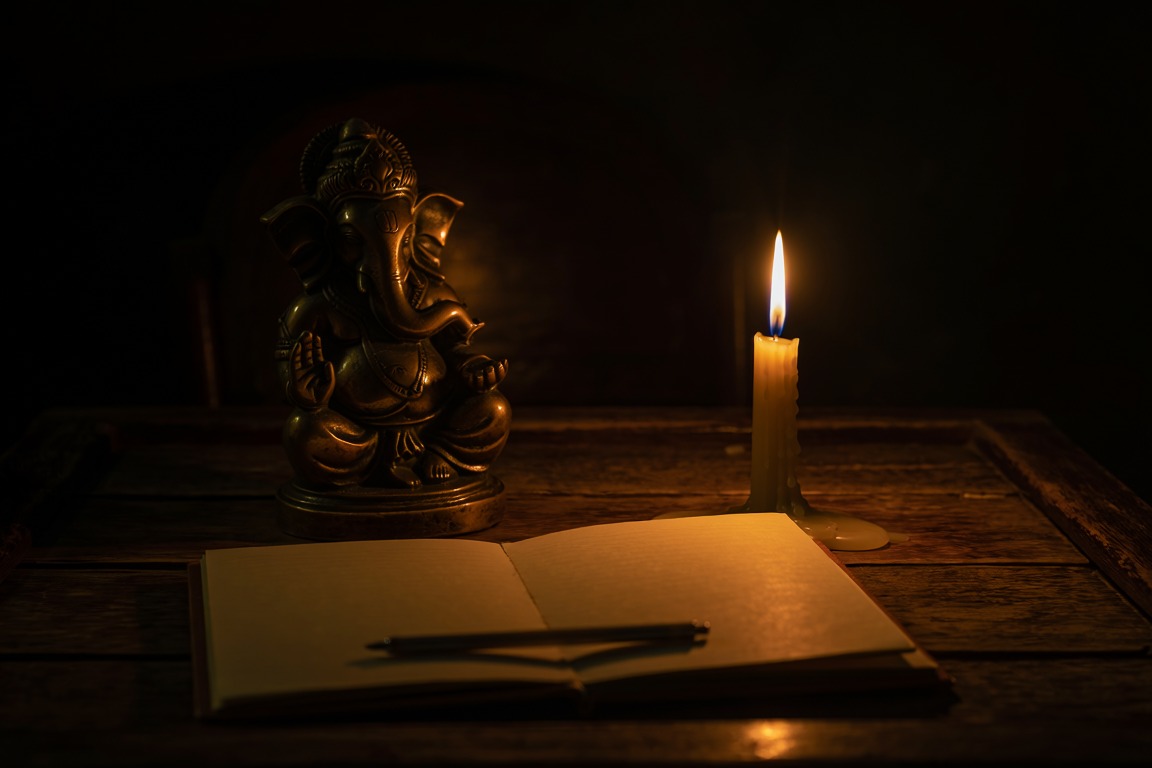
He sits to the left of my keyboard, just beyond the reach of my coffee cup, in the soft halo of a candle I light every time I sit down to write. He has been there for years. He watches everything, every word I type, every draft I delete, every moment I stare at a blank page wondering whether anything I have to say is worth the ink.
He is Ganesha. The elephant-headed god of the Hindu tradition. The remover of obstacles. The lord of beginnings. The patron of letters and learning and the arts.
And he is carrying a broken tusk.
Most people who see a statue of Ganesha notice the elephant head, the round belly, the four arms. But the detail that has lived with me the longest, the one I think about almost every time I sit down to write, is the tusk. One is intact. The other is broken. And the story of why changes the way I understand everything I do.
In the tradition that surrounds the Mahabharata, the sage Vyasa needed someone to transcribe his great epic, one of the longest and most profound works of literature in human history. He asked Ganesha. And Ganesha agreed, on one condition: that Vyasa would not pause in his dictation. Not for rest. Not for thought. Not for breath. The words must flow without stopping, and Ganesha would write without stopping.
But the pen broke. And rather than stop, rather than pause the sacred work, rather than let the flow of wisdom be interrupted, Ganesha snapped off his own tusk and used it as a pen.
A god who broke part of himself to create something for others.
I think about that every time I sit down at this desk. Not because I believe I am writing scripture. But because the image, the willingness to break yourself open in service of something larger, to use the broken part as the instrument, is the most honest description of meaningful work I have ever encountered.
And it is the reason I want to take you somewhere today. Somewhere I have been twice, and both times it changed me. Somewhere the builders understood what Ganesha understood: that the outer world you construct is always a mirror of the inner world you are building.
I want to take you to Angkor Wat.
The Crossing
You feel it before you see it.
The heat is the first thing. Cambodian heat, not dry, not comfortable, not the kind you acclimatise to. The kind that wraps around you like a wet cloth and stays. The air smells of laterite dust and frangipani and something ancient that has no name but you recognise in your body, because your body knows when it is standing on ground that has been sacred for a very long time.
And then you reach the moat.
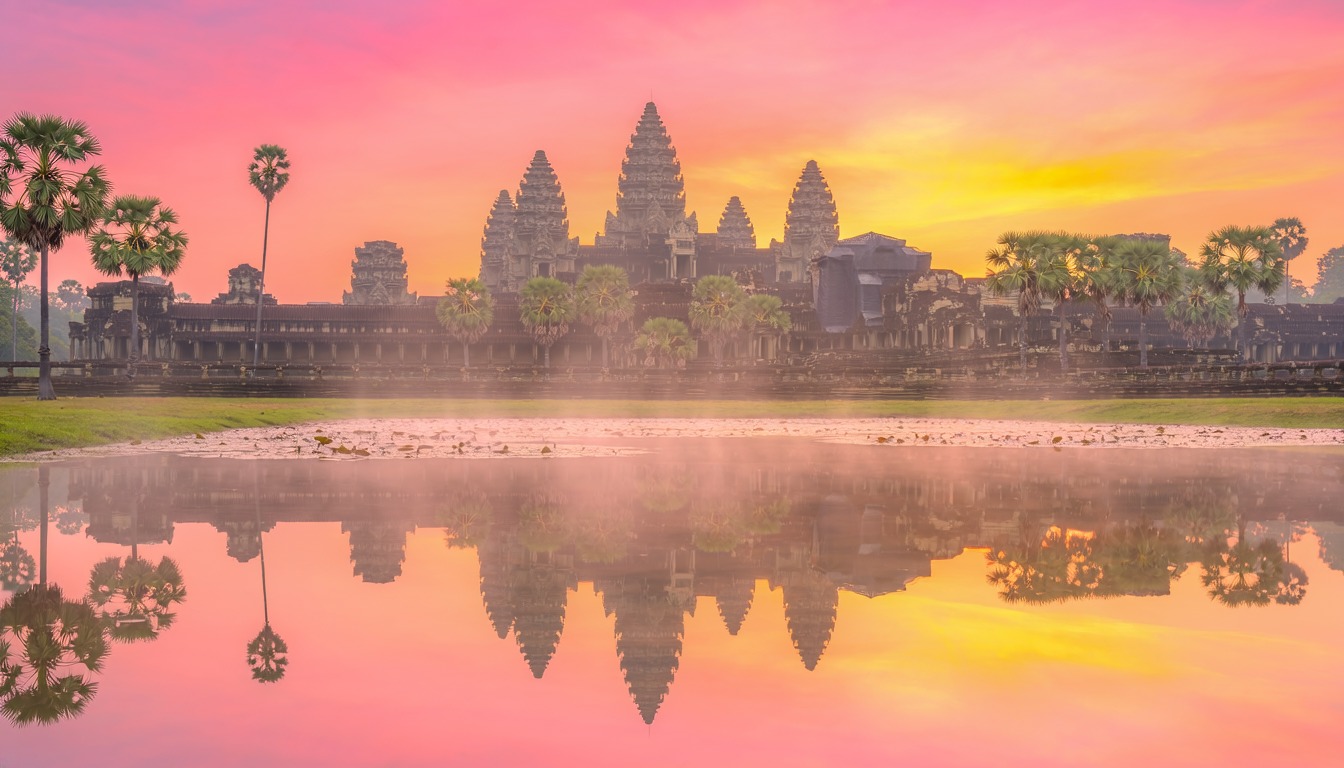
It is enormous, nearly two hundred metres wide, stretching in both directions until the water and the trees and the morning mist dissolve into each other. The surface is still. Lotus pads float on it. And across the water, reflected perfectly in the dawn light, is the silhouette of something that makes you stop walking.
Five towers. Rising from the jungle like stone fingers reaching for something only they can see. The central tower, sixty-five metres of carved sandstone, sits at the exact centre, flanked by four smaller towers in a pattern that is so symmetrical, so deliberate, so clearly intentional that you understand, before you have crossed the causeway, that this building was not designed by accident. Every stone is a sentence. Every corridor is a paragraph. Every level is a chapter in a story that was written in architecture because the builders believed that some truths are too important for words alone.
You step onto the causeway. The stone is warm under your feet. And as you cross the moat, as you leave the ordinary world behind and walk toward the temple, you feel something shift. Not dramatically. Subtly. The way the air changes when you enter a church. The way the noise of the world fades when you step into a library. Something in the crossing itself is doing work on you.
The Khmer architects knew this. The moat is not a defensive structure. It is a symbol, the cosmic ocean that, in Hindu cosmology, surrounds the universe. To cross it is to leave the chaos of the outer world and enter the ordered world within. The causeway is the bridge between what is and what could be. Between the life you are living and the life you are building.
You do not arrive at Angkor Wat. You cross into it. And the crossing changes you before the temple does.
A Map of the Universe, Carved in Stone
Most guidebooks mention this about Angkor Wat, but few truly explain it: it is not a building. It is a map.
The Khmer builders, working under King Suryavarman II in the early twelfth century, more than nine hundred years ago, did not set out to construct a temple. They set out to construct a model of the universe. The entire complex is a three-dimensional mandala, a diagram of existence itself, carved in some five million tonnes of sandstone, aligned with the equinox sun, and designed so that walking through it is not tourism. It is pilgrimage.
The moat is the cosmic ocean. The concentric walls are the mountain ranges that surround the sacred centre. The five towers are the five peaks of Mount Meru, the axis of the universe in both Hindu and Buddhist cosmology, the mountain where the gods dwell. And the central tower, the tallest, the innermost, the one you have to climb to reach, is the summit. The place where heaven and earth meet. The point of stillness at the centre of everything that moves.
Think about that. Nine hundred years ago, an entire civilisation, tens of thousands of workers, architects, artists, engineers, spent decades building a physical representation of the ordered universe. Not because they needed a place to pray. Because they believed something so deeply that they carved it into stone:
The outer world must mirror the inner one. If you want to live in an ordered universe, you must first build order within yourself.
That is not just Khmer philosophy. That is every tradition I have ever studied. That is the Stoics building their inner citadel. That is the Buddhists walking the eightfold path. That is every person who has ever sat down with a journal and tried to make sense of the rooms in their own mansion.
Angkor Wat says: if you can build it outside, you can build it inside. And if you can build it inside, truly build it, with the same patience and precision and sacred intention the Khmer brought to every stone, then the outer world will follow.
Walking the Corridors
When you walk through Angkor Wat, and I mean really walk through it, slowly, the way the builders intended, not the way the tour groups rush, you notice something that changes the way you think about your own life.
You cannot reach the centre without passing through every level.
There is no shortcut. No side door. No lift that takes you straight to the top. The temple is designed as a journey; each gallery leads to the next, each level rises above the last, and you must walk the full path, through every corridor, to reach the summit. The builders did not make this difficult out of cruelty. They made it difficult because the difficulty is the point. The journey through the temple is a mirror of the journey through a life, and a life worth living does not skip levels.
The outer gallery is where the great stories are told. The walls are covered with bas-reliefs, enormous, intricate, breathtakingly detailed carvings that stretch for hundreds of metres. Scenes from the Mahabharata and the Ramayana. Gods and demons in cosmic battle. The Churning of the Ocean of Milk, the Hindu creation story in which gods and demons pull a cosmic serpent back and forth across a mountain, churning the ocean until it produces the elixir of immortality.
Stand in front of that relief (I have, twice, and both times I couldn’t move) and you see something the guidebook doesn’t tell you. The gods and the demons are pulling together. On opposite sides, yes. In tension, yes. But together. The elixir, the thing of ultimate value, only emerges from the tension between opposing forces. Not from one side winning. From both sides pulling.
The Khmer understood something the modern world has forgotten: the most valuable things in life are produced by tension, not by comfort.
That is the outer gallery. The place of stories. The place where you learn that struggle is not the enemy of meaning; it is the source of it.
Then you climb. The stairs are steep, deliberately steep, the guides say, so that you must bow your head as you ascend, approaching the sacred with humility rather than entitlement. Your body bends. Your breath quickens. And when you reach the next level, the carvings change. The great battles give way to something quieter. The apsara dancers, more than seventeen hundred of them, each one unique, each one carved with individual features and expressions, line the walls. They are not fighting. They are dancing. They are the beauty that exists above the battlefield.
And then the final level. The summit. You climb the last steep staircase and emerge into the open air, and the noise of the lower levels fades, and you are standing at the top of Mount Meru. The centre of the universe. The place where the gods dwell.
And it is quiet. Not empty. Quiet. The kind of quiet that is full, full of everything you walked through to get here. The battles. The beauty. The steep climbs that made you bow your head. All of it is still with you. But up here, at the summit, it has been ordered. It has found its place. It has become architecture.
The Six Virtues in the Stone
I did not go to Angkor Wat looking for The Arete Path. I went as a traveller. But both times, standing in those corridors, I felt the six virtues in the stone as clearly as if someone had carved them there for me.
Fortitude is in the fact that it is still standing: nine hundred years of monsoons and wars and the slow, patient assault of the jungle, roots cracking the stone, vines splitting the walls, and the temple endures, not because it is invincible but because it was built on bedrock, literally and philosophically. Temperance is in the symmetry. Stand at the western causeway and look at it head-on: tower for tower, gallery for gallery, the left mirrors the right with a precision that is almost musical. The architects were conductors, holding a hundred competing elements in harmony. Nothing dominates. Nothing is missing. The entire complex is an orchestra in stone.
Wisdom is in the alignment. The central tower lines up with the equinox sunrise, the moment when light and darkness are perfectly balanced, and the builders embedded the movement of the cosmos into the distances between gateways. They were panning for gold in the mud of the universe, finding patterns and recording them in stone. Love is in the apsaras: seventeen hundred celestial dancers, each carved by hand, each unique. Someone spent years carving a single dancer that most visitors walk past in three seconds. That is love as a practice. Not for the audience. Not for the recognition. For the belief that the thing you are creating deserves your full attention even if no one ever pauses long enough to see it.
Courage is in the audacity of the project itself. Suryavarman II looked at a floodplain in the Cambodian jungle and said: here, we will build the universe. No cranes, no computers, just human hands and an idea so vast that most people would have dismissed it as impossible. The windmill does not wait for calm weather; the Khmer faced the jungle and built. And Gratitude is in the continuation. The temple was Hindu when it was built and became Buddhist when the culture shifted, and rather than tear it down, the Cambodian people tended it. They added Buddha statues alongside the Hindu carvings. They honoured what they inherited and planted new meaning in the same ground. Nine hundred years later, it is still a living place of worship: not a ruin, not a museum, but a garden that is still growing.
The builders of Angkor Wat did not separate the inner life from the outer one. They understood that the way you build your world reflects the way you build your soul. And they built accordingly.
The Broken Tusk
I want to return to the figure on my desk. Because Ganesha is not just watching me write. He is teaching me something every time I look at him.
He is teaching me that the instrument of creation is often something broken.
The tusk he snapped off, the one he used as a pen, was not a spare part. It was part of his face. Part of his identity. Part of what made him recognisable as himself. He didn’t reach for a tool that was lying around. He reached for the thing that was closest, most personal, most costly, and he broke it in service of the work.
That is what meaningful work costs. Not always comfort. Not always polish. Sometimes a piece of yourself. The piece you give to the page, to the conversation, to the person sitting across from you who needs something you can only offer by opening a part of yourself you would rather keep closed.
The Khmer builders understood this. Every stone in Angkor Wat was carried by human hands. Every carving was cut by human effort. Every year of the decades it took to build was a year of someone’s life, a year they would never get back, a year given to something they believed in more than their own comfort.
Ganesha understood it. The Mahabharata was not written with a pristine pen. It was written with a broken tusk, the most honest instrument in the world, because it cost something to use.
And I think, sitting at my desk, candle lit, the bronze figure watching, that this is what Arete asks of all of us. Not perfection. Not polish. Not the carefully curated version of ourselves that looks impressive from the outside. The willingness to break yourself open, just enough, just in service of something that matters, and use the broken part as the instrument.
There is a line often attributed to Hemingway, though no one has found it in his work, and it is true whoever said it: “There is nothing noble in being superior to your fellow man; true nobility is being superior to your former self.”
Superior to your former self. Not to anyone else. Not to the person beside you, or the person across the aisle, or the person on the other side of the world whose life looks nothing like yours. To your former self. That is the only competition that produces growth. That is the only comparison that leads to Arete. And that is the lesson Ganesha teaches every time I look at the broken tusk and sit down to write.
Your Temple
You are building something right now. Whether you know it or not.
Every decision you make, how you treat the person at the checkout, whether you keep the promise you made to yourself this morning, what you do in the forty-five minutes after the children are asleep, whether you choose kind over right in the kitchen tonight, is a stone being placed.
And the question Angkor Wat asks, the question that has haunted me since the first time I crossed the moat and felt the shift, is this: What are you building? And is it aligned with anything sacred?
Not sacred in the religious sense, unless that speaks to you, in which case, yes. Sacred in the sense of intentional. Ordered. Built with care and purpose and the kind of precision that says every stone matters. Every corridor leads somewhere. Every level has been earned.
The Khmer did not rush Angkor Wat. They aligned it with the cosmos. They carved seventeen hundred unique faces into the walls. They made the stairs steep so you would bow your head as you climbed. Every detail was deliberate. Every choice was in service of the whole.
What would your life look like if you built it with that kind of intention?
Not perfection; the temple is cracked, weathered, scarred by time. But intention. The difference between a building that was thrown together and a temple that was designed to mirror the universe is not the quality of the stone. It is the quality of the thought behind it.
The Bhagavad Gita, the sacred Hindu text that would have been known to every builder at Angkor Wat, says: “You have the right to work, but never to the fruit of work. You should never engage in action for the sake of reward.”
You have the right to work. Not to the fruit. The builders of Angkor Wat never saw it finished. Many of them died during the decades of construction. They placed stones they would never stand on. They carved apsaras they would never see from the gallery above. They built something that would outlast them by nine hundred years, and they did it without knowing that. They did it because the work itself was sacred. Because the building itself was the practice.
That is the deepest lesson Angkor Wat teaches. Not that you should build something grand. That you should build something intentional. That the way you construct your days, stone by stone, choice by choice, corridor by corridor, is the architecture of your character. And your character, like the temple, will outlast you.
Tonight
I am sitting at my desk. The candle is lit. Ganesha is watching. The broken tusk glints in the candlelight. And I am thinking about you.
I am thinking about the temple you are building, the one nobody else can see, the one that exists in the way you speak to your children, the way you keep your promises, the way you show up on the days when showing up is the hardest thing in the world. I am thinking about the moat you cross every morning when you leave the chaos of the outer world and step into the ordered space of your own intention. I am thinking about the corridors you walk, the battles on the outer walls, the beauty of the apsaras, the steep stairs that make you bow your head.
And I am thinking about the summit. The quiet place at the centre, where everything you have walked through finds its order. Where the noise settles. Where the virtues, the roots, the rhythm, the gold, the love, the wind, the garden, come together into something that is not perfect but is intentional. Not finished but aligned. Not a ruin but a living temple, still growing, still being tended, still open to worship.
The Khmer built their universe in stone. You are building yours in the choices you make every day. Build with intention. Build with care.
And when the pen breaks, because it will, because it always does, do what Ganesha did. Break yourself open. Use the broken part. The sacred work does not wait for a perfect instrument. It waits for a willing one.
The candle is lit. The figure is watching. The outer world is waiting to mirror the inner one.
Build accordingly.
About the author
Marcus J Emsley · The Guide
Marcus spent seventeen years as a welfare officer in the Royal Australian Air Force, at home and on operations overseas, sitting with people in grief, trauma and the mornings they did not want to rise. He is the founder of Arete Estate in the Barossa Valley, South Australia, the creator of The Sculptor's Journey and Wisdom & Wonder, and the author of the debut novel Wisdom & Wine. He is the son of a primary school teacher who coached footy, cricket and life, and a palliative care nurse who showed him what kindness at the hardest door looks like. He has stood in the dark himself, and he writes from the far side of it.
What we are building at Arete Estate
Arete is excellence becoming. It is the highest expression of who you were always meant to be, not the finished version, but the version that keeps reaching. It is not built. It is revealed.
Arete Estate exists to help people reveal, not construct, the highest version of themselves. We do this through six virtues drawn from the world's wisdom traditions, taught through stories, walked through daily practice, and offered to anyone who is ready to begin: the parent raising a child, the leader carrying a team, the soldier returning from service, the school shaping the next generation, the person sitting alone in the early hours of the morning wondering if there is a path through.
Our work is to make that path visible. To stand as a lighthouse for the seekers, the grieving, and the broken. To remind every person we reach that excellence is not built, it is revealed by storms, and that they are not alone in the storm.
We do not chase. We shine. The Sculptor's Journey (The Doorway, The Walked Path, The Guided Path), An Hour with the Guide, Meditate with Arete, Wisdom & Wonder and The Sculptor's Library are the rooms of that house.
Six virtues. One journey. Your highest self.
www.areteestate.com.au · info@areteestate.com.au · Instagram @areteestate
If this essay touched something raw
Some of what is written here is heavy. If it has stirred something you are carrying, please do not carry it alone tonight.
Lifeline 13 11 14 · Open Arms (veterans and families) 1800 011 046 · 1800RESPECT 1800 737 732 · Kids Helpline 1800 55 1800 · In an emergency, call 000.
Reaching out is not weakness. It is all six virtues at once: the Fortitude to stay, the Wisdom to know you need a hand, the Love to let someone in, the Courage to ask, the Temperance to set the weight down, and the Gratitude for the one who answers.

Responses