
Love · Dedicated to EH, a true lighthouse.
There is a kind of grief that doesn’t arrive all at once.
It doesn’t come as a single wave, the kind that knocks you down, and everyone sees you fall, and hands reach out because the falling was visible and the ground was wet and somebody thought to bring flowers.
That kind of grief is devastating. But it is understood. It has a shape. It has a name. It has a casserole on the doorstep and a card that says thinking of you and a window of time, six weeks or six months, where the world gives you permission to not be okay.
This essay is not about that kind of grief.
This essay is about the other kind. The kind that accumulates. Quietly. Over years. Loss after loss after loss, none of them dramatic enough to stop the world, but each one heavy enough to change the weight you carry when you walk through the door each morning.
The parent you lost. Then the friend. Then the marriage, or the career, or the thing you built that didn’t survive. Then the next one. And the next. Not a wave. A tide. Rising so slowly that you barely notice the water is at your chest until one ordinary afternoon you realise you’ve been breathing shallow for longer than you can remember.
This is compound grief. And if you carry it, I want you to know something before we go any further:
You are not broken. You are loaded. There is a difference. And the difference matters more than you think.
The Arithmetic Nobody Teaches
We are taught, in a hundred subtle ways, that grief is singular. One loss. One recovery. One narrative arc, from devastation to healing, from darkness to light, from the worst day to the better ones that follow.
And that arc is real. For a single loss, it holds true. You grieve. You carry. You slowly, painfully, beautifully rebuild. The models work. The timeline, while never as neat as the textbooks suggest, moves roughly in one direction.
But compound grief doesn’t follow that arc. Compound grief is what happens when the next loss arrives before the last one has finished teaching you what it came to teach. When the weight you’re carrying from two years ago gets added to by the weight from six months ago, which gets added to by the thing that happened last week. No single event is “the big one”. No single loss earns you the casserole on the doorstep. But the total, the accumulated, compounding, quietly crushing total, is something no human being was designed to carry alone.
And here’s what makes it harder: compound grief is invisible. Because each individual loss looks manageable from the outside. “They seem fine.” “They’re so strong.” “I don’t know how they do it.” People say these things with admiration. They mean well. But what they’re actually describing, without knowing it, is someone who has become so practised at carrying weight that the carrying itself has become invisible.
You smile. You show up. You hold the room. You make the dinner. You ask the questions. You check on the people around you (Are you okay? Do you need anything? I’m here) and nobody thinks to turn the question around. Because you don’t look like you need it turned around. You look like the person who’s handling it.
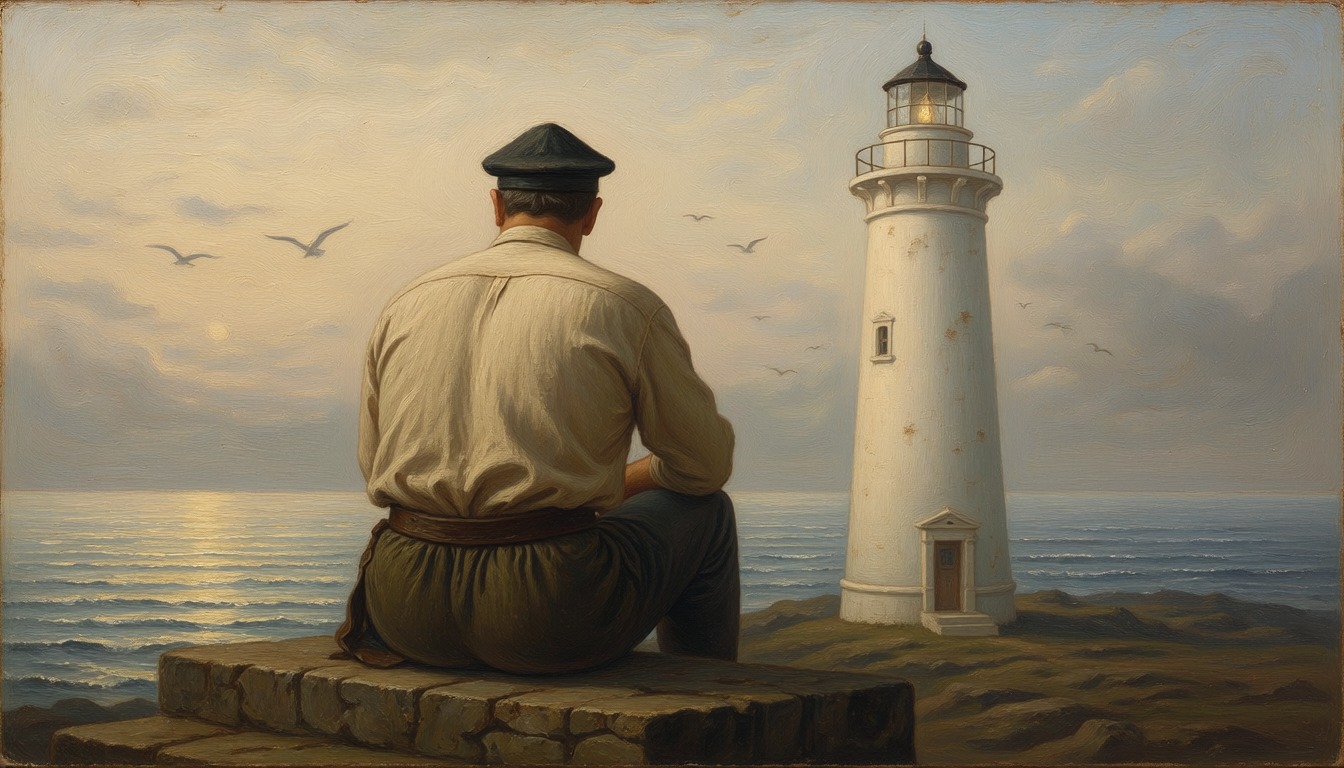
You look like the lighthouse.
And lighthouses, as far as anyone can tell, don’t need help. They just shine.
What It Costs to Keep Shining
I want to talk about what happens inside the lighthouse. Because from the outside, it looks effortless. Steady. Structural. The beam sweeps and the ships find their way and the storm rages and the light holds.
But inside?
Inside, the keeper is tired. Not the kind of tired that sleep fixes, the kind that lives deeper than sleep can reach. The tiredness of sustained vigilance. Of years spent scanning the horizon for other people’s storms while your own weather goes unwitnessed. Of being the person everyone leans on, which means being the person who never gets to lean.
The Stoic philosopher Seneca wrote something that I carry with me: “We suffer more in imagination than in reality.” And there is truth in that; the Stoics understood that our minds amplify what we fear. But there is also a kind of suffering that is not imagined. It is accumulated. It is real. And it sits in the body like sediment in a riverbed, layer after layer, season after season, until the river still flows but the bed is heavy with everything it has carried.
If you are that river, if you have been carrying sediment for years, still flowing, still finding a way forward, I need you to hear this:
The fact that you are still moving does not mean the weight isn’t real.
The fact that you are still showing up does not mean the cost isn’t accumulating.
The fact that nobody sees it does not mean it doesn’t matter.
It matters. You matter. And the weight you carry deserves to be acknowledged, not by the world, which may never fully see it, but by you. The person carrying it.
The Person Who Keeps Showing Up
There is a particular kind of human being I have come to recognise over the years. Not because they’re loud or visible or dramatic. Because they’re the opposite.
They’re the person who answers the phone. Every time. Even when their own life is collapsing in a direction they haven’t told anyone about. They’re the person who drives across town at midnight because someone they love is in trouble, and they never mention that they haven’t slept properly in weeks. They’re the person at the family gathering who holds the conversation together, who notices the cousin who’s going quiet, who cleans up afterwards while everyone else goes home, and nobody asks how they’re going because they’ve never once given anyone reason to worry.
They carry their own grief and everyone else’s too. Not because they’re asked to. Because it’s who they are. It’s in the architecture. They were built, by life, by loss, by the slow accumulation of being the one who shows up, into people who hold.
And the world is better for them. Immeasurably, quietly, profoundly better.
But.
But the holding has a cost. And the cost compounds the same way the grief does: silently, invisibly, one small withdrawal at a time from a reserve that nobody sees and nobody replenishes. You can carry the weight of the world for a very long time. You can carry it so well that people forget you’re carrying anything at all. But the body knows. The chest knows. The 3am ceiling knows.
This is not weakness. I want to say that again, because the people I’m writing this for tend to hear everything as evidence that they should try harder: this is not weakness. This is the natural, human, inevitable consequence of sustained compassion. Of prolonged love. Of being the kind of person who would rather absorb the impact themselves than let it reach the people around them.
That is not a flaw. That is Fortitude in its purest form. The lighthouse standing in the storm, not because it doesn’t feel the wind, but because it has decided that the light matters more than its own comfort.
But even lighthouses need maintenance. Even beacons need to be tended. And the bravest thing a lighthouse can do, braver than standing in any storm, is to let someone climb the stairs and check on the lamp.

Permission
I’m not going to tell you to ask for help. You’ve heard that. It hasn’t landed, because asking for help feels like failure to someone who has built their identity around providing it. I understand. I’ve been that person. I’ve sat across from hundreds of people who were that person.
So instead of telling you what to do, I want to offer you something smaller. Something you can hold without it feeling like a burden on top of the burdens you already carry.
Permission.
Permission to be tired. Not “burned out”. That’s a clinical word, and clinical words make people who are holding the world together feel like they’ve been diagnosed with something they should have prevented. Just tired. Humanly tired. The kind of tired that comes from years of showing up, and showing up, and showing up.
Permission to not be fine. Not in public. Not in front of the people who need you to be steady. Just inside yourself. Just in the quiet. Just in the honest space between you and whatever you call the truest version of yourself. You are allowed to acknowledge, in that space, that the weight is real.
Permission to put it down. Not all of it. Not forever. Just for a moment. The way you’d put down a heavy bag to stretch your shoulders before picking it up again. Nobody is asking you to stop being who you are. You couldn’t if you tried; the showing up is in your bones, in your architecture, in the fundamental wiring of who you’ve become. But you can set it down for long enough to feel your own hands. To remember that you have a body that has been carrying all of this. To let that body breathe.
And permission, this is the one that might be hardest, to be seen. Not admired. Not praised. Not told “you’re so strong.” Seen. In the full complexity of what you carry. The grief that compounded. The losses that accumulated. The tiredness that lives deeper than sleep. The love that kept you standing when the standing cost more than anyone knew.
You are allowed to be seen. The whole of you. Not just the lighthouse. The keeper, too.
What I Know to Be True
I have spent years building a framework around six virtues: Fortitude, Wisdom, Love, Courage, Temperance, Gratitude. I believe in those virtues with everything I have. They are the architecture I teach. The philosophy I live by.
But here is what I’ve learned that no framework can fully capture:
The people who embody these virtues most completely are almost never the people who would use those words to describe themselves. They don’t say “I practise Fortitude.” They just stand. They don’t say “I choose Love.” They just show up. They don’t say “I have Courage.” They just answer the phone.
They are the living, breathing, tired, beautiful proof that excellence is not revealed in the easy seasons. It is revealed by storms. Not despite them. By them.
And if you are reading this, if you are one of those people, I want you to sit with something for a moment.
You have been the lighthouse in someone else’s storm. Probably many storms. Probably more than you can count. You have stood firm when the waves crashed and the wind howled and nobody thought to ask whether the structure was holding because the light was so steady they assumed the structure was fine.
The structure is fine. You are fine. But fine doesn’t mean untouched. Fine doesn’t mean the weight isn’t there. It just means you’ve been carrying it with a grace that made it invisible.
I see it. Not everyone will. But I do. And I want you to know:
What you have done, what you are doing, by continuing to show up, by continuing to hold, by continuing to shine when the oil in the lamp is low and the stairs are long and the storm shows no sign of passing, is one of the most extraordinary things a human being can do.
Not because it’s heroic in the way the world usually means. Because it’s heroic in the way that actually matters. Quietly. Daily. Without applause.
The world will not give you a medal for this. The world may not even notice. But the people whose ships found safe harbour because your light was on? They know. Even if they don’t have the words for it yet. They know.
And One More Thing
You are allowed to rest.
Not when the work is done; the work of loving people, of carrying weight, of showing up, is never done. That’s not the kind of work that finishes. It’s the kind that becomes who you are.
But you are allowed to rest inside the work. To pause. To breathe. To sit on the steps of the lighthouse for a moment and watch the ocean without scanning it for ships.
The Stoics practised something called amor fati, love of fate. Love of the life you were given, including the difficult parts. Including the weight. Including the compound grief that arrived uninvited and stayed longer than anyone would choose.
But love of fate doesn’t mean carrying it all without flinching. It means accepting it fully, the mud and the gold, and choosing, each day, what you carry forward. Some of the weight is yours to hold. Some of it, you’ve been holding for other people, and some of those people are strong enough now to carry their own.
You don’t have to put it all down. Just the pieces that were never yours to begin with.
And then, lighter, even if only a little, you keep going. Because that’s who you are. That’s what you do. You show up. You hold the room. You shine.
But you do it knowing, now, that someone sees you. The whole of you. The lighthouse and the keeper.
And both of them are extraordinary.
About the author
Marcus J Emsley · The Guide
Marcus spent seventeen years as a welfare officer in the Royal Australian Air Force, at home and on operations overseas, sitting with people in grief, trauma and the mornings they did not want to rise. He is the founder of Arete Estate in the Barossa Valley, South Australia, the creator of The Sculptor's Journey and Wisdom & Wonder, and the author of the debut novel Wisdom & Wine. He is the son of a primary school teacher who coached footy, cricket and life, and a palliative care nurse who showed him what kindness at the hardest door looks like. He has stood in the dark himself, and he writes from the far side of it.
What we are building at Arete Estate
Arete is excellence becoming. It is the highest expression of who you were always meant to be, not the finished version, but the version that keeps reaching. It is not built. It is revealed.
Arete Estate exists to help people reveal, not construct, the highest version of themselves. We do this through six virtues drawn from the world's wisdom traditions, taught through stories, walked through daily practice, and offered to anyone who is ready to begin: the parent raising a child, the leader carrying a team, the soldier returning from service, the school shaping the next generation, the person sitting alone in the early hours of the morning wondering if there is a path through.
Our work is to make that path visible. To stand as a lighthouse for the seekers, the grieving, and the broken. To remind every person we reach that excellence is not built, it is revealed by storms, and that they are not alone in the storm.
We do not chase. We shine. The Sculptor's Journey (The Doorway, The Walked Path, The Guided Path), An Hour with the Guide, Meditate with Arete, Wisdom & Wonder and The Sculptor's Library are the rooms of that house.
Six virtues. One journey. Your highest self.
www.areteestate.com.au · info@areteestate.com.au · Instagram @areteestate
If this essay touched something raw
Some of what is written here is heavy. If it has stirred something you are carrying, please do not carry it alone tonight.
Lifeline 13 11 14 · Open Arms (veterans and families) 1800 011 046 · 1800RESPECT 1800 737 732 · Kids Helpline 1800 55 1800 · In an emergency, call 000.
Reaching out is not weakness. It is all six virtues at once: the Fortitude to stay, the Wisdom to know you need a hand, the Love to let someone in, the Courage to ask, the Temperance to set the weight down, and the Gratitude for the one who answers.

Responses