
Love · You do not find your path and then walk it. You walk, and the walking makes the path.
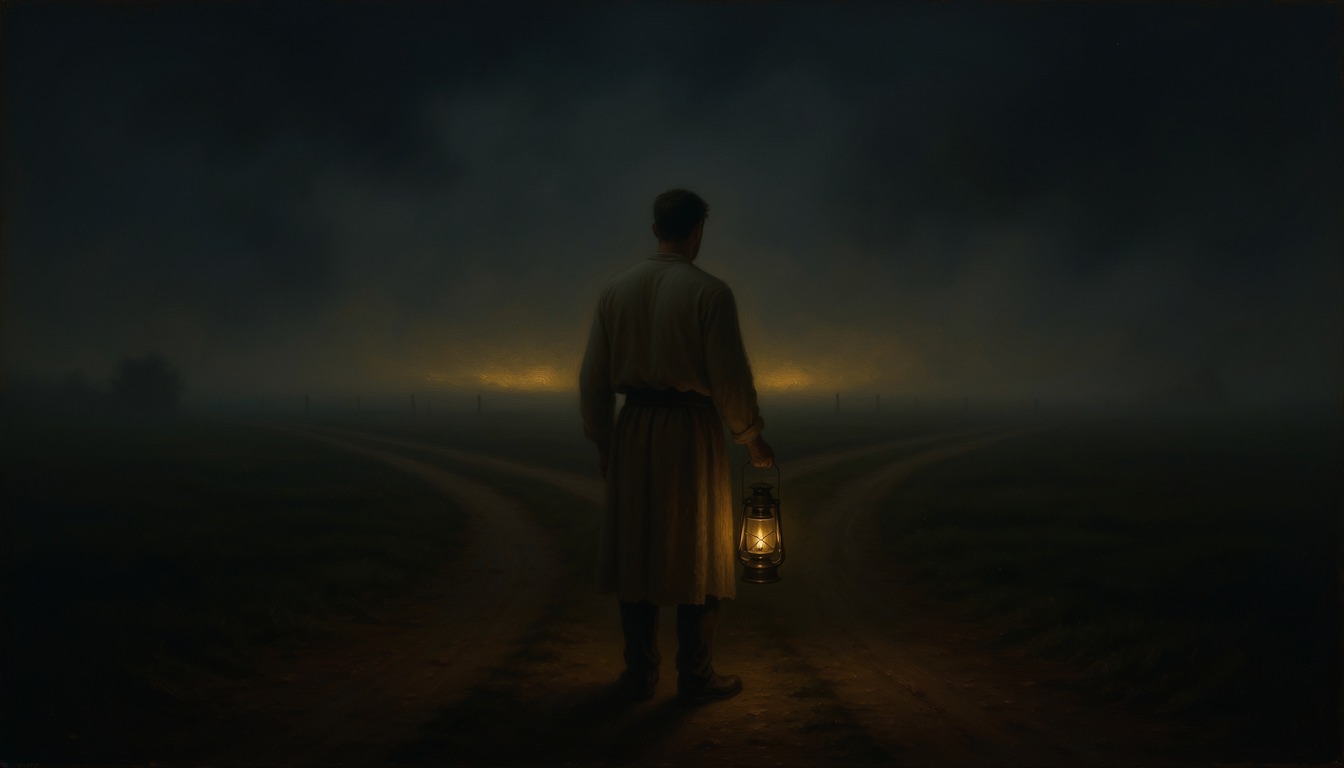
Some mornings you wake with the whole map laid out in front of you. And some mornings, the ones this letter is for, you wake at a crossroads in the dark, with no map at all, and no idea which way the road even runs. This is for anyone standing there now: the young person with no dream yet, the one who has lost everything and cannot find the way back, anyone waiting in the dark for a sign that has not come. I want to tell you something the dark would rather you never learned. You do not need to see the road to walk it. And you are far less lost than you feel.
“Not all those who wander are lost.” J.R.R. Tolkien
The Crossroads in the Dark
Picture the crossroads. Not a sunny one with helpful signs, but the real kind, the one you reach at night, in your life rather than on a map. Behind you, the road that brought you here has run out. Ahead, the way splits into paths you cannot see the end of, and every one of them vanishes into dark before it has gone ten steps. There is no signpost. No voice calls out the right direction. And the cruellest part is the silence, the feeling that everyone else was handed a map, and you alone are standing here without one.
We have a word for the person at this crossroads. We call them lost. And the moment that word lands, something in us begins to wait, to stand very still, hoping that if we do not move, the fog will lift on its own, or someone will come who knows the way, or the path will somehow light itself before we have to risk a step. But the fog does not lift for the ones who stand still.
Tolkien knew the difference, and he carved it into seven words that have outlived almost everything else he wrote. From the outside, the wanderer and the lost soul are identical, both off the marked road, both unable to name where they are going. But one of them is finished, and the other is on the most important journey of their life. And the thing that separates them is not the map in their hands. It is the fire in their chest.
Hear what the dark would rather you never learned: lost and wandering are not two kinds of people. They are two answers to the same question, the same crossroads, the same fog, the same missing map. And standing there, you do not discover which one you are. You decide. The lost wait for the light. The wanderer becomes it.
So decide. Not someday, when the road finally reveals itself, because it never will. Now. In the dark, with nothing proven and nothing promised, choose to be the one who walks. The path you are straining to see does not exist yet. It is waiting to be built, and it can be built by one thing only: your own feet, one step at a time, beginning the moment you stop asking the fog for permission.
And you will not walk it blind. There is a way to wander without being lost, older than you, and far stronger than your fear. You walk the six. You stand. You find your why. You love what you walk toward. You take the step. You keep the pace. And you learn, at last, to find the good life not at the end of the road, but in the walking of it.
Six virtues. One unknown road. A life that becomes, with every step you take, more unmistakably your own.
Let me walk it with you.
Fortitude: Stand in the Dark
There is a particular hour that visits people when a life comes apart, and if it has ever visited you, you will know it the moment I describe it. It is somewhere near three in the morning. The house is silent. The thing that held your life together, the job, the marriage, the plan, the person, the whole version of the future you were so certain of, is gone. And you are standing in the dark of a room you have stood in a thousand times, except tonight it is unfamiliar, because you are. You do not know what tomorrow is even for. You cannot see a single step ahead. And everything in you wants to go down, to sink to the floor and let the dark have you, because what is the point of standing when there is nowhere left to stand toward?
And then, and this is the moment everything turns on, though it will not feel like a turning point, it will feel like nothing at all, you don’t. You stay on your feet. You solve nothing. You find no way out. You simply remain standing in the dark, one more minute, and then one more after that. It looks like the smallest thing a person has ever done. It is, in fact, the whole of it beginning.
Because before you can walk an unknown path, there is something you must be able to do first, and it is the most underrated act of courage there is: stay standing when you cannot see. This is Fortitude, the foundation beneath every other virtue, the one that makes all the rest possible. Not strength as we usually picture it, the clenched jaw and the gritted teeth. Something quieter, and far harder: the simple refusal to be swept away by a darkness you cannot yet explain.
Think of the lighthouse on its rock. It does not know where the ships are. It cannot see through the storm any better than the sailors lost inside it. It holds no map of the night. But it has one task, and it performs that task no matter how little it can see, it stands, and it shines. It does not wait for the storm to pass before it begins its work; the storm is the very reason its work matters. Stand firm and shine, even when the storm is inside you.
And here is the truth that changes everything, if you are scanning your own black horizon right now for some light to appear, a rescue, a sign, a person further down the road who will finally show you the way. Stop searching the horizon. The light you have been waiting for is not coming from out there. It was never going to. The light you have been waiting for is the one you are here to become.
You are not lost in search of a lighthouse. You are the lighthouse, not yet lit.
The ground is laid. Now, what will you walk toward?
Wisdom: Find Your Why
Viktor Frankl, watching from inside the worst place human beings have ever built, saw who survived and who did not, and it was not the strongest, nor the youngest. It was the ones who still had a why: a wife they were determined to see again, a book not yet finished, some thread of meaning the camp could not reach in and sever. He walked out with one conviction burned into him: a person who has a reason to live can bear almost any conditions. When you are lost, the question that rises is almost always the wrong one. Where am I going? What is my path? But you do not need to know what you are walking toward. You need to know why you are walking at all. This is Wisdom: not knowing more, but seeing more clearly, panning a single fleck of gold from a whole river of mud. A what is a destination, a job, a title. A why is a reason, a value, a love, a direction of the heart you would keep even if every destination changed. The teenager with no dream has been told to find a what, and has none, and feels empty. But ask a why, what kind of person do you want to be, what do you want your one life to be for, and the emptiness turns out to have had an answer in it all along. A wanderer with a why does not need a map. They carry something better: a compass. And a compass works in the dark.
You do not need to know where you are going. You only need to know why you walk.
Love: Who You Walk For
Look closely at the centre of any why and you will almost always find a someone. The oldest story we still tell about a long, lost, unknown journey is, at its heart, a love story: Odysseus, ten years blown off course, offered ease and immortality by a goddess if he would only stay, refusing all of it for a small rocky island called Ithaca, a woman named Penelope, and a life he loved at the end of a road he could not see. It was not strength that carried him across the unknown. What carried him was love, a love so specific it had a name, and a shoreline, and a face. Ask people what kept them walking through the darkest stretch of their own lives, and they rarely name a goal. They name a person. And this matters most for the one who has lost everything, because grief is a liar. It tells you that because the thing you loved is gone, the love itself is gone too. It is not true. The love that built your old path did not die when the path did. You don’t fall in love, you choose it, and the fall is choosing it again tomorrow. Which means it can be chosen again. Aimed at a new horizon. Even from the floor of the worst night of your life. So as you stand at the edge of your unknown road, ask not “What is my plan?” but: who, or what, do I love enough to walk toward, even in the dark?
Every wanderer who kept walking was walking toward a love.
Courage: Take the Step
For most of human history, the maps ran out. Not metaphorically, actually. The known world ended at a coastline, and beyond it the cartographers drew sea serpents and wrote, in the empty space where their knowledge stopped, a warning: here be dragons. And for a long time, that was where people stopped too. The edge of the map was the edge of the possible. To sail past it was to sail into nothing, toward monsters, off the rim of the world. And yet, every coastline you can now name, every continent that sits solidly on a map today, was once on the far side of that warning. Every one was reached by someone who came to the edge of all that was known, looked at the blank space and the dragons, and put their ship in the water anyway.
This is the secret the lost never quite believe, so I will say it as plainly as it can be said. You do not find your path and then walk it. You walk, and the walking makes the path. The poet Antonio Machado wrote the truest line ever set down about the unknown road: traveller, there is no path, the path is made by walking. There was never a hidden trail you were failing to locate. The ground ahead is blank because it is yours to make, and it forms itself beneath your feet, one step at a time, and never a single step before.
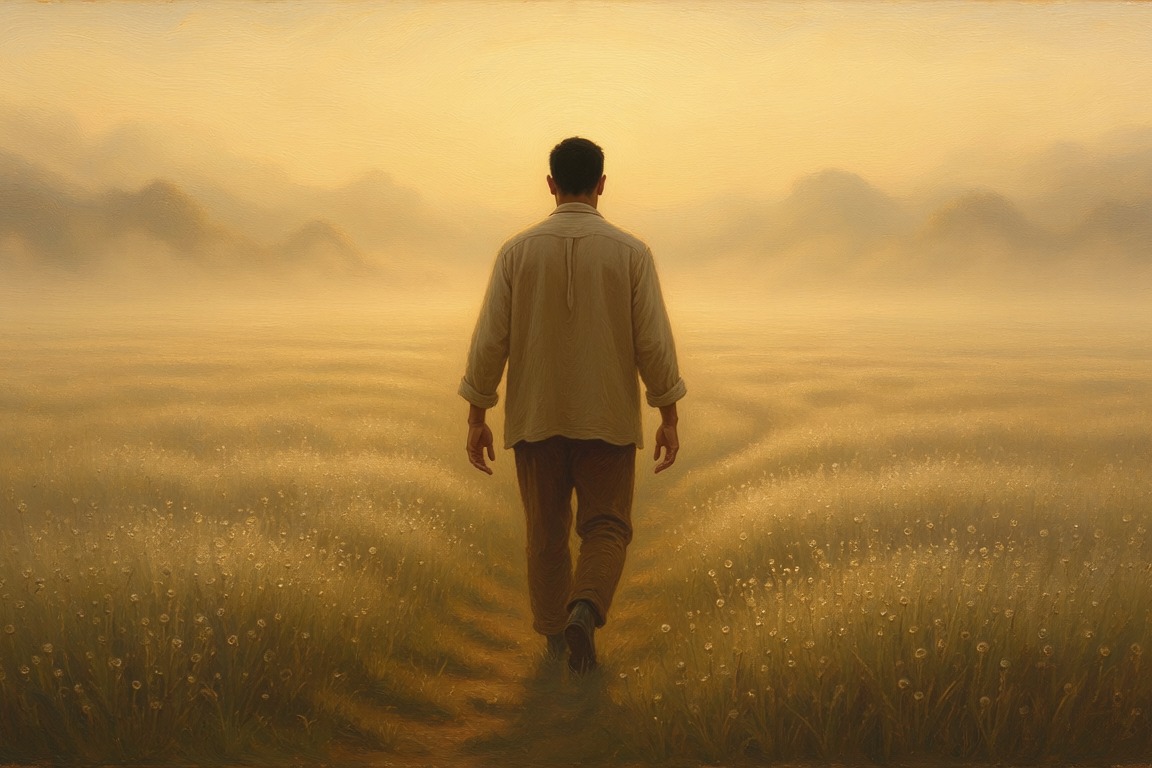
Which brings us, at last, to Courage, and to fear, which you have been waiting for me to tell you how to remove. I cannot, and I would not if I could. Fear is not the enemy of the unknown road; it is the fuel. The windmill does not curse the wind or wait for it to fall still, it takes the very wind that batters it and turns it into power. Your fear is not a sign you are unfit to walk. It is a sign that this matters, that the stakes are real, that you are standing at the edge of something that counts. Courage is not the absence of that fear. Courage hears it, says “noted”, and steps anyway.
You do not find your path and then walk it. You walk, and the walking makes the path.
The step is taken. Now comes the part almost nobody warns you about: not how to begin, but how to keep going when the road runs long.
Temperance: Walk the Long Road
Watch what happens the moment a person finally decides to change their life. There is a glorious surge, and the temptation is overwhelming to fling your whole self at it at once: wake at five, run ten miles, rebuild the business plan, overhaul every habit in a single heroic week. Then, somewhere around week three, the body gives out, or the spirit does. And here is the cruellest part: they do not say, “I went too fast.” They say, “I knew the path was wrong.” They mistake their own exhaustion for a verdict on the journey. The unknown road has a length you cannot see, and that is precisely why you cannot sprint it. This is Temperance, the most quietly underestimated virtue of the six: not the thin modern version that means merely “less”, but the conductor’s hand laid over the whole of a life, every instrument playing in its place, at its measure, all things in harmony. The rest is as deliberate as the effort. The pace is set not to how badly you want to arrive, but to what you can sustain, mile after mile, with your why intact and your love undimmed. Walk like someone who intends to be walking a long time. That is how long roads are won.
The unknown road is not won by the fastest. It is won by the one still walking when the fog thins.
Gratitude: The Good Life Is the Walking
There is an old story, told in many lands, of a traveller who comes upon an old man planting a tree by the side of the road. It is not a fast-growing tree; it is the kind that takes seventy years to give fruit. The traveller, puzzled, asks the old man why he bothers, surely he knows he will never live to eat a single piece of what he is planting. And the old man, without looking up from the soil, says: “I am not planting it for me. I came into a world full of trees that others planted before I was born, and ate fruit I did not earn, and sat in shade I did not grow. I am simply planting what I will not harvest, and tending, while I am here, what I did not plant.” And he goes on with his work, perfectly content, doing a thing whose reward he will never see, and somehow more at peace than any man rushing toward a finish line has ever looked.
That old man had found the thing this whole estate is named for. And if you have been waiting this entire journey for the part where I tell you how to reach the end of your road, where the path finally arrives somewhere and the not-knowing resolves into a destination that justifies all the walking, then here is the last and most freeing truth of all: there is no such arrival.
“To travel hopefully is a better thing than to arrive.” Robert Louis Stevenson
The Greeks had a word, eudaimonia, which we weakly translate as happiness, but which means a life well-lived, the flourishing of a human being doing what they were made to do. And Aristotle’s great insight, twenty-three centuries old and still the truest map we own, was that this good life is not a destination you reach. It is an activity. Not somewhere you arrive, something you do, the good chosen again and again in the living of an ordinary day. Arete, excellence, your truest self, is not waiting at the end of your road. It is in the very next step. The good life is the walking. It always was.
Arete is not waiting at the end of your road. It is available in the very next step.
So stop waiting to arrive before you let your life begin to count. The road itself, the standing, the why, the love, the brave step, the steady pace, is not the wait before the good life. It is the good life, happening now, in the dark, before any destination is in sight. Every step is the thing itself. So take the next one, not to get somewhere, but because the walking is the gift, and it is yours, right now, no permission required.
Not All Who Wander
So come back to the crossroads in the dark, and look at it again now. Nothing about the road has changed. It is still unmarked. You still cannot see where it ends. The fog has not lifted, and no signpost has appeared. The only thing that has changed is you, and that was always the only thing that needed to.
That is the difference between the wanderer and the lost. The lost person stands still in the dark, waiting for a light to come. The wanderer becomes the light, and walks, not because they can see the way, but because they have a why to walk it, and they have understood that the way is made by the walking.
You are not lost. You never were. You were only a wanderer who had not yet been told.
So stand. Find your why. Love what you walk toward. Take the step. Keep the pace. And walk the unknown road as what it has been all along, not the absence of your life, but your life itself, beginning now, in the dark, one good step at a time.
Not all those who wander are lost. And neither are you.
For the Young Ones
For any young explorer who doesn’t know the way yet. Read it aloud.
Grown-ups love to ask you one question: “What do you want to be when you grow up?” And if you don’t know the answer, it can feel like something is wrong with you. So here is a secret: you do not have to know yet. Almost nobody really does.
You do not need to know exactly where you are going before you start walking. You just need to know what kind of person you want to be along the way, kind, or brave, or true. That is your “why,” and a why is better than a map, because a map can only take you to one place, but a why can guide you anywhere.
And when the way ahead looks dark and you cannot see what comes next, you do not have to wait for someone to come and light it for you. You can be your own light. You take one small brave step, even when you feel scared, because feeling scared just means it matters, and then the next bit of the path appears. That is how every path is made. Not by finding it. By walking it and revealing it.
So you are not lost just because you don’t know the whole way yet. You are an explorer. And explorers were never meant to see the whole map. They were meant to walk, and be brave, and make the path as they go.
A practice, and, as always, the grown-up goes first.
Tonight, try this together. Don’t talk about what you want to do or to be. Talk about who you want to be like, name one quality you are trying to grow (braver, kinder, more patient), and one small step you took toward it today, even a tiny one. Then ask them: who do you want to be like? What is one brave step you could take tomorrow?
You are teaching them the most important thing an explorer can know, that you never need to see the whole path to take the next good step.
About the author
Marcus J Emsley · The Guide
Marcus spent seventeen years as a welfare officer in the Royal Australian Air Force, at home and on operations overseas, sitting with people in grief, trauma and the mornings they did not want to rise. He is the founder of Arete Estate in the Barossa Valley, South Australia, the creator of The Sculptor's Journey and Wisdom & Wonder, and the author of the debut novel Wisdom & Wine. He is the son of a primary school teacher who coached footy, cricket and life, and a palliative care nurse who showed him what kindness at the hardest door looks like. He has stood in the dark himself, and he writes from the far side of it.
What we are building at Arete Estate
Arete is excellence becoming. It is the highest expression of who you were always meant to be, not the finished version, but the version that keeps reaching. It is not built. It is revealed.
Arete Estate exists to help people reveal, not construct, the highest version of themselves. We do this through six virtues drawn from the world's wisdom traditions, taught through stories, walked through daily practice, and offered to anyone who is ready to begin: the parent raising a child, the leader carrying a team, the soldier returning from service, the school shaping the next generation, the person sitting alone in the early hours of the morning wondering if there is a path through.
Our work is to make that path visible. To stand as a lighthouse for the seekers, the grieving, and the broken. To remind every person we reach that excellence is not built, it is revealed by storms, and that they are not alone in the storm.
We do not chase. We shine. The Sculptor's Journey (The Doorway, The Walked Path, The Guided Path), An Hour with the Guide, Meditate with Arete, Wisdom & Wonder and The Sculptor's Library are the rooms of that house.
Six virtues. One journey. Your highest self.
www.areteestate.com.au · info@areteestate.com.au · Instagram @areteestate
If this essay touched something raw
Some of what is written here is heavy. If it has stirred something you are carrying, please do not carry it alone tonight.
Lifeline 13 11 14 · Open Arms (veterans and families) 1800 011 046 · 1800RESPECT 1800 737 732 · Kids Helpline 1800 55 1800 · In an emergency, call 000.
Reaching out is not weakness. It is all six virtues at once: the Fortitude to stay, the Wisdom to know you need a hand, the Love to let someone in, the Courage to ask, the Temperance to set the weight down, and the Gratitude for the one who answers.

Responses