
Love · A companion to the Virtue Series essay on Love. Love is not one thing; it lives in every room of your house, and in every room it asks the same question.

We usually speak about love as romantic love, because that is where the lie about love lives loudest. But if Love is a virtue, and it is, one of the most demanding of all six on The Arete Path, then it does not live in one room of your life. It lives in every room. And in every room, it asks the same question: will you choose me today?
The answer changes shape depending on the room. But the cost is always the same. Love costs you the easier option.
A Parent’s Love
It is 3am and there is a small body in your bed again. She had the nightmare, the one she can’t describe, the one with the thing in the cupboard that doesn’t have a name. She is four years old and she is trembling and she has wedged herself between you and the edge of the mattress with an elbow in your ribs and a foot against your spine and you have to be up in three hours and you are so tired you could weep.
And you pull her closer. Not because it is convenient. Not because sleep doesn’t matter. Because she is afraid and you are the answer to that fear: not with words, not with logic, not with a lecture about how there is nothing in the cupboard. With your body. With your warmth. With the steady rhythm of your breathing that says, without a single word: I am here. Nothing can get you while I am here.
That is love. The 3am kind. The kind that costs you sleep you cannot afford and gives you something no amount of sleep could.
Fast forward ten years. She is fourteen. She does not want to be in your bed. She does not want to be in the same room as you. She is a stranger who lives in your house and communicates primarily in monosyllables and eye rolls and the occasional door slam that rattles the picture frames in the hallway.
And the thing in the cupboard has changed. It is not imaginary anymore. It is the friend group that turned on her. It is the boy who said something cruel. It is the body she is growing into that doesn’t match the one she sees on her phone. And she won’t tell you. She won’t let you in. She has locked the door of her room the way she used to climb into your bed, not because she doesn’t need you, but because needing you feels dangerous now, and independence is the armour she is learning to wear.
And you love her. You love her by leaving the light on in the hallway. By making the sandwich she didn’t ask for. By saying goodnight through a closed door and meaning it even when nothing comes back. By resisting, with every fibre of your body, the urge to force the door open, to fix it, to make her be four again when everything was simpler and she fit between your ribs and the edge of the mattress.
That is love. The fourteen-year-old kind. The kind that costs you control and gives you something harder and more valuable: trust.
Fast forward again. She is thirty-two. She lives in another city. She calls on Sundays, sometimes. She has a life you didn’t build and a partner you didn’t choose and opinions about things you didn’t teach her. She is, in the most beautiful and painful sense of the word, her own person.
And you love her by letting her be.
By not correcting the decision you think is wrong. By biting your tongue when the advice is sitting right there, perfectly formed, desperate to be delivered. By saying how are you and meaning it, and listening to the answer without trying to fix what you hear. By trusting, with everything you’ve built across thirty-two years of 3am nightmares and slammed doors and sandwiches left outside closed rooms, that the foundation holds. That the love you poured in is still there, even when you can’t see it, even when she doesn’t say it, even when the call on Sunday doesn’t come.
A parent’s love is the longest act of faith a human being will ever perform: believing in something you built, long after you’ve stopped being able to see it.
A Child’s Love
We talk about a parent’s love as though it is the harder one. It isn’t. Or rather, it is hard in a different direction.
A child’s love is hard because it has to survive the discovery that your parents are human.
There is a moment in every person’s life, and you remember yours, even if you have never spoken about it, when you looked at your mother or your father and saw, for the first time, not the giant, not the hero, not the unshakeable force that had always been there, but a person. A tired, uncertain, imperfect person who was doing their best with tools they had inherited from their own tired, uncertain, imperfect parents.
That moment is a kind of grief. The grief of realising that the people you loved as gods are mortal. That they made mistakes, some of them serious, some of them still living in rooms in your mansion with the light on. That the love they gave you, fierce and real and well-intentioned as it was, came with dents and scratches and blind spots that you are still, decades later, learning to see.
And the choice, the love choice, is what you do with that discovery.
You can harden. You can catalogue the mistakes. You can hold the ledger up and say: you fell short here, and here, and here. And you would not be wrong. The ledger is real. The dents are real.
Or you can do something much harder and much more beautiful. You can look at the person who raised you, the one who got it wrong sometimes, the one who shouted when they should have whispered, the one who didn’t know how to say I love you because nobody ever said it to them, and you can choose to love them anyway. Not because they were perfect. Because they were there. Because they showed up. Because they made the coffee. Because they stood in the rain at the football game, even if they got a hundred other things wrong.
A child’s love is the grace of seeing your parents clearly, every flaw, every failure, every unhealed wound, and choosing to love the human being, not the version you needed them to be.
That grace is not automatic. It is not owed. It is chosen. And sometimes it takes a lifetime to get there. But the people who do, the ones who find a way to love their parents as humans rather than as heroes or villains, carry a freedom that the ones who don’t will spend their lives searching for.
A Friend’s Love
There is a kind of love that the world does not take seriously enough, and it is this one.
It is a Tuesday night and your phone rings. The name on the screen belongs to someone you haven’t spoken to in three months, not because anything went wrong, but because life did what life does. It filled every gap. It consumed every margin. The friendship didn’t end. It just got quieter, the way a song fades when you drive out of range of the radio station: still playing, somewhere, but you can’t hear it anymore.
You answer. And within forty-five seconds, it is as though no time has passed at all. The voice is the same. The laugh is the same. The way they say your name, the particular emphasis, the warmth that lives in a single syllable, is the same. And something in your chest that you didn’t know was clenched gently unclenches.
That is friendship love. And it is one of the most undervalued forces in human life.
Because friendship love is the love you choose with nothing at stake. No contract. No vow. No biological imperative. No shared mortgage or custody agreement or legal consequence for walking away. You stay in a friendship for one reason only: because you want to. Because this person sees you, not the version you perform for the world, not the curated highlight reel, but the you who is afraid and uncertain and a bit of a mess sometimes, and they stay anyway. And you see them the same way. And neither of you flinches.
It looks like the friend who drives forty minutes to sit in your kitchen after the phone call that changed everything: not to fix it, not to offer solutions, just to be in the room. To make the tea. To sit in the silence with you, because the silence of someone who loves you is different from the silence of being alone, and you both know it.
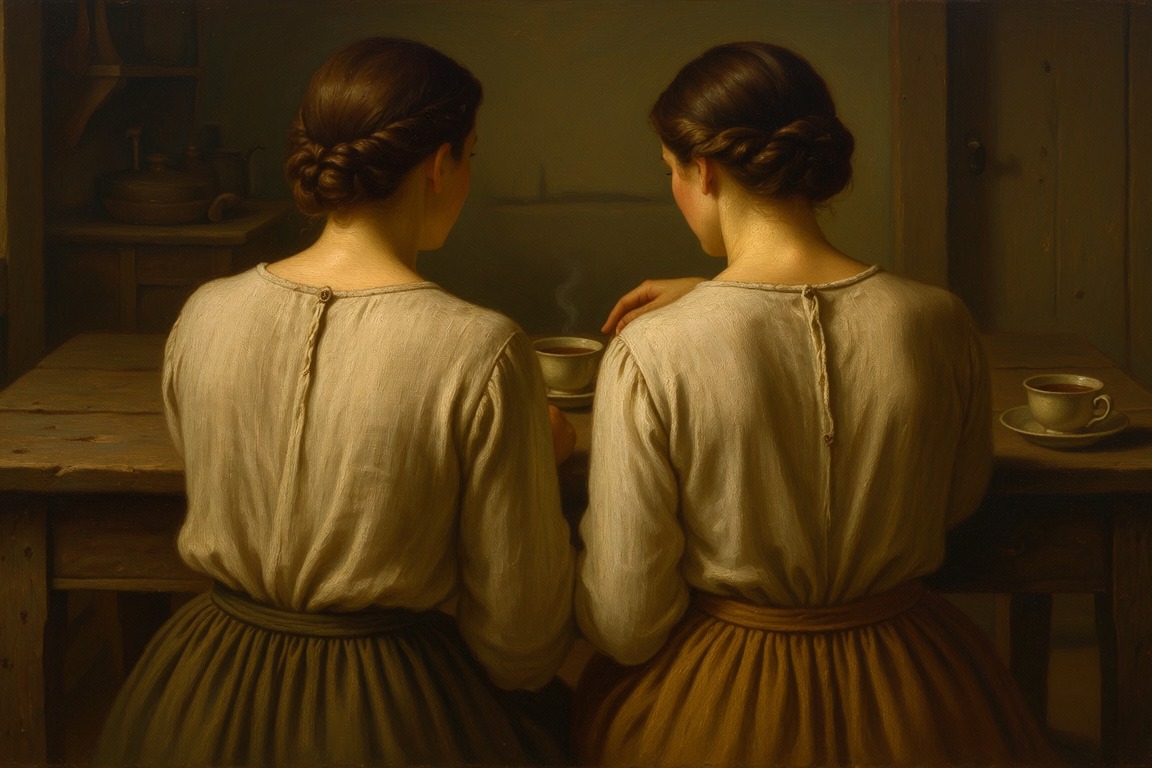
It looks like the friend who tells you the truth when the truth is hard. Who says, gently but clearly: I think you’re making a mistake. Not because they want to be right. Because they love you more than they love your approval. And that, the willingness to risk the friendship in service of the friend, is one of the bravest forms of love there is.
Friendship is the love you practise with no safety net. No contract holds it together. Only the choice, made again and again, to show up.
Loving Yourself
And then there is this one. The one most people skip. The one that feels indulgent to even mention, because the world has taught you that loving yourself is either narcissism or a luxury you haven’t earned yet.
It is neither.
Loving yourself is the foundation that every other form of love stands on. And most of us are trying to pour from a cup we have never filled.
Here is what self-love actually looks like. Not the bubble bath version. Not the treat yourself version. The real one.
It looks like the woman who catches herself in the mirror after a shower and, for the first time in as long as she can remember, does not immediately catalogue what is wrong. Who looks at the body that has carried her through every storm of her life, through the 3am nightmares and the slammed doors and the hospital corridors and the cemetery in the rain, and says, quietly, without performance: thank you. You carried me. I am sorry I have spent so many years at war with you.
It looks like the man who finally says no to the extra commitment, not because he doesn’t care, but because he has learned, the hard way, that a person who says yes to everything is a person who has said no to themselves so many times they’ve forgotten what their own voice sounds like.
It looks like the person who goes to therapy. Not because they are broken. Because they have decided that the way they talk to themselves, the voice inside their head that is harsher than any voice they would use on a stranger, deserves to be examined. Challenged. Replaced with something kinder.
Thich Nhat Hanh, who lived a life of such gentle, consistent, chosen love that it became impossible to separate the man from the practice, said:
“To love without knowing how to love wounds the person we love.” Thich Nhat Hanh
That includes you. If you do not know how to love yourself, if the only voice in your head is the critic, if rest feels like laziness and kindness toward yourself feels like weakness, then every other love you practise will carry that wound into the room. You will love your partner from a place of depletion. You will love your children from a place of exhaustion. You will love your friends from a place of guilt. And none of them will get the version of you that you are actually capable of being.
Self-love is not selfish. It is structural. It is the cup that must be filled before anything can be poured.
And it is a choice. The same choice as every other love in this letter. Made daily. Made on the mornings when you don’t feel worthy of it. Made especially then.
How They All Coexist
Nobody prepares you for this: you are practising all of it at the same time.
On any given Tuesday, you are the partner choosing to make the coffee. You are the parent leaving the light on in the hallway. You are the child learning to see your mother as a person. You are the friend who should pick up the phone. And you are the human being who hasn’t said a kind word to themselves in three weeks.
All of it. At once. Every day. And the conductor, the Temperance in you, is trying to give each one its proper volume, its proper moment, its proper care.
Some days one love will need more than the others. The child is sick and the partner waits. The friendship is in crisis and the self-care gets postponed. The parent needs you and the routine falls apart. That is not failure. That is the orchestra responding to the music of the moment.
But here is what matters: none of them can go silent forever. An instrument that stops playing doesn’t just go quiet; it goes out of tune. And bringing it back takes longer than it would have taken to let it play a few notes along the way.
Love your partner. Love your children. Love your parents, as they are, not as you needed them to be. Love your friends. And love yourself, not last, not with what’s left over, but with the same deliberate, daily, chosen care you give to everyone else.
Love is not one thing. It is every room in your house, lit from within, each one asking the same question: will you choose me today?
To love without knowing how to love. That is the sentence that should keep us all awake. Because most of us are loving with tools we inherited from people who were also loving without knowing how. And the chain continues, imperfect love teaching imperfect love, until someone stops and says: I want to learn. I want to love better. Not perfectly. Better.
That willingness, that single, humble, brave willingness, is the beginning of everything this virtue asks of you.
You don’t fall in love. You choose it. The fall is choosing it again tomorrow. In every room.
About the author
Marcus J Emsley · The Guide
Marcus spent seventeen years as a welfare officer in the Royal Australian Air Force, at home and on operations overseas, sitting with people in grief, trauma and the mornings they did not want to rise. He is the founder of Arete Estate in the Barossa Valley, South Australia, the creator of The Sculptor's Journey and Wisdom & Wonder, and the author of the debut novel Wisdom & Wine. He is the son of a primary school teacher who coached footy, cricket and life, and a palliative care nurse who showed him what kindness at the hardest door looks like. He has stood in the dark himself, and he writes from the far side of it.
What we are building at Arete Estate
Arete is excellence becoming. It is the highest expression of who you were always meant to be, not the finished version, but the version that keeps reaching. It is not built. It is revealed.
Arete Estate exists to help people reveal, not construct, the highest version of themselves. We do this through six virtues drawn from the world's wisdom traditions, taught through stories, walked through daily practice, and offered to anyone who is ready to begin: the parent raising a child, the leader carrying a team, the soldier returning from service, the school shaping the next generation, the person sitting alone in the early hours of the morning wondering if there is a path through.
Our work is to make that path visible. To stand as a lighthouse for the seekers, the grieving, and the broken. To remind every person we reach that excellence is not built, it is revealed by storms, and that they are not alone in the storm.
We do not chase. We shine. The Sculptor's Journey (The Doorway, The Walked Path, The Guided Path), An Hour with the Guide, Meditate with Arete, Wisdom & Wonder and The Sculptor's Library are the rooms of that house.
Six virtues. One journey. Your highest self.
www.areteestate.com.au · info@areteestate.com.au · Instagram @areteestate
If this essay touched something raw
Some of what is written here is heavy. If it has stirred something you are carrying, please do not carry it alone tonight.
Lifeline 13 11 14 · Open Arms (veterans and families) 1800 011 046 · 1800RESPECT 1800 737 732 · Kids Helpline 1800 55 1800 · In an emergency, call 000.
Reaching out is not weakness. It is all six virtues at once: the Fortitude to stay, the Wisdom to know you need a hand, the Love to let someone in, the Courage to ask, the Temperance to set the weight down, and the Gratitude for the one who answers.

Responses