
What Sir Peter Cosgrove teaches us about the kind of steadiness a shaking world cannot do without.
THE ARETE HEROES SERIES · PART IV
Modern lives that embody the ancient pursuit of excellence
Nearly two thousand years ago, a Roman emperor sat in a war camp on the Danube and wrote a note to himself that nobody else was ever meant to read.
Be like the promontory against which the waves continually break; but it stands firm and tames the fury of the water around it.
Marcus Aurelius was not describing a rock, though that is what a promontory is: a headland, a high shoulder of stone that juts out into the open sea and takes the full force of every wave the ocean can throw, while the water behind it stays calm enough for harbour. He was describing a kind of person. The rarest kind. The person who, when everything around them is heaving, the room, the market, the family, the nation, does not heave with it. The person other people instinctively move toward when the ground starts to shake, the way ships in a black sea turn toward the one light that holds its place.
We are living in a heaving season. You don’t need me to list the waves. You can feel them, in the news, in the group chat, in the kitchen at ten o’clock at night. And in seasons like this, a quiet lie takes hold: that the answer to a shaking world is to shake louder than it does. To be more outraged, more urgent, more everywhere.
The ancient Greeks knew better. So does one Australian whose life I want to set in front of you today, not as a celebrity, not as a saint, but as proof.
Here is the teaching this essay carries, and I’ll give it to you straight before his story earns it:
In a shaking world, the steadiest person in the room becomes the room’s centre. And steadiness is not a temperament you are born with. It is a discipline you build, storm by storm, decade by decade, until the day your country picks up the phone and there is only one name to call.
Australia has picked up that phone, again and again, for fifty years.
It kept calling the same man.
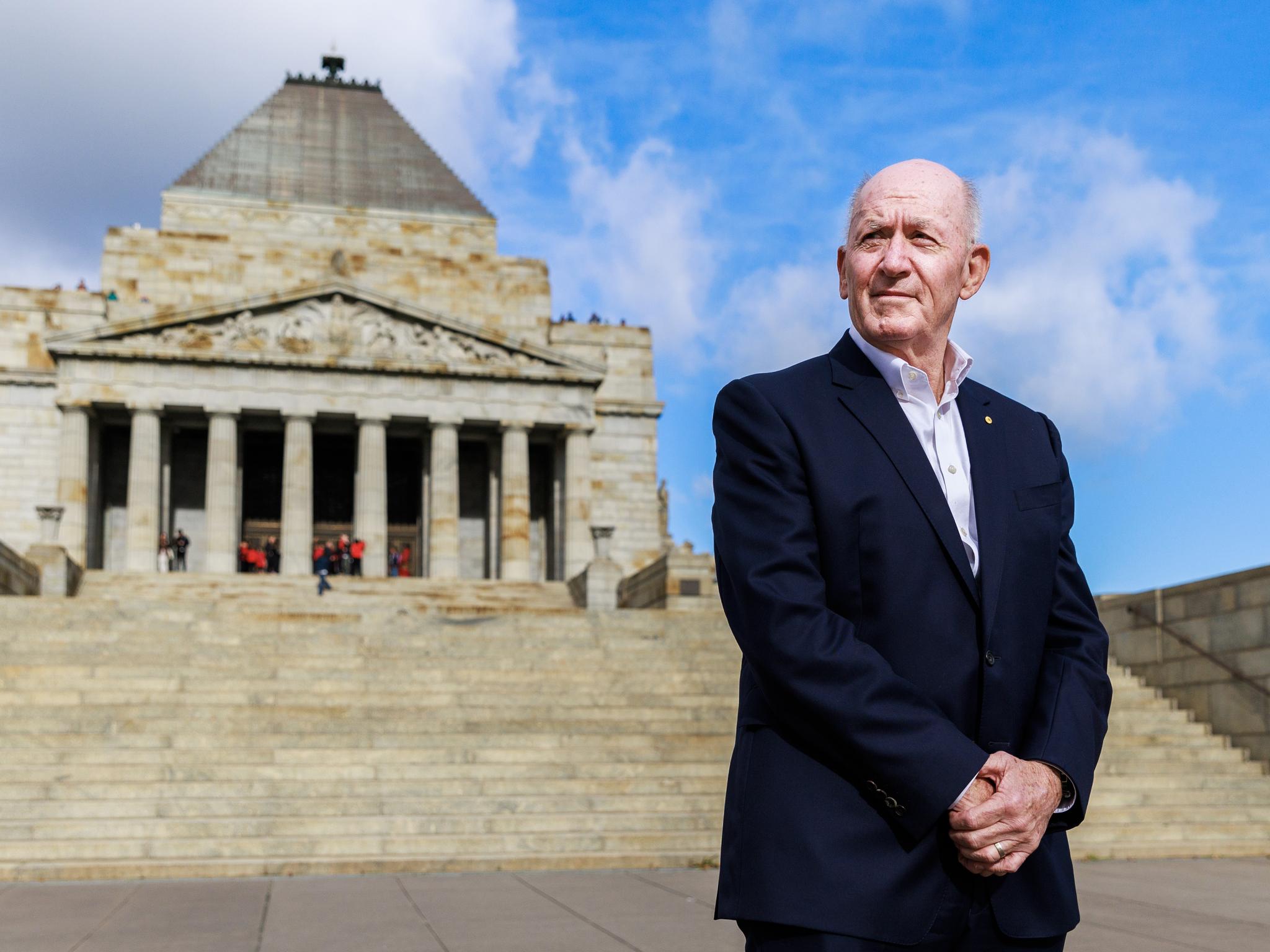
September 1999. Dili Is Burning.
Picture it. A city on fire on our doorstep. East Timor has voted for its independence, and the price of that vote is being exacted in smoke and blood. Militias roam. Hundreds of thousands of people are displaced. The world is watching, and the world is asking one question of Australia: who do you send into that?
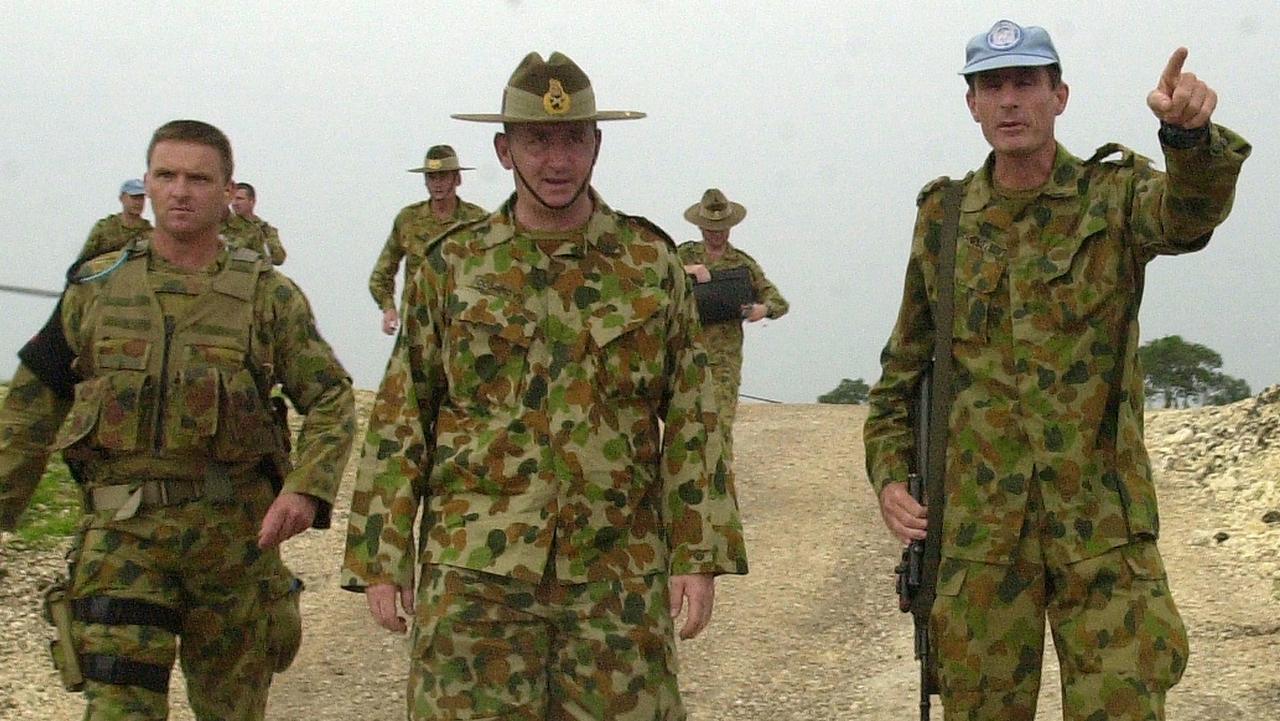
The man who steps off the aircraft into that chaos is fifty-two years old. Major General Peter Cosgrove, commander of INTERFET — the international force charged with stopping a catastrophe with the whole region holding its breath.
What happens over the following months is studied still. A force drawn from many nations. A newborn country stabilised. A transition to independence secured. And, this is the part the textbooks underline, it was done less by fury than by presence. By a commander who, in the middle of the inferno, made a point of sitting down with the Timorese leadership, of dealing with everyone around him with dignity, of building a relationship with the resistance leader Xanana Gusmão that endures to this day. Years later, when Cosgrove was appointed Governor-General, Gusmão, by then Timor-Leste’s Prime Minister, wrote to congratulate him, praising his record and what he called his fine character.
Think about that. The leader of the people Cosgrove was sent to protect didn’t remember his firepower.
He remembered his character.
The waves broke. The promontory stood. And a nation that was drowning found something to hold on to.
But promontories are not built in the storm. They are built long before it. So we have to go back, back to where the steadiness started, and walk this life through the six virtues of Arete. Because Peter Cosgrove did not perform these virtues.
He is what they look like with their sleeves rolled up.
I. Courage — “Fear tells you the stakes. Courage says ‘noted’ — and begins anyway.”
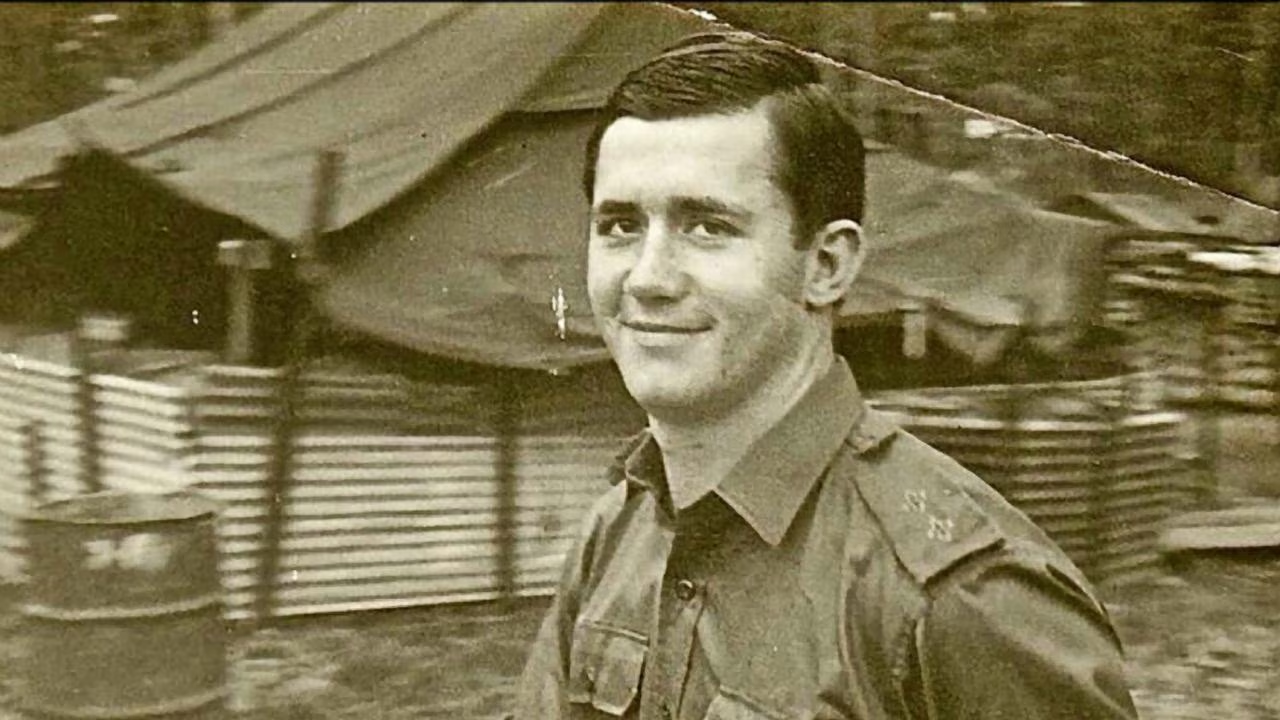
He was a soldier’s son from Sydney. Waverley College, then the Royal Military College, Duntroon, graduating in 1968 into an army at war. By his early twenties, Lieutenant Peter Cosgrove was in Vietnam, commanding a rifle platoon, which is a polite way of saying he was a young man responsible for other young men’s lives in a place where the trees shot back.
In 1971 he was awarded the Military Cross for his leadership during an assault on enemy positions. Strip the citation language away and what you have is this: there was a moment when every cell in a young man’s body said don’t, and he went forward anyway, and he brought his men with him.
Here is what matters for you and me, who will likely never hear a shot fired in anger. Courage at twenty-two is not a different substance from courage at fifty-two. It is the same muscle. The general who walked calmly into burning Dili was drawing on an account a platoon commander had opened thirty years earlier in the scrub of Vietnam. Fear told him the stakes, both times. He said noted, both times. And began.
You cannot withdraw steadiness in your fifties that you never deposited in your twenties. The storm doesn’t build the promontory.
It reveals it.
II. Wisdom — “Acknowledge the mud. Record the gold. Choose what you carry forward.”
War leaves mud on everyone it touches. Vietnam left plenty, on the soldiers who fought it and on the nation that sent them and then, shamefully, looked away from them when they came home.
Cosgrove carried that mud. He never pretended otherwise. His own soldier’s saying, the one he chose as the title of his memoir, You Shouldn’t Have Joined... comes from the old army line: if you can’t take a joke, you shouldn’t have joined. It is the wisdom of a man who learned early that hardship is the entry fee, not the malfunction. Acknowledge the mud.
But watch what he chose to carry forward. Not bitterness. Not the swagger of the warrior. From the mud of Vietnam, he panned a different gold: the knowledge that force is the last tool, not the first. That the soldier’s deepest purpose is protective, not destructive. And when East Timor came, that gold was what he spent. The general who had seen what war costs was precisely the general wise enough to win a peace, communicating, listening, sitting with leaders, restraining where a lesser commander might have flexed.
Heraclitus said it twenty-five centuries ago: character is destiny. Wisdom is the part of character that decides which of your experiences gets a vote in your future. Cosgrove let the right ones vote.
So must you. You have mud. Everyone reading this has mud. The question wisdom asks is never did it happen to you? It is: what did you choose to carry forward?
III. Temperance — “Conduct your life with balance — all instruments in harmony.”
In 2000 he became Chief of Army. In 2002, Chief of the Defence Force, the highest uniform in the land. In 2001, he was named Australian of the Year, with a citation that read like a character reference for the nation’s ideal self: strength, determination, intelligence, compassion, humour.
Pause on that list. Notice it is a chord, not a single note.
Power is the great unbalancer. History is a long ledger of capable people who reached the top and let one instrument drown out the orchestra, strength without compassion becomes cruelty; intelligence without humour becomes coldness; determination without wisdom becomes a battering ram. Churchill, who knew something about command, warned his old school in the darkest year of the war: never give in, never, never, never, but the lesser-quoted half of that speech is the qualifier: except to convictions of honour and good sense. Even defiance must be conducted.
What Australians kept noticing about Cosgrove at the summit of power was the harmony. The general who could command a multinational force could also laugh at himself. The man with the Military Cross was the man journalists described as warm. The toughness never ate the humanity; the humanity never softened the toughness. All instruments, one piece of music.
That is temperance, not the absence of appetite or power, but the conducting of it. And let me say this plainly, because it needs saying in this season: anyone who holds public office in this country, of any party, any chamber, any level, should keep this example on the desk. Not as nostalgia. As a standard. The measure of a public life is not which side you serve. It is how you hold what you’ve been handed, and whether the nation is steadier because your hands were on it.
It is the reason the story doesn’t end at Chief of the Defence Force. Unbalanced men are spent by their careers.
Balanced men are just getting started.
Mens Sana in Corpore Sano — An Interlude
A sound mind in a sound body. The ancients refused to separate the two, and this series won’t either.
Cosgrove was an infantryman, and infantry is the trade of the body, the pack, the march, the heat, the discipline of physical hardship absorbed daily for forty years, from the parade grounds of Duntroon in 1965 to his retirement from the Army in 2005. That conditioning was never about vanity. It was about availability. A body kept ready is a promise you make to people who might need you.
And they did need him. At fifty-eight, retired, decorated, entitled to an armchair, he was tramping through the flattened banana plantations of Far North Queensland. At seventy-two he was back in the field again among the bushfire ash. The steady mind needs a body that can still show up.
Yours does too. Whatever shape your service takes, the training you do this morning is not for this morning. It is for the day, years from now, when someone needs you to be physically present in their disaster, and you can be.
Train for that day.
IV. Love — “You don’t fall in love. You choose it. The fall is choosing it again tomorrow.”
In early 1975 a young officer met a Sydney woman named Lynne. They married in 1976. Three sons. Two grandchildren. Fifty years of choosing it again tomorrow, through postings and deployments and decades when the Army owned the calendar. Every public life that lasts has a private vow holding it up, and his does. Any honest portrait says so.
But I want to show you Cosgrove’s love at national scale, because this is where his story stretches the word past where most of us keep it.
March 2006. Cyclone Larry tears through Far North Queensland and flattens Innisfail. Homes gone, crops gone, livelihoods gone. And the man asked to lead the recovery is a general one year into his retirement, a man who had every right to say I’ve done my bit.
He went. And the image Queenslanders kept was not a man behind a desk in Brisbane. It was Cosgrove in the wreckage, among the people, week after unglamorous week, putting a shattered community back on its feet. There were no enemies in Innisfail. No medals. Just neighbours who had lost everything, and a man who decided they were his to help.
Then, as Governor-General from 2014, the same love wearing a different uniform. When MH17 was destroyed and Australian families were shattered, he was there. Through floods and fires and funerals, he was there. The role’s quiet, constitutional definition, a leadership beyond politics, as it was put when he was appointed, became, in his hands, something warmer: the nation’s steady presence at its own bedside. He once said his hope for the office was simply to meet as many of his fellow Australians as possible. He kept that promise in hospital wards and drought paddocks and school halls for five years.
Love, in the Arete understanding, is not a weather event that happens to you. It is the daily decision to keep showing up for what you have claimed as yours. Lynne. The Army. Innisfail. Australia.
He chose it again tomorrow. Every tomorrow.

V. Fortitude — “Stand firm and shine, even when the storm is inside you.”
And now we reach the lighthouse itself, the virtue this whole life has been spelling out.
Run the timeline. Vietnam at twenty-two. Battalion command in his thirties. Brigades and divisions in his forties. Dili at fifty-two. Chief of the Defence Force at fifty-five. Innisfail at fifty-eight. Governor-General at sixty-six. The bushfire rebuild, unpaid, at seventy-two.
On the surface it looks like a life of constant motion, new ranks, new crises, new continents. But look again. Look at what never moved.
The dignity never moved. The good humour never moved. The instinct to serve never moved. The steadiness under pressure never moved. For more than fifty years, through every storm Australia could generate, military, natural, constitutional, human, the inner architecture of the man stayed exactly where it stood. Kipling could have been writing his service record: if you can keep your head when all about you are losing theirs...
This is the teaching, friends, so let me hold it up to the light one more time.
A lighthouse is not impressive because of its height or its lamp. It is impressive because of one quality and one only: it does not move. Its entire value to the ships is its refusal to drift. A lighthouse that relocated with every storm would be worse than no lighthouse at all, it would wreck the very ships that trusted it.
We live among people who drift. Opinions drift with the algorithm. Commitments drift with the mood. Presence drifts with whatever is louder. And into that drift, the Cosgrove life speaks a hard, magnificent word: you can be the fixed point. Not by being rigid, the man’s warmth and humour prove steadiness isn’t stiffness, but by deciding, long before the storm, which things in you are simply not available to the weather.
Seneca wrote that fire tests gold and adversity tests the brave. Notice the verb. The fire doesn’t create the gold. It finds it.
Excellence revealed by storms. It was always going to come back to that.
VI. Gratitude — “Planting what you won’t harvest — and tending what you didn’t plant.”
Here is my favourite detail in this entire life, and I’d wager most Australians have never noticed it.
In 1972, a young captain, fresh home from Vietnam, Military Cross on his chest, was posted as aide-de-camp to the Governor-General of Australia. His job, in his mid-twenties, was to tend an office someone else held. To serve an institution he had no reason to believe would ever be his.
Forty-two years later, he was sworn in as the twenty-sixth Governor-General of the Commonwealth of Australia, knighted on the same day.
The young man tended what he didn’t plant. The old man harvested what the young man had no idea he was sowing. If you ever wanted the Garden teaching drawn as a single human life, there it is.
And then, this is the part that moves me, having harvested everything a grateful nation could give, he went back to planting. In January 2020, with the country in ashes after the Black Summer fires, Sir Peter Cosgrove, seventy-two years old, took on the voluntary role of chairing the community rebuilding effort. Unpaid. Largely unheralded. Tending gardens in towns he will never live in, for families whose recovery would take years he might not see.
He had said, on taking the Governor-Generalship, that he came to it with unfailing optimism that this great nation would only get better. Most people say things like that at podiums. He said it with his calendar. A man keeps planting at seventy-two for one reason only: because gratitude, in the end, is not a feeling.
It is what you do with your hands.
The Note
I need to tell you something now that I have never put in an essay.
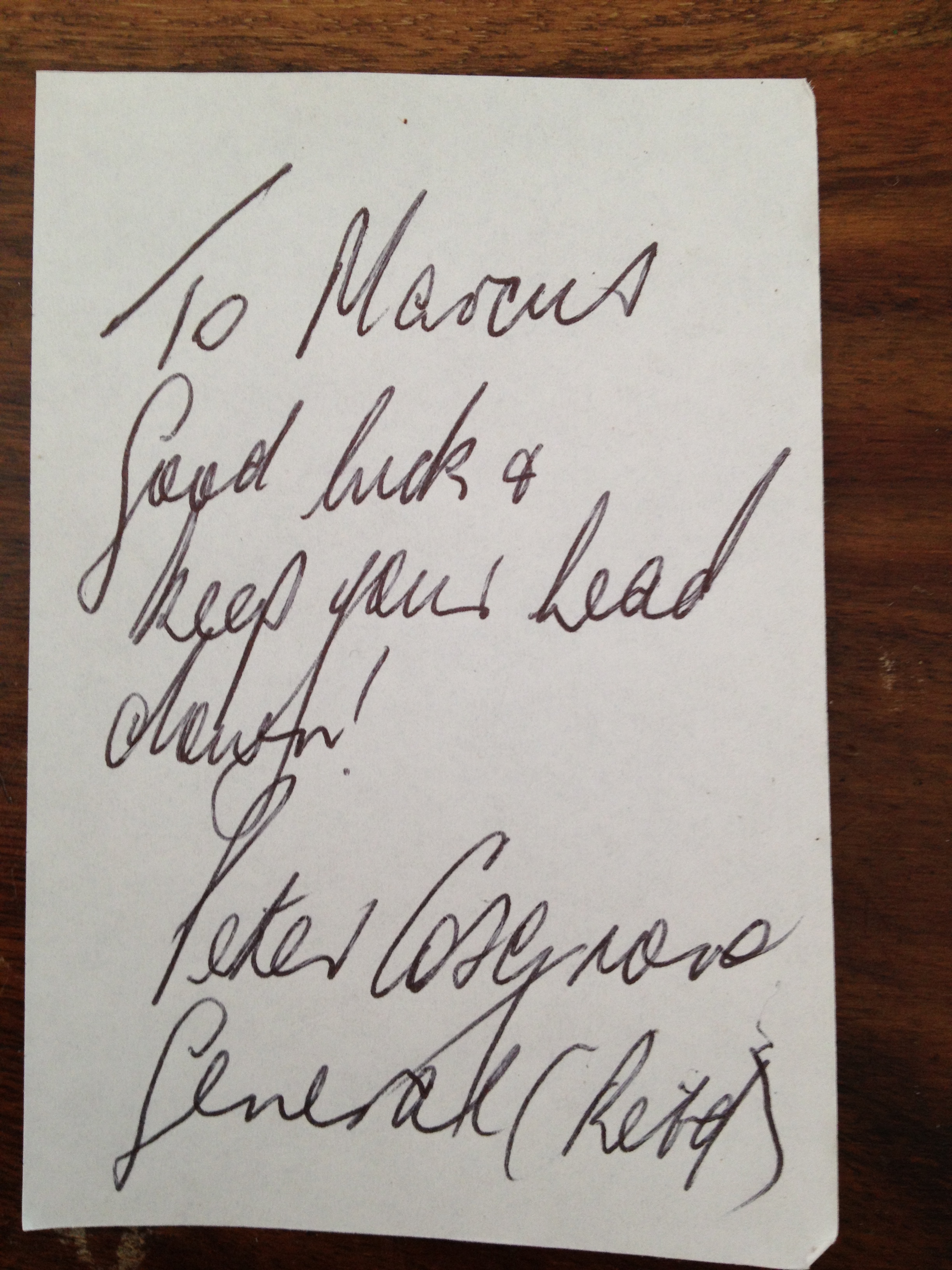
I have a note from Peter Cosgrove.
It was written to a junior airman who was about to deploy to the Middle East for the first time, a young man with his pack on and his stomach in knots, walking toward the kind of unknown that no briefing can prepare you for. The note was short. Few words, and a name.
“To Marcus,
Good luck & Keep your head down.
Peter Cosgrove – General (Ret’d)”
That serviceman was me.
I have thought about those four words for years, and here is what I’ve come to understand. He didn’t write make me proud. He didn’t write be a hero. He didn’t reach for anything grand, though no Australian alive had more right to the grand register than he did. He wrote the oldest sentence in the soldier’s language, the one diggers have been saying to each other since Gallipoli, and in the soldier’s language it means everything at once. It means be careful. It means stay humble. It means do your job, look after your mates, and come home. It is a whole philosophy of service folded into something small enough to carry in a breast pocket.
And it means one thing more, which I only understood writing this essay. Keep your head down is the promontory’s instruction. Don’t posture above the waves. Don’t perform for the storm. Set yourself low and solid and let the sea do its worst, because the ones who keep their heads down are the ones still standing when the water clears, and standing is the whole assignment.
A man at the summit of Australian life took a moment to steady one young serviceman he would never command, headed to a war that would never make him famous. That is who he is when nobody is watching. The character was the same at every altitude.
I kept my head down, I came home. And everything I now build, for my family, for the young people we teach, for anyone whose room is shaking, is, in some quiet way, downrange of men like you.
To Those Who Are Tired of the Shaking
Maybe that’s you tonight. Maybe the waves I mentioned at the start aren’t abstractions in your house, maybe they’re the mortgage, the diagnosis, the fractured friendship, the country that feels like it’s arguing with itself in every room you enter.
Hear the teaching one last time, because it was written for you.
You cannot calm the sea. Cosgrove never calmed a single storm, not in Vietnam, not in Dili, not in Innisfail. The storms raged exactly as long as storms rage. What he did was simpler and infinitely harder: he became the thing in the storm that could be trusted not to move. And around that fixed point, frightened people found their bearings. Soldiers. A newborn nation. A flattened town. A grieving country.
The steadiest person in the room becomes the room’s centre. Someone is going to be that person in your room, your home, your workplace, your team, your street, in this rocky season.
Why shouldn’t it be you?
Begin This Week
This series never ends with admiration. Admiration is cheap. It ends with assignments. Here are yours, three, specific, this week:
1. Choose your non-negotiables before the next storm. Tonight, take a page of your journal and finish this sentence three times: “No matter what this season does, I will not move on ______.” Your patience with your kids. Your integrity at work. Your training. Name the things in you that the weather is not allowed to touch. A lighthouse decides where it stands before the fog comes in.
2. Thank a promontory. Somewhere in your life is a steady person you navigate by, and steady people almost never get thanked, because steadiness is invisible until it’s gone. This week, tell them. Name what their steadiness has meant. One message. Send it before Sunday.
3. Do one Innisfail. One act of unglamorous, unwitnessed service, the kind with no medal, no audience, no post. Help someone rebuild something this week, even something small. Because the lesson of Cosgrove’s life is brutally simple: the nation only calls at seventy-two the kind of person who answered at twenty-two. Your future summons is being decided by this week’s small yes.
This Is Bigger Than One Essay
The Arete Heroes Series is one part of something we’re building, a movement to put character back at the centre of how we raise, coach, teach and lead the next generation.
If this essay resonated, start here:
• The Lighthouse Doesn’t Chase the Ships — An essay about Fortitude — and the radical decision to stop chasing and start shining.
• When Hercules Wore Navy — Part I of the Arete Heroes Series: Anthony Koutoufides, and the excellence that only storms can reveal.
• What the Ocean Gave Back — Part II: Layne Beachley AO, and what it costs to keep paddling back out.
• The Whole Man — We told boys who not to be. We never told them who they could be.
Listen. The Arete Path Podcast takes these ideas deeper, myth, philosophy and real stories of character under pressure. Season One is coming. Follow us so you don’t miss the first episode.
Bring Arete to your school or club. Our Wisdom & Wonder curriculum and The Sculptor’s Journey coaching framework help young people develop the six virtues, Fortitude, Wisdom, Love, Courage, Temperance and Gratitude, through real-world practice, not lectures. If you work with young people, reach out. We’d love to talk.
Connect. Find us at www.areteestate.com.au or write to me directly at marcus@areteestate.com.au. I read every message.
The Arete Heroes Series is a portrait of modern lives that embody the ancient pursuit of excellence. These are not profiles of perfection. They are stories of people whose Arete, their highest character, was revealed by the storms they refused to run from.

Written by Marcus J Emsley, The Guide, at Arete Estate in the Barossa Valley. First published 11 June 2026.
Excellence revealed by storms.

Responses