
Love · A father is not a lifeboat. He is the light the boat steers by.
“From my father: gentleness of temper, and an unshakeable steadiness in what he had once decided.” (Marcus Aurelius, Meditations)
This essay is set for every chair at the Father’s Day table. For the one who will ring his father this morning and get the usual three-minute call that says everything without saying it. For the one whose father is a grave, and who will visit it, or not, and carry the day quietly either way. For the one whose father is a blank, a name on a form or not even that, and who has learned to treat the day like weather. For the mother who is doing both jobs and wonders every year whether she is enough. For the daughter, who is watching too, and learning what a good man’s steadiness looks like. For the man with no children who has never once thought of himself as anyone’s light. And for my Pop, Donald Raggatt, for my father, and for Sean: each a lighthouse on the shore.
All of you are in this essay, because Father’s Day was never only about fathers. It is about the light on the shoreline, who stands there, and what the light is for.
The Boy on the Shore
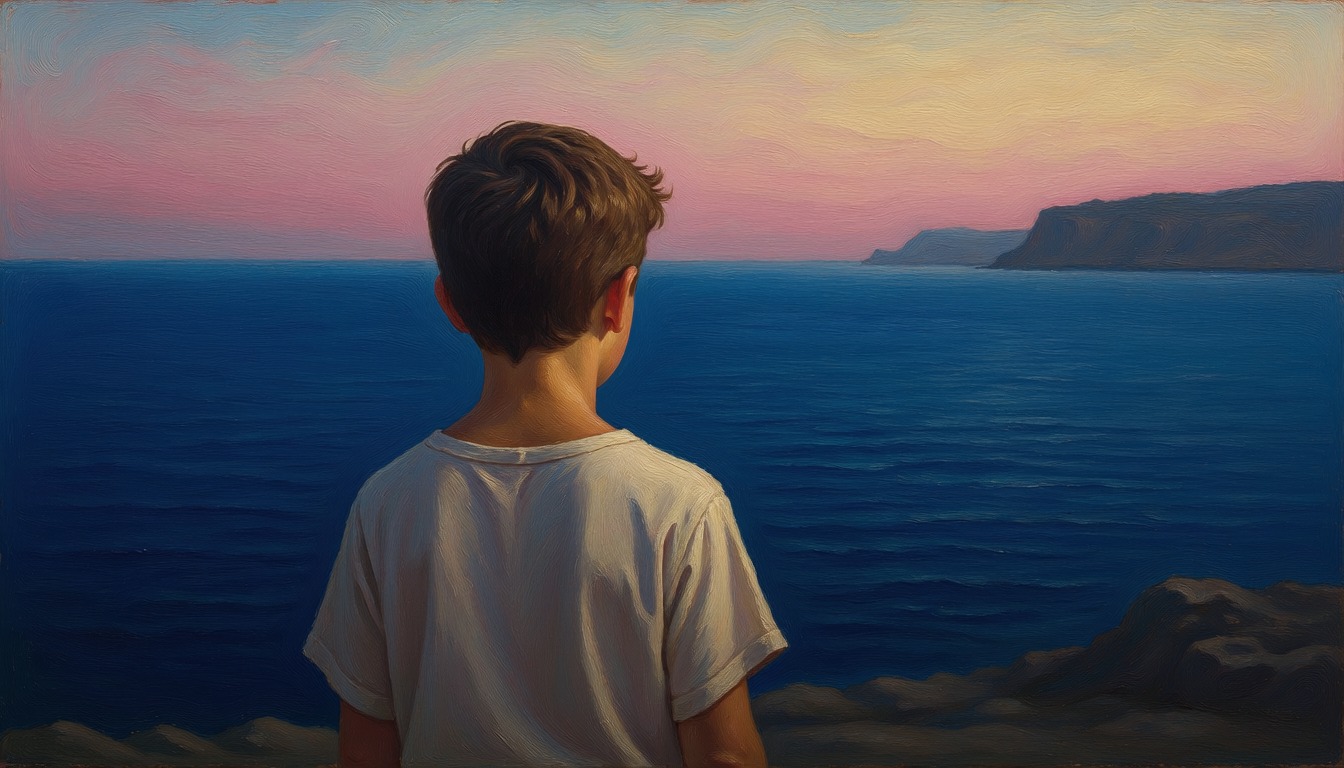
Start with a boy standing on a beach three thousand years ago, looking at an empty sea. His name is Telemachus. His father sailed for Troy when he was a baby and has not come home, and the boy is now twenty, raised by his mother in a house full of men who want her and despise him. He is, in the oldest word we have for it, fatherless. And this is what the Greeks did with that boy, because it is the most hopeful thing in the whole of Homer. They did not leave him alone on the sand. Before Odysseus sailed, he had asked an old friend to watch over his household and his son. The friend’s name was Mentor. And when the goddess Athena decides the boy must finally become a man, she does not appear as a goddess and she does not conjure up his father. She takes the shape of Mentor. She stands beside the boy on the shore and tells him to stop weeping, gather a crew, and go and find out who he is.
Sit with what that story is saying, because it was written for every fatherless child who has ever lived and it has been waiting for you. The word mentor, the one we use for every coach and teacher and steady adult who ever believed in a young person, was born from an absent father. The Greeks knew something we keep forgetting: the boy does not need his father to come home in order to become a man. He needs someone to stand on the shore. Telemachus grows up in a single voyage because one steady figure said the words a father says. And when Odysseus finally returns, he finds not a boy but a man standing beside him, shield to shield, and they take the house back together. That is the whole architecture of hope for the reader whose father is a grave or a blank. The light does not have to come from the father. It has to come from somewhere. And somewhere is a thing you can find, and, one day, a thing you can be.
The word mentor was born from an absent father.
Ask yourself: who stood on your shore when your own father could not, and have you ever told them what they were?
Every Child Needs a Lighthouse
The people who have spent their lives working with young people keep arriving at the same finding, and it is the finding the Greeks reached on that beach. Every child on the road to adulthood needs at least one steady adult beyond their parents who truly cares about them, believes in them, and will always have their back. One safe human. That is the minimum, and the child without one, the untethered one, is the one most likely to get lost on the way. Fatherhood matters enormously here, and so do father figures, which is not the same thing and is the whole hope of this essay: the grandfather, the uncle, the coach, the teacher who keeps a jar of pencils on the desk for the kids who arrive without them. Those figures are a person standing on a shore. What this estate calls the lighthouse is the posture they stand in. The same light, seen from two sides of the water.
And we should be unsentimental about what boys actually need, because our age has grown nervous of it. Boys need rough-and-tumble play, the wrestling and the chasing and the being thrown in the air, because that play is where a boy learns boundaries: how strong he is, when to stop, what another person’s no feels like in his body. Boys have tender hearts, far more tender than the world lets them show, and they grow best not under shame and harshness but under understanding and clear expectations. And they need to be surrounded by stories of good men. Not perfect men. Good ones. Men whose strength has a direction. This is not a boys-only truth, either. Every daughter watching a good father learns two things at once: what steadiness looks like in a man, and what she has every right to expect from one. The lighthouse does not check who is in the boat before it shines.
Ask yourself: which young person, boy or girl, is steering by your light right now, whether you have noticed or not?
The Sea We Tried to Drain
Now the hard part, said carefully, because this essay is a celebration and not a complaint. Somewhere in the last generation we noticed that some men were storms, and we drew the wrong conclusion. We decided the problem was the sea. So we tried to drain it: to quiet the roughness out of boys, to treat their fire as a fault, to teach them that the safest kind of man is the smallest kind. But the fire was never the problem. Aimed, courage, protection and drive are the finest things a man can carry. Unaimed, they curdle. The Greeks did not fear a boy’s fire; they gave it a forge and a master. Achilles had Phoenix. Telemachus had Mentor. Every hero in the old stories had an older hand on his shoulder saying, this way, not that way, here is what your strength is for.
And where there is a void, something always fills it, and what fills it is whatever is loudest. The answer was never less masculinity. It was better men, closer, more present, with a calm voice and a steady hand, and stories of good men told at every table. Balance does not come from subtraction. It comes from role models, heroes, and light.
We tried to drain the sea to stop the storms.
Ask yourself: which good man’s story have your children heard from you this year, and which one is overdue?
Not the Water. Not the Dark.
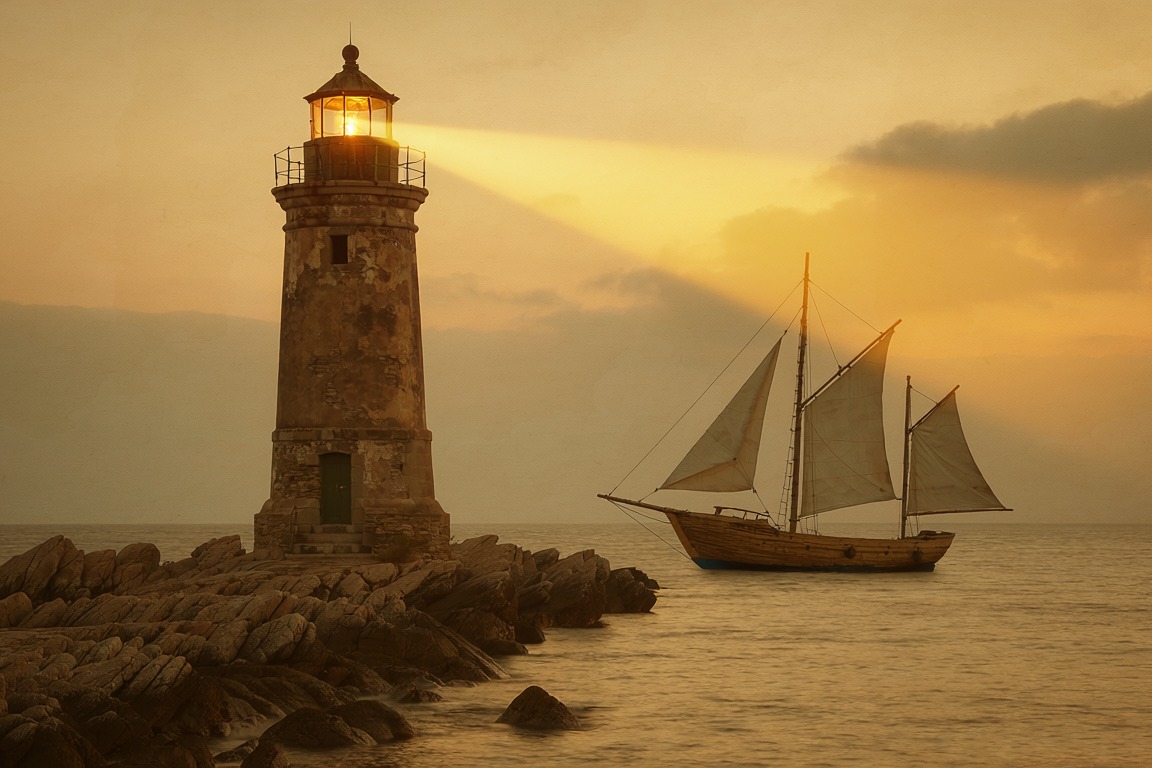
So what is a father for? This is the estate’s answer, and it will sting a little, because it means giving up something most of us want. A father is not a friend. He can be warm, he can be funny, he can be the first person his son calls, but he is not a mate, and the moment he tries to be one he has dimmed his own light to seem more approachable, and the ship loses the thing it was steering by. A father is a role model, a guide, a mentor: the lighthouse on the shoreline, and the sea in front of him is his children’s lives. He does not command the sea. He cannot calm it. His whole job is to stand where the light can be seen and keep it on.
A lighthouse can fail in exactly two ways, and every father alive has felt the pull of both. The first is to jump into the water: to swim out and steer the boat yourself, to fix the friendship, finish the assignment, fight the coach, absorb every storm so the child never learns they can sail through one. It feels like love. It is fear wearing love’s coat, and the child who is never allowed to steer never learns they can. The second failure is to turn the light away: to be present in the house and absent in the room, face lit by a phone instead of by them; or to be gone altogether, by choice, and to tell yourself they are fine. Between the two failures stands the whole discipline of fatherhood, and it is the hardest thing I know: to stand, to shine, and to let them steer. To watch your child heading into a swell you can see and they cannot, and to hold your light steady instead of your breath, so that when they turn to look, you are exactly where they left you. That is what Marcus Aurelius meant when he thanked his father for gentleness and an unshakeable steadiness. Not a man in the water. Not a man in the dark. A light on a rock.
A father is not a lifeboat. He is the light the boat steers by.
Ask yourself: this year, have you been swimming out to your children, turning the light away, or standing where they can find you?
My Lighthouses
I know what the light looks like because I have been steered by many, but I want to tell you about one of them, and to tell you about him whole, because an essay about good men that only tells the good would be a lie, and he would have known it. My grandfather, Pop, Donald Raggatt, was born on the sixth of September 1926. If he were with us this Father’s Day he would be cutting a cake with a century of candles on it and pretending not to enjoy the fuss. I knew him for only a small portion of my life. He worked hard, laughed hard, drank hard, and conducted the music like no man I have seen before or since. He had his own demons, the way every one of us does, and he did not always win against them. And still, when I look at his photographs today, the smile in them shines like a lighthouse. That is the strange arithmetic of a life: the light outlasts the weather that beat against it.
He is why the name Raggatt lives in my novel, Wisdom & Wine. I could not write a book about what a life pours out for others and leave his name out of it, and I did not write him in as a saint. I wrote him in the way we should all be remembered: for the good and for the hard, for the music and for the battles, because that is what scars are for. We scar so that we remember what we fought, and what was worth carrying into tomorrow. A lighthouse is not a man without storms. It is a man whose light kept reaching the water anyway. That is the good man I steer by. Not a hero from a film. A man with a laugh you could hear across a paddock, a baton in his hand, and a fight of his own he never fully spoke about, whose light still finds me from a photograph forty years on.
Pop, if you are listening, and I like to think that wherever you are you have found something to conduct, that there is an orchestra somewhere and a garden somewhere and you are standing in the middle of both with your arms raised and everything blooming in time: I hope we have made you proud. Your children, and their children, and theirs. I hope the estate I am building, with its stories of good men told whole, their storms and their light together, and its lamp always on, is the kind of thing you would have nodded at and said, quietly, that’ll do. Happy birthday, old man. Your light is still on. It moved into us.
The lighthouses we loved do not go dark. They move into us.
Stand. Shine. Let Them Steer.
As I wipe my own tears away, I remember that this is a Father’s Day essay, so it ends with something to do on the day, for every chair at the table.
If you are a father: put the phone face down for the whole day. Tell your children one story of a good man you knew, and what he did. Then find one thing today you would normally do for them, and let them do it, while you stand where they can see you. That is the lighthouse working.
If your father sits in the grave: say his name aloud today, maybe light a candle, and tell them one thing he taught you. The light moved into you. Let someone else see it burning.
If your father is a blank: you are Telemachus, and the story is yours. Name the person who stood on your shore instead, the coach, the uncle, the teacher, the neighbour, and if they are alive, tell them today what they were. Then decide whose shore you will stand on. The boy without a father is not sentenced to the dark. He is handed a light and asked to carry it further.
If you are a mother doing both jobs: you are already a lighthouse, and you were never meant to be the only one. Recruit: the grandfather, the uncle, the coach, the good man next door. Ask one of them today, plainly, to be a steady figure in your child’s life. Good men are waiting to be asked. Most of them have never been, or are now too worried to step forward.
If you are a daughter: watch, and choose the light, not the noise. The men worth steering by are the steady ones on the rock, not the loud ones in the water.
And if you are a man with no children of your own: look around. Somebody smaller or newer or more lost than you is already steering by your light, and you have not noticed. Notice today. Stand a little straighter. Keep it on.
Everything at Arete Estate is built on this one conviction: that character is handed on by steady figures telling old stories to young ones, and that no one walks it alone. The lamp is lit. Come in when you are ready. And today, wherever you are standing, be the light on the shoreline. Not the water. Not the dark. The light.
Excellence revealed by storms.
For the Young Ones
The same truth, made small enough to hold. To be read aloud.
Have you ever seen a lighthouse? It stands on the rocks at the edge of the sea, tall and still, and every night it shines its light out over the water. This is the clever part: the lighthouse never goes out to the boats. It cannot. If it climbed down off its rock and swam out to help, the boat would have no light left to steer by, and both of them would be lost. So the lighthouse does the bravest thing there is. It stays. It shines. And it trusts the sailor to steer.
Your dad, or your grandad, or your uncle, or your coach, or the grown-up who always turns up for you, is a lighthouse. Their job is not to sail your boat for you. Their job is to stand somewhere steady, keep their light on, and believe you can steer. Sometimes that looks like letting you try something hard. Sometimes it looks like a hug at the end of a rough day. Both are the lighthouse doing its work.
And this is the secret for you: one day, you will be a lighthouse too. Somebody smaller will be out on their own dark sea, looking for a light. Stand steady, keep it on, and they will find their way.
A Father’s Day Practice (and the Grown-Up Goes First)
Play “My Lighthouses” at the table today. Everyone names the people who are lighthouses for them: the ones who stand steady and keep their light on. Grown-ups, you go first, and name one from when you were small, and say what they did. Then the young ones. Then the game turns around: name one person you are a lighthouse for, someone smaller or newer who steers by your light. If Dad is not at the table today, for whatever reason, this is the game that puts his light back in the room: say his name, say one thing he taught you, and keep it on.
About the author
Marcus J Emsley · The Guide
Marcus spent seventeen years as a welfare officer in the Royal Australian Air Force, at home and on operations overseas, sitting with people in grief, trauma and the mornings they did not want to rise. He is the founder of Arete Estate in the Barossa Valley, South Australia, the creator of The Sculptor's Journey and Wisdom & Wonder, and the author of the debut novel Wisdom & Wine. He is the son of a primary school teacher who coached footy, cricket and life, and a palliative care nurse who showed him what kindness at the hardest door looks like. He has stood in the dark himself, and he writes from the far side of it.
What we are building at Arete Estate
Arete is excellence becoming. It is the highest expression of who you were always meant to be, not the finished version, but the version that keeps reaching. It is not built. It is revealed.
Arete Estate exists to help people reveal, not construct, the highest version of themselves. We do this through six virtues drawn from the world's wisdom traditions, taught through stories, walked through daily practice, and offered to anyone who is ready to begin: the parent raising a child, the leader carrying a team, the soldier returning from service, the school shaping the next generation, the person sitting alone in the early hours of the morning wondering if there is a path through.
Our work is to make that path visible. To stand as a lighthouse for the seekers, the grieving, and the broken. To remind every person we reach that excellence is not built, it is revealed by storms, and that they are not alone in the storm.
We do not chase. We shine. The Sculptor's Journey (The Doorway, The Walked Path, The Guided Path), An Hour with the Guide, Meditate with Arete, Wisdom & Wonder and The Sculptor's Library are the rooms of that house.
Six virtues. One journey. Your highest self.
www.areteestate.com.au · info@areteestate.com.au · Instagram @areteestate
If this essay touched something raw
Some of what is written here is heavy. If it has stirred something you are carrying, please do not carry it alone tonight.
Lifeline 13 11 14 · Open Arms (veterans and families) 1800 011 046 · 1800RESPECT 1800 737 732 · Kids Helpline 1800 55 1800 · In an emergency, call 000.
Reaching out is not weakness. It is all six virtues at once: the Fortitude to stay, the Wisdom to know you need a hand, the Love to let someone in, the Courage to ask, the Temperance to set the weight down, and the Gratitude for the one who answers.

Responses