
Love · Stop hacking at heads. Meet the root, and let a second hand in.
“People are disturbed not by things, but by the views they take of them.” Epictetus
Some fights never leave the house. There is a voice that has been arguing with you about you for as long as you can remember. You know its timbre better than any voice on earth. Not clever enough. Not far enough along. Not the body, not the title, not the life it decided you should have by now. So you fight it the only way anyone ever taught you: you achieve at it. You lose the weight. You win the promotion. You run the marathon, buy the house, prove the case. For a week the house is quiet, and you allow yourself the word: finally. Then Monday comes, and the voice is back at the table, unmarked, with new paperwork. It’s not enough. You’re not enough. The Greeks knew this fight three thousand years ago. They dragged it out of the human chest, put it in a swamp, gave it nine heads, and hid inside the story the only strategy that has ever ended it. It is not what you think. And it cannot be done alone. That is not a weakness in the plan. In an age as lonely as ours, it is the plan.
The Voice You’ve Beaten a Dozen Times
Count your victories over it. There have been many. The qualification it said you would never finish is framed on the wall. The promotion it swore you weren’t ready for, won. The weight it mocked, lost. Every one a severed head. And how long did the quiet last? A fortnight? A weekend? The voice does not stay dead. Worse, it comes back with the goalposts already moved. The degree was the easy one. The promotion was luck, and they’ll find you out. Lose five more, then we’ll talk. Somewhere around the dozenth resurrection a colder despair sets in: nothing silences it. I have tried everything. Maybe this is simply the sound of being me.
So we swing harder, because harder is the only setting the modern world sells. Hustle harder, optimise harder, curate harder. More hours, more metrics, more mirrors. And the voice grows fat on every rep. Here is what nobody tells you about the not-enough voice: achievement is not its enemy. Achievement is its food. Every trophy you throw it buys a fortnight of quiet, and teaches it exactly what you will pay next time.
You cut off the head. Two grew in its place.
Ask yourself: where has the voice already moved your goalposts, and what did it cost you in the very seasons you were winning?
The Swamp of Lerna
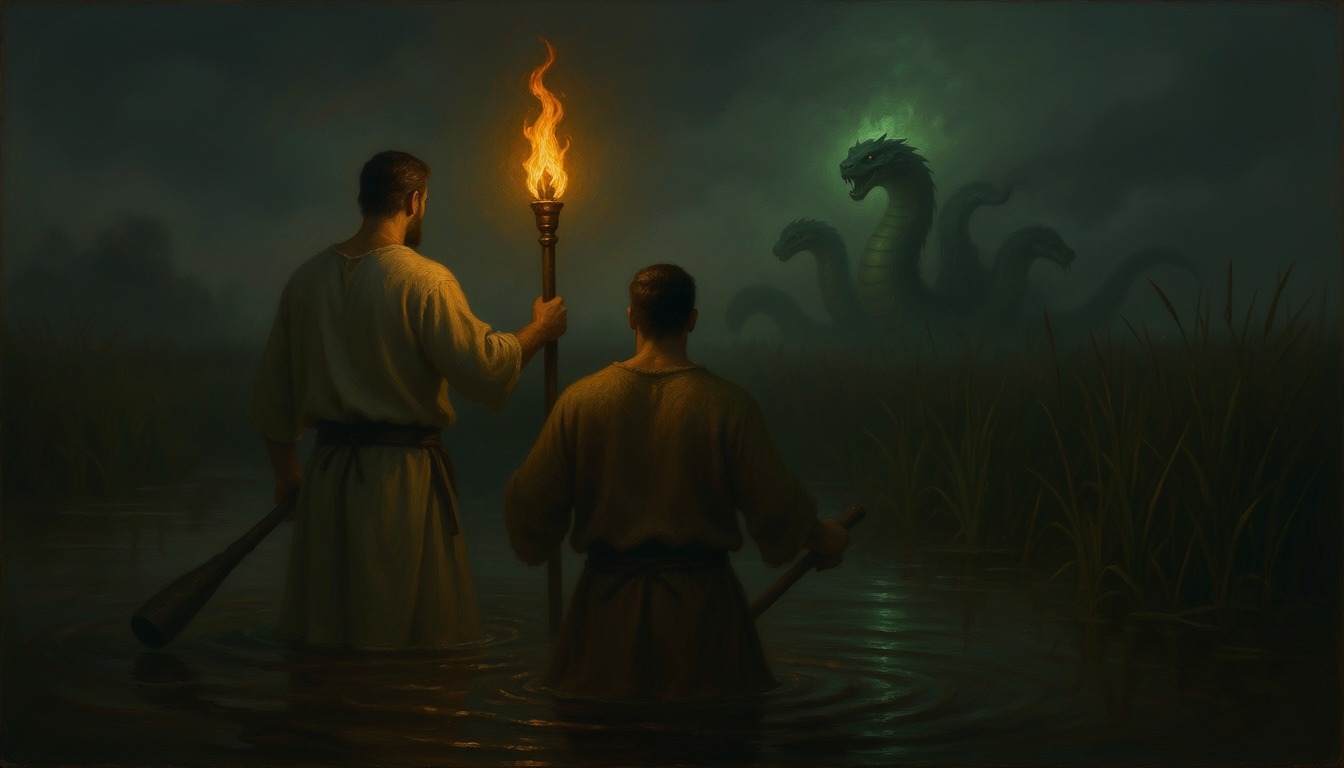
The Greeks knew this fight so well they built a monster out of it. In the swamp of Lerna lived the Hydra, a serpent with many heads and the most demoralising trick in all mythology: cut off one head, and two grew back in its place. Heracles came to the swamp fresh from his victory over the lion, carrying the sword that had never failed him and the strength that had never met its match. The swamp taught him, swing by swing, that both were worthless here. The very air over the water was venom. In this fight, even breathing near the thing cost something, as anyone who has spent a season at war with their own reflection already knows. And watch the mechanics, because they are the mechanics of your inner fight. Every furious stroke doubled his enemy. Every act of force fed the thing he was trying to kill. His strength, the one tool that had never let him down, had become the Hydra’s food supply. Some things cannot be beaten by force, because force is the very thing they eat.
The battle turned on two changes. Two, not one, and both belong to you. First, the target changed. He stopped swinging at the heads everyone could see and took the fight to a different level: to the sealing of what lay beneath them, so that what was cut could not return. Second, he let another hand into the fight. Do not miss this. His nephew Iolaus stood beside him in the poisoned swamp with a burning torch, searing each wound the moment it was made. The old tellers, who missed nothing, even sent a giant crab snapping at the hero’s heels mid-battle. Because that is exactly how it goes: take on your deepest thing, and life will send its distractions anyway. The strongest man who ever lived, and the Labour was not his alone. It could not have been. Different level. Second hand. That is the entire strategy, and it has not aged a day in three thousand years.
Some things cannot be beaten by force. Force is what they eat.
Meet the Root
Here is what the swamp is teaching, said plainly. The not-enough voice grows back because we fight it at the wrong level. The heads are the ones you have been cutting all along: the body, the title, the follower count, the salary band. Hack one off and two grow in its place. A new comparison. A higher bar. Because the life of the thing was never in the heads. It runs below the waterline, in the root. A view, planted so early you mistake it for the floor of the world. I am worth what I produce. Love is earned by performance. If I stop proving, I disappear.
Epictetus named it twenty centuries ago, in a sentence modern psychology has spent a hundred years confirming: we are disturbed not by things, but by the views we take of them. The mirror was never the problem. The view doing the looking is. The job was never the judge. The belief that worth is a scoreboard is. Find the view and you have found the root. And a root, unlike a head, does not grow back once it is truly met. One cut, made at the right level and sealed properly, ends what a lifetime of achieving at it never could.
Stop hacking at heads. Meet the root.
Ask yourself: what is the view beneath your voice, the sentence about your worth planted so early it feels like the floor of the world?
The Torch in Another’s Hand
Now the sealing. Here our age has made things harder in a way no century before us ever managed. The root is precisely the part you cannot see from inside. From within, the view feels like plain reality. Of course worth is earned. Of course they’ll find you out. It takes a second set of eyes. And exactly here the modern world fails us. We have never been more connected, and never more alone. We scroll past two hundred faces a night and go weeks without one conversation that touches the waterline. The devices promised community and delivered an audience. An audience is the worst possible company for a not-enough voice, because an audience is something you perform for. The voice thrives in that seclusion. Its whole power depends on never being contradicted, and in a room of one, it never is.
I watched this for seventeen years in uniform. People of enormous courage carrying the voice for decades, squared away on the outside, under siege within. Then one honest conversation, with the right person, doing what all the medals and promotions never could. Here is the mercy hiding in the mechanics: the not-enough voice cannot survive being said aloud to someone who loves you. Spoken into a safe room, it stops sounding like the truth and starts sounding like what it is. An old view, planted in an old season, repeating itself in the dark. Heracles could have cut heads until the end of the age. It was the torch in another’s hand that ended it. Yours is waiting in someone’s hand too. Community is not a nice-to-have in this fight. It is the cauterising fire.
The voice that says you’re not enough cannot survive being said aloud to someone who loves you.
Ask yourself: when did you last have a conversation that went below the waterline, and who could you have one with this week?
Sit Down at the Water’s Edge
So this week, put down the sword and study the beast like a strategist. Two questions find roots. First: what does my way of fighting this actually feed? Trace one full cycle. Trigger, swing, regrowth. Find the exact moment your effort became its meal. The 11pm scroll through other people’s highlight reels that promises motivation and delivers a bigger Hydra by morning. The verdict after every stumble: behind, blown it, everyone else is further along. It is the verdict, not the stumble, that resets the whole cycle. The fighting style is the food supply, and the fighting style is the one thing entirely in your hands.
Second, and deeper: write the root in one plain sentence. Actually write it. If I stop achieving, I will stop mattering. I am only as good as my last result. If they saw the real me, they would leave. Roots hate daylight. Half their power is in never being written down. Then comes the second hand. Take your sentence to a real human being. Not a feed. Not an audience. A face. The counsellor whose entire craft is sealing exactly these wounds. The mate who has met their own voice. Say it aloud, and let a second set of eyes confirm what you already half-suspect: it is a view, not a law. A story, not a sentence. Cut once, there, together, and stand back amazed at the quiet.
One last detail from the old story, because the Greeks were too honest to leave it out, and I will not either. The Hydra’s final head was immortal. It could not be killed. Not by Heracles, not by anyone, ever. So the hero did not kill it. He buried it beneath a great stone and walked out of the swamp into the rest of his life. Keep that, because it is the truest thing mythology ever said about the voice: some heads are not erased. They are outranked. A day may come, years into your healing, when you hear a murmur from under the rock. It will frighten you far less than it used to. A memory sealed beneath a stone you placed is not a monster loose in your swamp. It is weather from an old season, and you are the one holding the torch now.
Name your Hydra. You will not carry the torch alone; that is the whole promise of The Sculptor’s Journey, learning to fight at the right level, in the right company, beside people who refuse to let each other swing alone in the dark. The lamp at Arete Estate is lit. It will not chase you. It will keep burning, like every good torch, until you are ready. Come in when you are. The swamp is easier with company.
Excellence revealed by storms.
For the Young Ones
The same truth, made small enough to hold.
Have you ever pulled a weed? Here is the tricky thing about weeds. If you grab the leafy top and yank, it snaps off in your hand, and the garden looks tidy for a week. But the weed isn’t gone. Down in the dark, under the soil, the root is still there, drinking away, and before long, up comes the weed again, right in the same spot. Sometimes two come up where there was one! You can pull tops all summer and never win. The gardeners who really beat weeds do something different. They dig down, find the root, and take the whole thing out. Then it never comes back.

Problems can be exactly like weeds. Maybe you keep having the same argument with your brother. Or the same worry keeps coming back at bedtime. Or you keep making the same mistake even though you promised you wouldn’t. If a problem keeps growing back, it usually means we’ve only been pulling the top, and the root is still under there. The root is the reason underneath: the worry under the argument, the scared feeling under the mistake.
And here is the best secret of all: root-digging works better with two people. Even Heracles, the strongest hero in all the old stories, could not beat the nine-headed monster alone. His nephew stood beside him with a torch, and together they did what neither could do apart. So when a problem keeps coming back, you don’t have to dig alone. Grab a grown-up you trust, and dig together.
A practice, and the grown-up goes first
Tonight at the table, play “Tops and Roots”, and grown-ups, you go first. Tell them about one problem in your life that kept coming back no matter how many times you fixed it, and what was really underneath it, down at the root. Then it’s their turn: what keeps coming back for you? And what do you reckon is under it? Dig gently; no fixing, just finding. And if the weather’s good this week, go out to the garden together and dig one real weed. The whole thing, root and all. Hold it up. That is what winning actually looks like.
About the author
Marcus J Emsley · The Guide
Marcus spent seventeen years as a welfare officer in the Royal Australian Air Force, at home and on operations overseas, sitting with people in grief, trauma and the mornings they did not want to rise. He is the founder of Arete Estate in the Barossa Valley, South Australia, the creator of The Sculptor's Journey and Wisdom & Wonder, and the author of the debut novel Wisdom & Wine. He is the son of a primary school teacher who coached footy, cricket and life, and a palliative care nurse who showed him what kindness at the hardest door looks like. He has stood in the dark himself, and he writes from the far side of it.
What we are building at Arete Estate
Arete is excellence becoming. It is the highest expression of who you were always meant to be, not the finished version, but the version that keeps reaching. It is not built. It is revealed.
Arete Estate exists to help people reveal, not construct, the highest version of themselves. We do this through six virtues drawn from the world's wisdom traditions, taught through stories, walked through daily practice, and offered to anyone who is ready to begin: the parent raising a child, the leader carrying a team, the soldier returning from service, the school shaping the next generation, the person sitting alone in the early hours of the morning wondering if there is a path through.
Our work is to make that path visible. To stand as a lighthouse for the seekers, the grieving, and the broken. To remind every person we reach that excellence is not built, it is revealed by storms, and that they are not alone in the storm.
We do not chase. We shine. The Sculptor's Journey (The Doorway, The Walked Path, The Guided Path), An Hour with the Guide, Meditate with Arete, Wisdom & Wonder and The Sculptor's Library are the rooms of that house.
Six virtues. One journey. Your highest self.
www.areteestate.com.au · info@areteestate.com.au · Instagram @areteestate
If this essay touched something raw
Some of what is written here is heavy. If it has stirred something you are carrying, please do not carry it alone tonight.
Lifeline 13 11 14 · Open Arms (veterans and families) 1800 011 046 · 1800RESPECT 1800 737 732 · Kids Helpline 1800 55 1800 · In an emergency, call 000.
Reaching out is not weakness. It is all six virtues at once: the Fortitude to stay, the Wisdom to know you need a hand, the Love to let someone in, the Courage to ask, the Temperance to set the weight down, and the Gratitude for the one who answers.

Responses