
Love · You do not bounce back. You are remade.
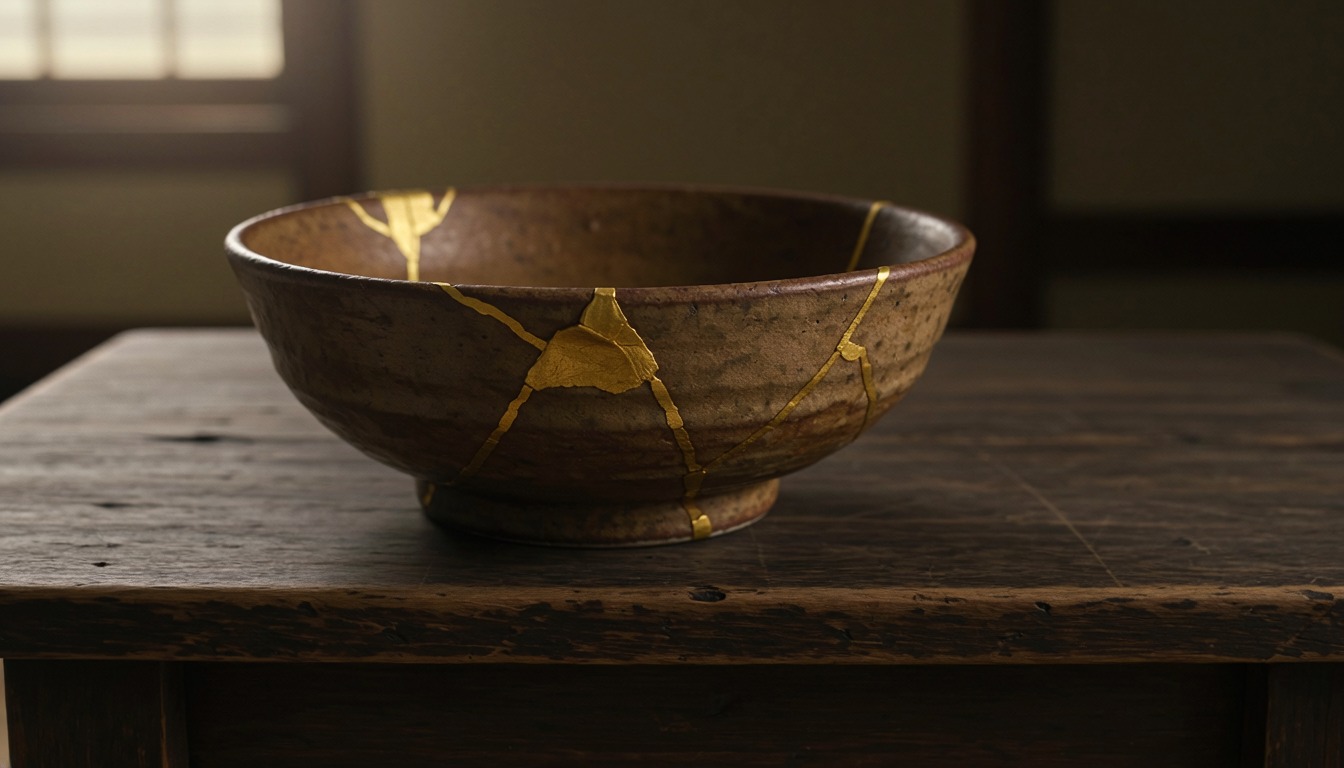
“The world breaks everyone, and afterward many are strong at the broken places.” (Ernest Hemingway, A Farewell to Arms)
There is a version of you from before. Before the diagnosis, the divorce, the phone call. The one who laughed without effort, slept through the night, made plans without bracing for them to break. And some part of you has been trying to get back to that person ever since, as if healing were a road running backwards, as if the whole point of surviving were to end up unmarked. Much of what I write is about standing in the storm. This essay begins after it passes, among the pieces, with a five-hundred-year-old answer to a question nobody asks out loud: what do you do with a broken thing you still love? The Japanese answer will change how you see every crack in your life.
The Japanese, they poured gold into theirs.
The Gallery of Unbroken Bowls
Somewhere this weekend, at a barbecue in an ordinary backyard, a man will say “all good, mate, she’ll be right,” with a beer in his hand and a marriage in ruins behind his ribs. Watch his hand, not his face. The knuckles whitening a little around the bottle when someone mentions wives. Eighteen months he has carried it, carried it the way you carry something broken inside your chest: carefully, constantly, so the pieces don’t shift. Nobody at that table knows. Not because they don’t care, because he has become a craftsman of concealment: the angled bowl, the deflecting joke, the subject changed with a tradesman’s efficiency.
And across town, at a kitchen bench, a woman is laughing at a comment that should never have been made, the little remark dressed up as a joke, the one that found the exact crack it was aimed at. Watch her too. The half-second where her eyes go somewhere else. The small breath she takes before the laugh arrives. She is pushing the hurt down where she pushed all the others, one on top of another, year on year, a whole cellar of swallowed comments sealed beneath a smile that holds like a dam wall. She should not have to accept it. She knows she should not have to accept it. And she will be lovely all afternoon.
Where did they learn it, these two magnificent, breaking people? Where we all learned it. Every feed is a wall of unbroken bowls: the renovated kitchen, the anniversary post, the finish-line medal. Nobody posts the diagnosis. Nobody posts the third night on the couch. Nobody posts the comment swallowed at the bench. And the gallery teaches its one lesson a hundred times a day without ever saying a word: breaks are private failures, and healed means invisible.
So every shattering, in the gallery’s world, costs twice. First the break. Then the long second tax: years of strength spent keeping the seam out of the light, his hand steady on the bottle, her laugh landing right on cue. And for all that spending, the gallery offers exactly one picture of healing: back to normal. As if breaking were damage to be undone. As if the best a life could hope for was a well-hidden join and a story never told. But hear it plainly: back to normal is not healing. It is taxidermy, the outward form kept, the living thing gone. And these two people, spending their whole strength hiding their seams, have nothing left for the one thing the seam is actually asking for. Which was never concealment. It was gold.
Ask yourself: how much of your strength is going into keeping one seam out of the light right now?
The Golden Repair
In the fifteenth century, the story goes, the shogun Yoshimasa dropped his favourite tea bowl. He sent it all the way to China for repair, the finest workshops in the world, and months later it came back mended with metal staples, riveted together like a bucket. Functional. Joyless. A treasured thing fixed the way you would fix a fence. The craftsmen of Japan looked at that stapled bowl, and something in them refused. A treasured thing, they decided, deserved a mending worthy of the treasuring. So when the next precious bowl broke, they gathered every piece, every piece; nothing that was part of the bowl is ever discarded, and mended it, seam by slow seam, with lacquer dusted in gold. Not gold hidden in the joins. Gold declared along them: molten light run down every crack until the breaks became the most luminous thing about the bowl. Kintsugi, they called it. The golden repair.
The gold is a sentence, and it says three things. The break is not the bowl’s disgrace. The history of a thing belongs to its beauty. This bowl lived, here is where, and we will honour the living in the brightest material on earth. The collectors agreed: the mended bowls came to outrank the unbroken ones, because an unbroken bowl is merely perfect, and perfection has no story. The mending could not be hurried, the lacquer sets in its own time, layer on layer, the patience itself part of the art. And what came off the mending table at the end was never the old bowl restored. It was something the old bowl could not have been.
The bowl is not returned to what it was. It is made into what it could never have been unbroken.
Strong at the Broken Places
Hemingway wrote the line at the top of this essay like a man reporting from inside the wreckage, so read it the way he wrote it, plainly. The world breaks everyone. No exemptions; the unbroken bowls in the gallery are a trick of the light. And afterward many are strong at the broken places. Many. Not all. The whole labour of this essay lives inside that one word, because the gold does not pour itself. Time alone mends nothing. Time alone only settles the pieces where they lie. There are lives that have sat thirty years among their own settled pieces, calling it healed because the dust stopped moving.
And the gold asks one thing before it will run, so let it be said gently: you must grieve the bowl that was. The person from before is gone. That is a real loss, and honouring it is not weakness, it is the first layer of the lacquer. But then watch what the mending makes. The compassion that only shattering teaches. The patience learnt in the long setting. The steadiness of a thing that knows, in its own seams, that it can break and hold. You become able to carry what the unbroken you never could. The bowl that has been mended can be trusted with hotter tea.
You do not bounce back. You are remade.
Ask yourself: what can you carry now (what compassion, what patience, what steadiness) that the unbroken you could never have held?
The Mending Table
Now look once more at the artisan’s workshop, and notice what hides in plain sight: the bowl does not mend itself. There is always a second pair of hands. Always a mending table. Broken things are not asked to reassemble themselves, not in any craft, in any country, in any century. Yet that is exactly what we demand of ourselves after our shattering: alone, door shut, hiding the pieces even from the people who love us, as though asking for hands were a second breaking. I spent seventeen years in uniform watching this up close, men and women who would run toward danger without blinking, who could hold a crew steady through the worst day of its life, and who could not, for the life of them, put their own pieces on someone else’s table. And I will tell you the strongest thing I ever watched a person do. It was not any of the brave things. It was sitting down, at last, and saying: I cannot mend this alone. That is not the moment weakness wins. That is the moment the gold arrives. Do not fight alone. It is the first law of every golden repair: the gold comes by another’s hand as often as by your own.
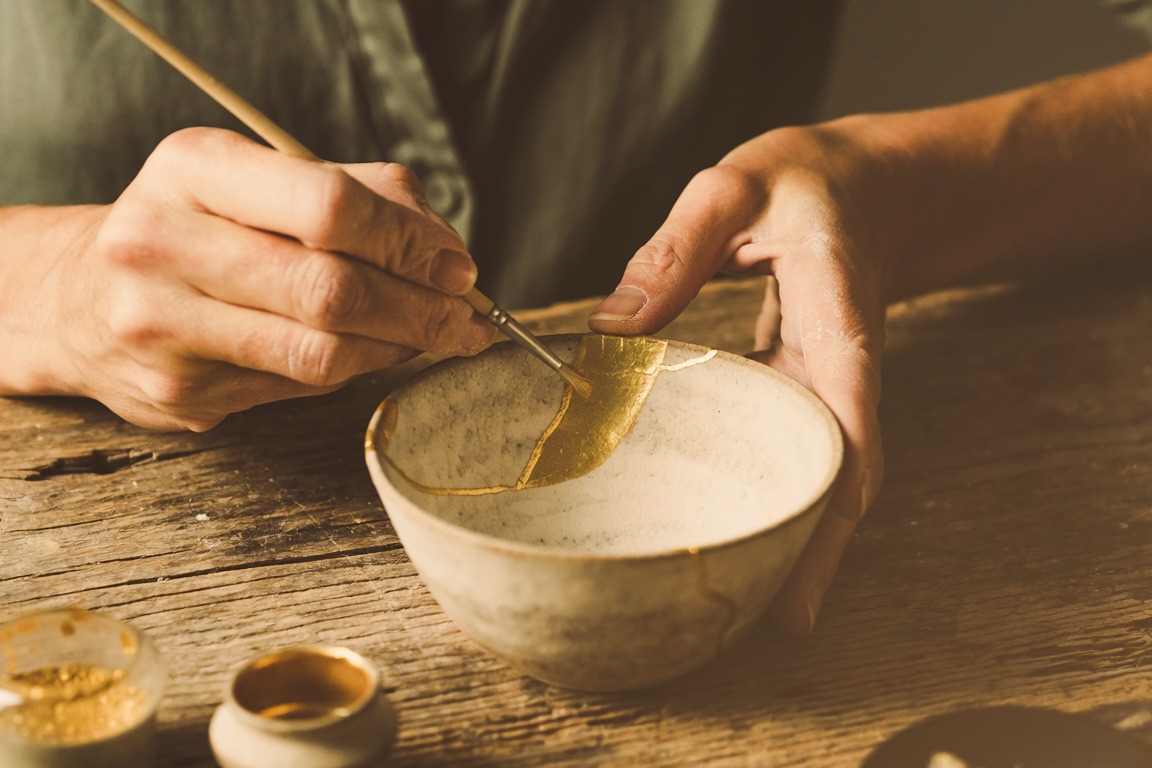
And once poured, the gold is not hidden, that is the bowl’s final teaching, and the one the world most needs from you. You already know it from your own life. Remember the moment someone you respected told the truth of their shattering, the marriage, the breakdown, the failure, plainly, without performance, mended but unhidden. Remember what moved through you as they spoke. Not pity. Permission. Relief. The sudden knowledge that you were not uniquely broken, and that mending is real, because there it stood in front of you, holding its tea. People in the dark do not steer by flawless surfaces. They never have. They steer by light, and light, in a human life, comes through the seams.
People in the dark do not steer by flawless surfaces. They steer by the light through the seams.
Ask yourself: whose open seam once gave you permission, and who, right now, might be steering by yours?
Pour the Gold
So this is the practice, and it is a brave one. This week, choose one break. Not your rawest; the gold runs best where the lacquer has had time. A true one, though, a loss, a failure, a season that cracked you open. And tell the truth of it to one safe person. Not the performance of it, polished for the telling. Not the bleeding of it, either. The truth of it: what shattered. What the shattering cost. What the mend has made possible in you that was never there before. Then watch the room. The leaning in. The breath let out. The answering truth that almost always comes back across the table. Open seams give off light. Yours is ready to.
And if the truer thing is that your pieces are still lying where they settled, the break too recent, or too old and never mended, then your practice is simpler and braver still: find your artisan. One conversation. One safe pair of hands, a counsellor, a wise friend, a professional trained in exactly this lacquer. Broken things are not asked to reassemble themselves. You were never the exception. You were only told you were.
Find your crack. The library lamp at Arete Estate is lit. It will not chase you. It will keep shining, through every one of its own seams, until you are ready. Come in when you are. Bring your pieces.
Excellence revealed by storms.
For the Young Ones
The same truth, made small enough to hold.
In Japan, a long time ago, people worked out something wonderful about broken things. When a special bowl got dropped and cracked into pieces, they didn’t throw it away. And they didn’t hide the cracks, either. They did the very opposite: they glued the bowl back together with gold. Real, shining gold, run along every single crack, so that the mended bowl sparkled in exactly the places where it had broken. And this is the amazing part: people loved those golden-cracked bowls more than the perfect ones. The cracks made them special.
People work the same way. When something goes wrong, you make a big mistake, you lose the game, something sad happens, it can feel like you’re broken, and you might want to hide it and pretend it never happened. But the things that go wrong are where your gold goes in. The mistake teaches you something nobody could have told you. The sad thing makes your heart bigger and kinder. The hard thing makes you braver. You don’t go back to being who you were before. You become someone even better, with gold in your cracks.
So never be ashamed of the places where things went wrong. A person with golden cracks has lived, and learnt, and grown strong in the mended spots. The bravest thing you can ever do is let someone see your gold.
A Practice (and the Grown-Up Goes First)
Tonight at the table, play “The Golden Story”, and grown-ups, you go first. Tell them about one time something broke in your life, a mistake, a plan that went wrong, a sad season, and then tell them the gold: what it taught you, or how it made you kinder or braver. Then it’s their turn: what went wrong for you, and where’s the gold in it? And if you want to make it something they’ll never forget: find a broken plate or an old cracked pot, get a gold paint pen, and mend it together along the cracks. Put it somewhere everyone can see. Every family should own one golden-cracked thing, and know exactly why it’s the most precious bowl in the house.
About the author
Marcus J Emsley · The Guide
Marcus spent seventeen years as a welfare officer in the Royal Australian Air Force, at home and on operations overseas, sitting with people in grief, trauma and the mornings they did not want to rise. He is the founder of Arete Estate in the Barossa Valley, South Australia, the creator of The Sculptor's Journey and Wisdom & Wonder, and the author of the debut novel Wisdom & Wine. He is the son of a primary school teacher who coached footy, cricket and life, and a palliative care nurse who showed him what kindness at the hardest door looks like. He has stood in the dark himself, and he writes from the far side of it.
What we are building at Arete Estate
Arete is excellence becoming. It is the highest expression of who you were always meant to be, not the finished version, but the version that keeps reaching. It is not built. It is revealed.
Arete Estate exists to help people reveal, not construct, the highest version of themselves. We do this through six virtues drawn from the world's wisdom traditions, taught through stories, walked through daily practice, and offered to anyone who is ready to begin: the parent raising a child, the leader carrying a team, the soldier returning from service, the school shaping the next generation, the person sitting alone in the early hours of the morning wondering if there is a path through.
Our work is to make that path visible. To stand as a lighthouse for the seekers, the grieving, and the broken. To remind every person we reach that excellence is not built, it is revealed by storms, and that they are not alone in the storm.
We do not chase. We shine. The Sculptor's Journey (The Doorway, The Walked Path, The Guided Path), An Hour with the Guide, Meditate with Arete, Wisdom & Wonder and The Sculptor's Library are the rooms of that house.
Six virtues. One journey. Your highest self.
www.areteestate.com.au · info@areteestate.com.au · Instagram @areteestate
If this essay touched something raw
Some of what is written here is heavy. If it has stirred something you are carrying, please do not carry it alone tonight.
Lifeline 13 11 14 · Open Arms (veterans and families) 1800 011 046 · 1800RESPECT 1800 737 732 · Kids Helpline 1800 55 1800 · In an emergency, call 000.
Reaching out is not weakness. It is all six virtues at once: the Fortitude to stay, the Wisdom to know you need a hand, the Love to let someone in, the Courage to ask, the Temperance to set the weight down, and the Gratitude for the one who answers.

Responses