
Fortitude · On holding your position when every wave says move.
“Confine yourself to the present.” Marcus Aurelius, Meditations
What cannot be fled must be faced. But I owe you the truth about facing: it is the easier half. Anyone can turn around once, in one brave, burning moment. The half that decides everything, the marriage, the recovery, the comeback, the character, is the part nobody applauds and nobody teaches: what you do in minute two, when the fire dies down and every cell in your body starts screaming one word. Move. This letter is about the discipline that quietly builds every life worth having. The discipline of staying.
When Every Wave Says Move
Let me name something out loud that our whole age has agreed to keep in the shadows. We have become a civilisation of leavers. We ghost. We quit. We scroll past. We abandon the diet by Thursday, the gym by February, the hard conversation before it starts and the commitment the moment it stops being easy. We have built an entire culture around the exit, and then dressed the exit in borrowed robes: moving on, protecting my peace, keeping my options open. Some of that language holds real wisdom, and we will honour it before this letter is done. But beneath it, something has quietly gone missing from the modern soul, and you can feel its absence in your own life without me pointing to where. The old, unglamorous, magnificent discipline of staying.
And the subtlest exit of all is the one we make a hundred times a day: we rarely flee a hard moment with our feet. We flee with our attention, the reach for the phone, the change of subject, the sudden urgent need to be anywhere but here, and we call it coping. Endurance does not trend. Nobody films the person who simply held their post. And yet every life you have ever admired was built on exactly that.
It is a quarter to ten on an ordinary Tuesday night, and you are standing in your own kitchen, two minutes into the conversation you have been avoiding for a year. You finally said the first sentence. It is out. And now the silence is stretching, and your heart is going like a fist on a door, and something is rising through your chest with the force of the sea, and it wants your car keys. It wants the door. It wants anywhere on earth but this room. You know this wave. You have met it a hundred times, in a hundred costumes.
Because it is the same wave at day nine of the change you swore: just this once, it whispers. The same wave halfway through the apology, begging you to soften it, take it back, fill the silence. The same wave at the hard set in the gym, in the grief you finally sat down beside, in the pause before the sharp reply you already know you will regret. Different rooms, same sea. It rises in the body before you have even had a thought, and it carries one message, always the same: move. Leave. Quit. Scroll. Snap. Pour. Anything but here. And hear this, because it is the hinge of the whole letter: most lives are not shaped by their storms. They are shaped by how fast we obey that word.
So let me hand you, right at the start, the secret the wave has kept from you your whole life. It passes. Every wave, without exception, passes. The urge that feels eternal at its crest is gone in minutes, often in ninety seconds, if you simply refuse to feed it. Its entire power is one magnificent lie: that it will last forever. It never has. Not once, in the whole history of waves.
The wave always passes. The question is whether you are still there when it does.
Ask yourself: where does the wave hit you hardest, the moment you most reliably reach for the exit, and how fast do you usually obey it?
The Headland
Now meet the man who stared down more waves than almost anyone who has ever lived, and left us the image this whole letter stands on. Marcus Aurelius wanted one thing from life: a quiet room and a shelf of books. What life handed him instead was the throne of Rome, and with it, nineteen years of everything a soul might reasonably flee. A plague that emptied whole cities. A war that would not end. The graves of his own children. And then, as if the sea were not finished with him, the betrayal of a trusted general who declared himself emperor while Marcus still lived. Any one of those waves would have driven most of us off our rock. He stood in all of them at once, at a freezing frontier post he never wanted, and did not move for two decades.
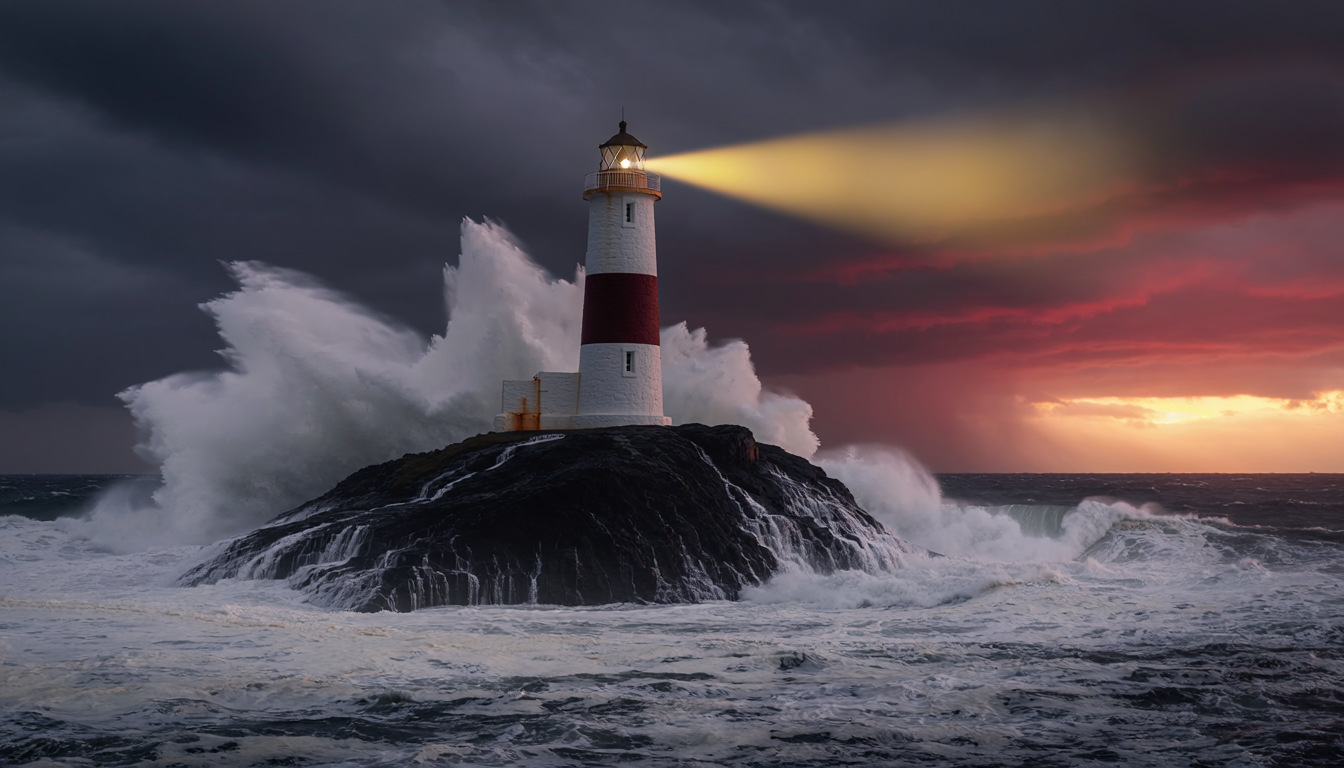
How? Not because he felt nothing; his private notebook is soaked in the waves. But because he had written himself one instruction, and he kept it the way a drowning man keeps a rope: be like the headland on which the waves break and break; it stands firm, and tames the fury of the water around it. Look hard at what the headland actually does, because it is the entire discipline in a single image. It does not fight the sea. It does not chase the waves back out, and it does not argue with the weather. It does exactly one thing: it remains. And in remaining, and this is the part that should raise the hair on your arms, it tames the fury around it. The sea spends itself against what will not move. The wave breaks, foams, slides away beaten, and the rock is still there in the quiet after, unmoved, having thrown not a single punch. Staying is not passive. Staying is the most powerful act on that whole coastline. Everything else out there is just water, obeying itself.
And tucked beside the headland in that same notebook sits the quieter instruction that makes the standing possible, five words that carry the whole secret: confine yourself to the present. Marcus never once asked himself to endure nineteen years. He could not have; no one can. Forever is where courage drowns. He asked himself only to hold his post today, this hour, this wave, this now. That is the hidden architecture of every great act of staying ever performed: it was never one heroic span. It was a chain of small presents, held one at a time, by a person who had stopped negotiating with forever.
And notice what human beings build on headlands. We build lighthouses, set deliberately where the weather is worst, on the very rocks the waves break hardest against, with one purpose: to hold position precisely when everything around them is chaos. A lighthouse cannot flee its storm. It was never meant to. And because it stays, it can do the one thing the storm most needs of it: keep shining. That is the final secret of this whole discipline, the sentence this estate was founded on. You do not stay merely to survive the wave. You stay because somewhere out in that same storm, someone is steering by your light.
The headland does not argue with the sea. It simply remains.
Ask yourself: what has leaving early cost you over the years, and what might ninety more seconds of staying have saved?
The Ship That Held
And if a Roman headland feels a long way from your kitchen, come south, as far south as a human being can go, to the greatest act of staying ever recorded. In 1915, deep in the Antarctic pack ice, the timbers of Ernest Shackleton’s ship began to scream. The Endurance was being crushed, slowly, over days, the ice closing like a fist, until the sea swallowed her whole and left twenty-eight men standing on a drifting floe at the frozen end of the earth. No signal that could reach a living soul. No rescue coming. Hundreds of kilometres of lethal ocean between them and help. Every wave a life can produce, terror, hunger, cold, despair, the slow madness of waiting, broke over those men for the better part of two years.
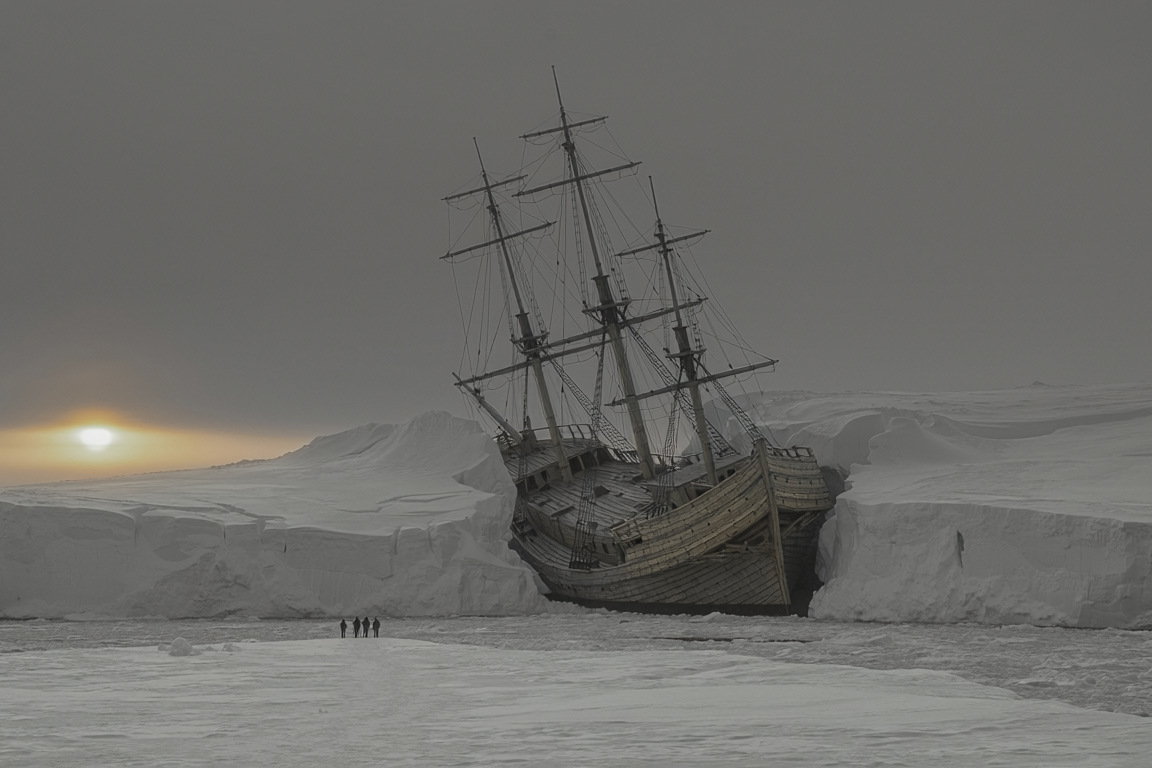
And Shackleton stayed. Not merely in place: in himself. Through every crisis he remained exactly what twenty-seven other heartbeats needed him to be: steady, present, unhurried, certain in his bearing even on the nights he was anything but certain in his heart. His men said afterwards that they lived on his steadiness the way a body lives on bread. And when it was finally over, the ice, the open boats, the impossible crossing, every single one of those twenty-seven men walked home alive. Not one lost. At the centre of one of the greatest feats in human history there is no sword and no speech. There is a man who would not be moved, whose staying became the rock an entire crew stood on. Because that is what this discipline builds at full scale: not just a steadier you. A place where other people can stand.
Ask yourself: who in your life is standing on your steadiness right now, and what does that make worth staying for?
Staying Is Not Stubbornness
Now one thing must be said plainly, between friends, before the practice, because I spent seventeen years in uniform sitting with people in the hardest rooms of their lives, and I will not send this letter into the world without it. The discipline of staying applies to storms, not to harm. Stay in the hard conversation, the honest grief, the slow rebuild, the marriage doing the real work, the discomfort that is forming you. Those are weather, and weather passes, and you are the headland. But a person who hurts you is not weather. A place that degrades you is not a wave. If you are being harmed, truly harmed, not merely stretched, then leaving is not weakness, and staying is not virtue. Sometimes the bravest act of Fortitude is walking out the door and not looking back. Storms that form you are for staying. People who harm you are not. If you are unsure which one you are standing in, do not decide it alone: ask someone wise, someone safe, someone a stretch further up the road. That, too, is strength.
Practise Staying Once
So here is the practice, and I am going to hand it to you like a dare, because this week, the wave is coming for you. It always is. Somewhere in the next seven days you will be two minutes into something hard, and the sea will rise in your chest, and it will say the word: move. And this time, one time, you are going to do something different. You are going to plant your feet and stay ninety seconds past the wave. Not fight it. Not obey it. Just stand in it, breathe slow, and count, while the oldest lie in your life breaks against you and discovers, for the first time, that you are rock.
Ninety seconds. That is the whole ask, and notice what it really is: the emperor’s five words, made physical. You are not promising forever. You are confining yourself to the present, and holding your post inside it, one gust, then the next. One more breath. One more hour. One more day. And on the far side of it you will find what every headland has always known: the wave passed. The sea went quiet. And you are still there, with proof in your own body that the urge was never a command. It was only ever weather. Do it once and you have evidence. Do it a few hundred times across a year, in traffic, in grief, at the hard set, in the pause before the sharp reply, and the waves stop running your life altogether. They still come; they always come. But you are no longer driftwood. You are becoming the headland, the still point your family, your work and your future can build on. That is not a mood. It was never a gift some people got and you missed. It is a discipline, the quiet refusal to abandon your post when the storm is loudest, and it is built exactly one wave, one held now, at a time, beginning with the one already rolling toward you.
Practise staying once, and if you find you want the longer walk that builds it into your bones, wave after wave, that is what The Sculptor’s Journey at Arete Estate is for. The library lamp is lit. It will not chase you across the water; it will simply keep shining until you are ready. Come in when you are, and stay as long as you like.
For the Young Ones
The same truth, made small enough to hold · to be read aloud
Have you ever stood in the waves at the beach? Here is how it goes. A wave comes rolling in, bigger than you, and it pushes you, hard. And if you panic and try to run, the water tangles your legs and down you go. But if you plant your feet, bend your knees, and just hold on, the wave washes right past you. And then, this is the best part, it’s gone. The sea goes quiet again. And you’re still standing.
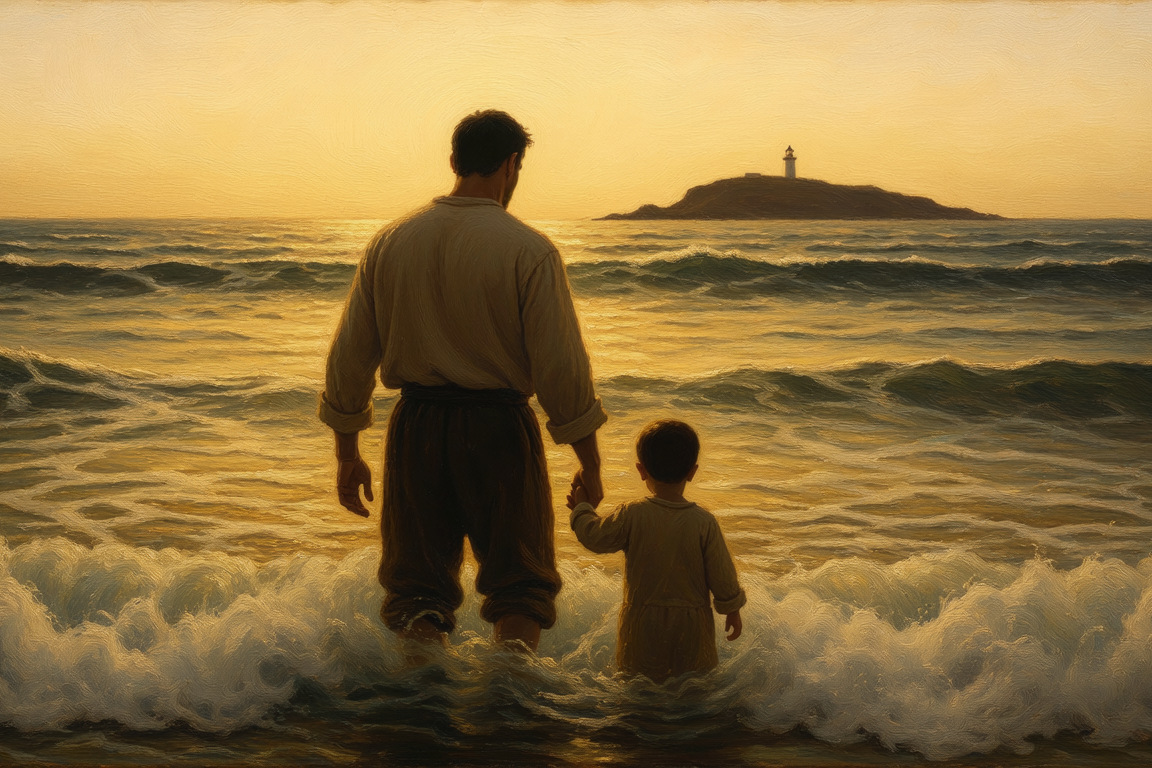
Hard feelings work exactly like waves. When something is tricky, the puzzle won’t work, the reading is hard, you’re cross or sad or scared, a big wave rises up inside you, and it says one thing: give up, run away, stop. It pushes hard. But here is the secret the wave doesn’t want you to know: waves always pass. Every single one. If you can plant your feet and stay just a little bit longer, count to ninety if you like, the wave washes through, and you are still there. Still standing. And a little bit stronger than before.
Staying when it’s hard is not a magic gift. It’s a skill, like standing in the surf. Every time you practise it, your legs get steadier. That is how brave people are made: one wave at a time.
A practice, and the grown-up goes first
Tonight at the table, play “The Wave Game”, and grown-ups, you go first. Tell them about one wave that hit you today, a moment you wanted to give up, snap, or walk away, and whether you ran or stayed. Be honest; they learn more from your honesty than your perfection. Then it’s their turn: what was your wave today? Did it pass? Finish with the secret, said together: waves always pass. You are teaching them the quiet skill that will carry them through every storm of their lives: plant your feet, count slowly, and let it wash through.
About the author
Marcus J Emsley · The Guide
Marcus spent seventeen years as a welfare officer in the Royal Australian Air Force, at home and on operations overseas, sitting with people in grief, trauma and the mornings they did not want to rise. He is the founder of Arete Estate in the Barossa Valley, South Australia, the creator of The Sculptor's Journey and Wisdom & Wonder, and the author of the debut novel Wisdom & Wine. He is the son of a primary school teacher who coached footy, cricket and life, and a palliative care nurse who showed him what kindness at the hardest door looks like. He has stood in the dark himself, and he writes from the far side of it.
What we are building at Arete Estate
Arete is excellence becoming. It is the highest expression of who you were always meant to be, not the finished version, but the version that keeps reaching. It is not built. It is revealed.
Arete Estate exists to help people reveal, not construct, the highest version of themselves. We do this through six virtues drawn from the world's wisdom traditions, taught through stories, walked through daily practice, and offered to anyone who is ready to begin: the parent raising a child, the leader carrying a team, the soldier returning from service, the school shaping the next generation, the person sitting alone in the early hours of the morning wondering if there is a path through.
Our work is to make that path visible. To stand as a lighthouse for the seekers, the grieving, and the broken. To remind every person we reach that excellence is not built, it is revealed by storms, and that they are not alone in the storm.
We do not chase. We shine. The Sculptor's Journey (The Doorway, The Walked Path, The Guided Path), An Hour with the Guide, Meditate with Arete, Wisdom & Wonder and The Sculptor's Library are the rooms of that house.
Six virtues. One journey. Your highest self.
www.areteestate.com.au · info@areteestate.com.au · Instagram @areteestate
If this essay touched something raw
Some of what is written here is heavy. If it has stirred something you are carrying, please do not carry it alone tonight.
Lifeline 13 11 14 · Open Arms (veterans and families) 1800 011 046 · 1800RESPECT 1800 737 732 · Kids Helpline 1800 55 1800 · In an emergency, call 000.
Reaching out is not weakness. It is all six virtues at once: the Fortitude to stay, the Wisdom to know you need a hand, the Love to let someone in, the Courage to ask, the Temperance to set the weight down, and the Gratitude for the one who answers.

Responses