Courage · There is a moment when you stop building what’s impressive, or for other people, and start building what you were actually made for. This is mine.

I want to tell you something I’ve never written down in full.
Not because it’s dramatic. Not because it ends with a lightning bolt moment of clarity or a single conversation that changed everything. It doesn’t. The truth is quieter than that, and slower, and in some ways harder to explain precisely because of that.
But I think it might be the most important thing I can tell you about why Arete Estate exists. Why I write what I write. Why I get up before dawn and work on ideas that most people haven’t asked for yet. Why I walked away from seventeen years of a career that was, by every external measure, exactly what I was supposed to be doing.
This is that story.
The Career
I joined the Australian Defence Force because I wanted to matter.
I don’t say that lightly or with embarrassment. I think the desire to matter, to do something with your life that actually counts for something, is one of the most honest impulses a human being can have. And for a long time, the uniform gave me that. More than gave it. It confirmed it. It placed me inside a structure where purpose was built into the daily rhythm, where the work was serious, where the people around me were facing real things and needed real help.
My role was welfare. For seventeen years I sat with people in the hardest moments of their lives. Grief that had no language. Trauma that had rewritten them from the inside out. Loss so complete that the person across from me sometimes couldn’t remember who they had been before it arrived. Relationships fracturing under the weight of repeated deployments. Young men and women discovering, sometimes for the first time, that the strength they had built in training was a different kind of strength than what life was now asking for.
I was there for all of it.
And I want to say this clearly, because I think it matters: that work was real. It was meaningful. The privilege of sitting with a person in their most unguarded moment, of being trusted with the version of them that no one else was allowed to see. That is not a small thing. That is, I believe, one of the most sacred forms of human work there is.
I was good at it. And I loved it. Which is exactly what made the accumulation so slow. And so difficult. And so undeniable when it finally reached its tipping point.
The Accumulation
It didn’t happen in a day.
It happened in hundreds of days, spread across years, each one adding something small to a weight I was carrying without fully naming. A conversation that ended with me thinking, there is something more I should have been able to give this person. A moment in a session where I could see exactly what someone needed, not just crisis support, but a framework. A way of understanding who they were and what they were made of and why the difficulty they were in wasn’t destroying them, it was forming them. And realising I didn’t have the language for it yet.
A slow, growing awareness that the system I was working within, however good and necessary, was designed for response. For intervention. For catching people when they fell. And I was increasingly convinced that the more important work was upstream. That if people had a philosophy before the crisis arrived, a set of virtues they understood not as rules but as identity, the crisis would still come, because it always comes, but they would meet it differently.
They would meet it as marble that already knows it contains something worth revealing.
And I began to feel, quietly at first and then with increasing insistence, that I was being called toward that upstream work. Not away from the people. Never away from the people. But toward something that could reach more of them, earlier, with something more complete.
The purpose I had found in the uniform began to pull against the purpose that was forming in me. And slowly, over months and then years, the gap between those two things became impossible to ignore.
What Others Expected
This is the part I find hardest to write.
Because the accumulation wasn’t only internal. There was also the weight of what others had come to expect of me. And I want to be honest about how real that weight was, because I think a lot of people reading this will know exactly what I mean.
When you are good at something for a long time, people stop seeing you separately from it. The career becomes the identity. The role becomes the person. And without anyone meaning harm by it, with nothing but respect and goodwill, the expectations of others begin to function like a kind of marble themselves. Compressing you. Holding you in a particular shape.
This is what you are. This is what you do. This is who we know you to be.
And there is a comfort in that, I won’t pretend otherwise. There is real warmth in being known. In being valued. In having a clear answer to the question what do you do that carries weight and meaning and the quiet respect that comes with service.
To consider leaving that, not because the work had stopped being good, but because something else was calling, felt, on the harder days, almost like ingratitude. Like turning away from a gift.
But I kept coming back to a question I couldn’t shake.
Am I doing the work I was actually made for? Or am I doing the work I was shaped to do by the expectations of others?
There is a difference between those two things. It is not always a comfortable difference. But it is a real one. And I knew, in the quiet hours before anyone else was awake, which side of that line I was standing on.
The Tipping Point
I can’t give you a single moment. There wasn’t one. What I can give you is the shape of how it arrived.
It arrived as a kind of clarity that had been building so long it almost felt ordinary when it finally became undeniable. A morning, one of many, but somehow the one that counted, where I sat with everything I had been accumulating and finally let myself say out loud what I had been circling for years.
This work is more important. The work I haven’t fully built yet. The work that doesn’t have a salary or a title or a structure that anyone else has handed me. That work, the philosophy, the teaching, the writing, the ideas that have been forming in me since before I had names for them, is what I was made for.
Not the career I had. Not the identity the uniform gave me. Not the expectations that had formed a shape around me over seventeen years. What I was made for.
And once I had said it, once I had let myself hear it, there was no convincing myself otherwise.
I didn’t make this decision alone. My wife and co-founder saw it before I said it. She has always known the things about me that I am last to name. The courage she has shown in her own life, the kind that comes from a person who has truly decided that fear is not a good enough reason to stay on the ground, became part of what made this possible. We made the decision together. And that matters more to me than I know how to say.
What This Work Actually Is
Let me tell you what I walked toward, because I think it deserves to be named clearly.
I walked toward a conviction that I have carried since my earliest days in welfare, that has only deepened with every year of study and every hour of sitting with people in the dark: human beings are not broken things in need of repair. They are marble in need of a sculptor.
Inside every person, before the performance, beneath the fear, behind the borrowed identities and the careful management of how they appear, there is a form waiting to be found. Not built from scratch. Not constructed piece by disciplined piece. Found. Revealed. Uncovered by the patient, courageous, philosophically intentional work of a life lived with virtue.
That conviction became Arete Estate: the six virtues taught as a daily practice, a novel that carries them into story, a path for young people before the marble hardens, and this Library, the ongoing record of everything I am learning as I do the work. One conviction, made larger: that excellence is not built. It is revealed. By the storms.
Who This Is For
When I close my eyes and think about the person this work is meant to reach, I don’t see one face.
I see the person in the dark room who doesn’t know who they are anymore. Who has been through something that stripped away every version of themselves they had been relying on, and is sitting in the rubble wondering if what remains is enough. I want them to know it is more than enough. It is, in fact, the truest thing about them.
I see the young person, fifteen, sixteen, seventeen, who is already beginning to build an identity that belongs to everyone else. Who is performing rather than living, accommodating rather than becoming, shrinking rather than growing. I want to reach them before the marble hardens. Before the shape gets set.
I see the person who has built something impressive and goes home at night wondering why it doesn’t feel like enough. Who suspects, somewhere beneath the performance, that they have not yet found the thing they were actually made for.
I see all of them. I have always seen all of them. And this work, every piece of writing, every conversation, every virtue taught and every story told, is my answer to what I saw.
The Call
I don’t know where you are as you read this.
Maybe you’re in your own accumulation right now. Maybe you have been adding weight to a question you haven’t let yourself fully ask. Maybe there is a gap forming, slowly, quietly, persistently, between the life you have built and the life you were built for.
If that’s true, I want to tell you something I have told people in dark rooms and in conversations that cost everyone involved something real: the gap is not a warning. It is an invitation.
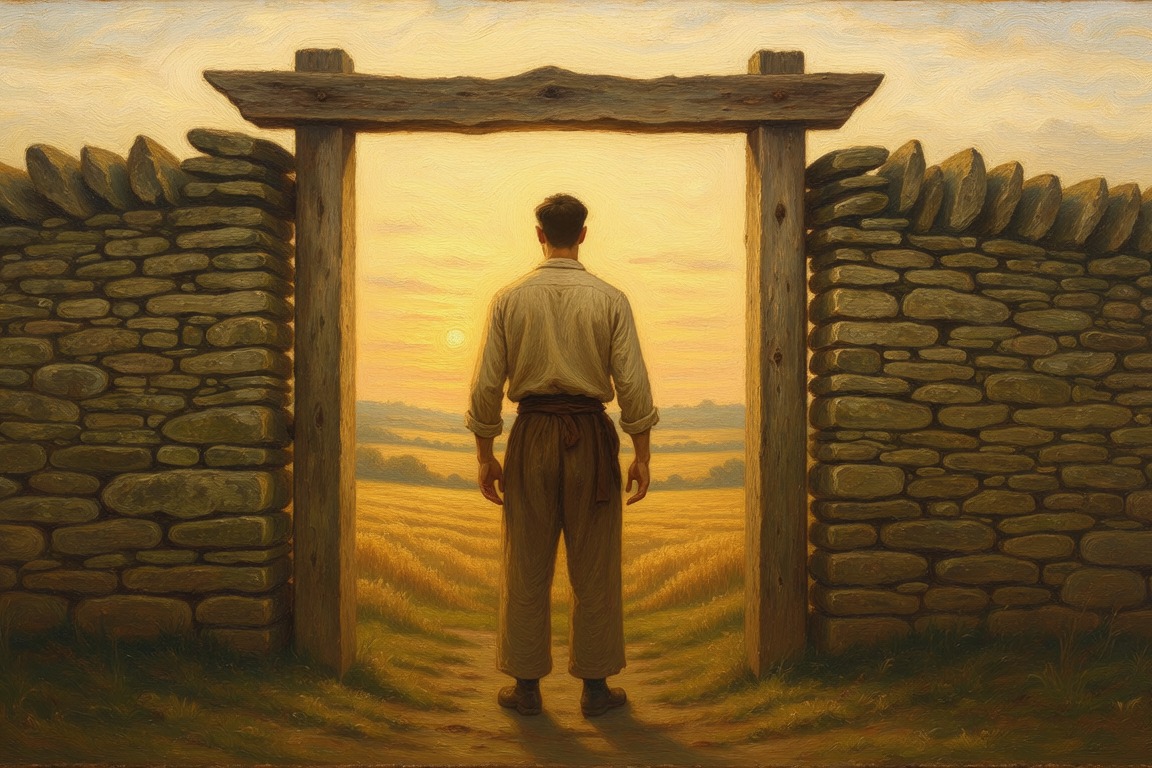
The discomfort you feel when you are living at a distance from your truest self is not a malfunction. It is formation. It is the marble acknowledging that the chisel is needed. It is the angel letting you know it is still there, still waiting, still pressing against the stone.
You did not arrive empty. You arrived carrying something: a shape, a calling, a particular quality of soul that no one else in history has carried in quite the same configuration. And every difficult season you have walked through, every expectation you have finally been willing to question, every quiet morning where you have let yourself hear the thing you have been circling, that is the chisel working.
This is the work I gave my career for. Not because the career was wrong. But because this was more right.
And I am more convinced today than I have ever been that the world does not need more impressive people. It needs more true ones. People who have done the work of finding out who they actually are, and then had the courage to build from that place, regardless of what it costs and regardless of what anyone expected them to be.
That is what Arete Estate is for. That is what you are for.
So here is the question I want to leave you with, the one that changed everything for me, the one I am still answering every day:
What would you do, and who would you become, if you stopped building what was impressive and started building what you were actually made for?
Don’t answer quickly. Sit with it in the early morning. Let it find the places in you that have been waiting for permission to speak. Let the accumulation, whatever yours looks like, finally reach its tipping point.
The work is waiting. And so is the angel in your marble.
About the author
Marcus J Emsley · The Guide
Marcus spent seventeen years as a welfare officer in the Royal Australian Air Force, at home and on operations overseas, sitting with people in grief, trauma and the mornings they did not want to rise. He is the founder of Arete Estate in the Barossa Valley, South Australia, the creator of The Sculptor's Journey and Wisdom & Wonder, and the author of the debut novel Wisdom & Wine. He is the son of a primary school teacher who coached footy, cricket and life, and a palliative care nurse who showed him what kindness at the hardest door looks like. He has stood in the dark himself, and he writes from the far side of it.
What we are building at Arete Estate
Arete is excellence becoming. It is the highest expression of who you were always meant to be, not the finished version, but the version that keeps reaching. It is not built. It is revealed.
Arete Estate exists to help people reveal, not construct, the highest version of themselves. We do this through six virtues drawn from the world's wisdom traditions, taught through stories, walked through daily practice, and offered to anyone who is ready to begin: the parent raising a child, the leader carrying a team, the soldier returning from service, the school shaping the next generation, the person sitting alone in the early hours of the morning wondering if there is a path through.
Our work is to make that path visible. To stand as a lighthouse for the seekers, the grieving, and the broken. To remind every person we reach that excellence is not built, it is revealed by storms, and that they are not alone in the storm.
We do not chase. We shine. The Sculptor's Journey (The Doorway, The Walked Path, The Guided Path), An Hour with the Guide, Meditate with Arete, Wisdom & Wonder and The Sculptor's Library are the rooms of that house.
Six virtues. One journey. Your highest self.
www.areteestate.com.au · info@areteestate.com.au · Instagram @areteestate
If this essay touched something raw
Some of what is written here is heavy. If it has stirred something you are carrying, please do not carry it alone tonight.
Lifeline 13 11 14 · Open Arms (veterans and families) 1800 011 046 · 1800RESPECT 1800 737 732 · Kids Helpline 1800 55 1800 · In an emergency, call 000.
Reaching out is not weakness. It is all six virtues at once: the Fortitude to stay, the Wisdom to know you need a hand, the Love to let someone in, the Courage to ask, the Temperance to set the weight down, and the Gratitude for the one who answers.

Responses