
Courage · The fork is not a place you passed. It is a place you live.
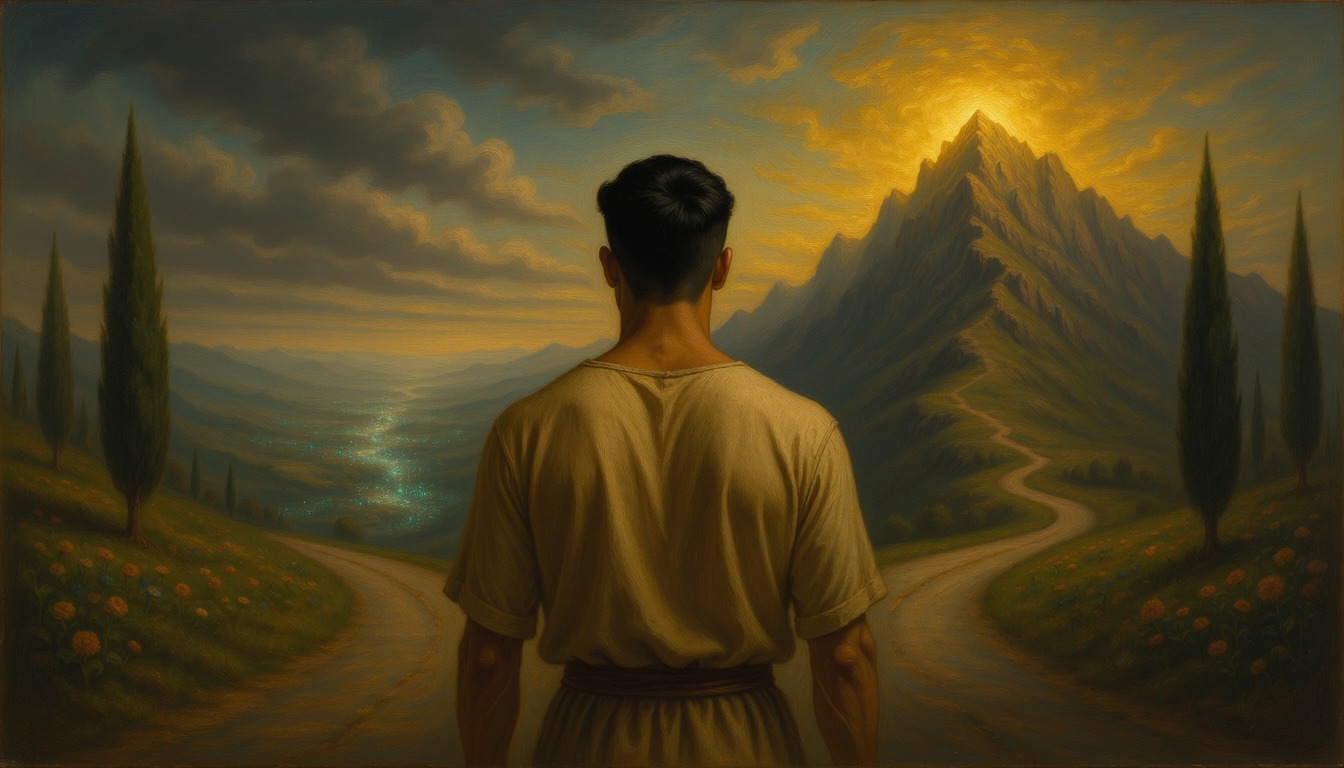
“Character is destiny.” (Heraclitus)
There is one story this whole estate is named for, and every walk through the oldest questions a person can ask about who they are becoming has to begin with it. It is nearly two and a half thousand years old, it is about a young man standing at a fork in a road, and I would wager everything that you have stood at the very same fork, perhaps this week.
The Fork in the Road
The story comes down to us from a teacher called Prodicus, and it goes like this. Heracles, not yet the hero of the twelve Labours, just a young man on the edge of his life, walks out alone to a quiet place to think. He has reached the age where a person must decide what road their one life will take, and he does not know the way. And as he sits at the crossroads, two figures approach him, one down each road.
The first arrives in a hurry, radiant and easy, and gets her offer in before the other can speak. Come my way, she says, and yours will be the pleasantest and easiest road of all. You will taste every delight and dodge every hardship. No war, no work, no worry, only the question of which pleasure to choose next. Others will labour; you will enjoy the fruits of it. Her friends, she admits, call her by a harder name, but she calls herself Happiness.
The second figure waits. And when she speaks, she makes the strangest sales pitch in all of literature, she promises him difficulty. I will not deceive you with sweet beginnings, she says. Nothing that is truly good is given to us without labour; the road I offer climbs. But walk it, and you will become everything you are capable of being, strong in body, wise in mind, beloved by friends, useful to your people, worthy of honour that is real because it was earned. If you want the harvest, you must tend the field. If you want to be loved, be worth loving. If you want your life to matter, do the things that matter, though they cost you.
Her name, and this is why the story is the first stone of everything we build here, was Arete.
The Two Voices
Now, the reason this parable has outlived the civilisation that told it is that it is not really about Heracles. The two figures at the fork are not strangers on a Greek roadside; they are the two voices that meet you and me at every decision worth the name. One of them you will recognise the moment I describe her, because she spoke to you this week. She is the voice of the effortless option: sleep in, scroll on, let it slide, say nothing, have another, start Monday. She is not evil, that is the parable’s genius. She is pleasant, plausible, and endlessly patient. She simply asks nothing of you.
The easy road asks nothing of you, and gives you back exactly that.
And the second voice, quieter, always second to speak, never shouting over the first, is the pull you feel underneath the comfortable option even while you are taking it. The nagging sense that you were built for something that would cost you more and mean more. That voice has been given many names across the centuries: conscience, calling, the better angel. The Greeks simply called it Arete, the summons toward your own excellence, the truest and fullest version of the person you are capable of being. Everyone hears her. Not everyone stops to listen. The whole difference between the lives people end up living, I have sat beside enough of them, in their hardest hours, to say this with some authority, comes down to which of the two voices they made a habit of obeying.
Ask yourself: which of the two voices spoke to you this week, and over what? What did the easy road offer you, and what, quietly, did it cost?
Character Is Destiny
Heraclitus compressed the entire teaching into three words a full generation before the parable was told: character is destiny. We usually read that as poetry. It is closer to mechanics. He was not saying your fate is written in advance; he was saying the opposite, that the shape of your life is not decided by the stars, the economy, your talent or your luck, but by the settled pattern of your choosing, compounding quietly across the years the way interest compounds on a debt or a fortune. Show me which voice a person obeys at the daily fork, he is saying, and I will show you their future without a crystal ball.
Because the paintings of the parable always get one thing wrong. The artists give us one grand crossroads, one magnificent, once-in-a-lifetime choosing. But you and I know the truth of it: the fork is not behind you, passed at some decisive hour of your youth. The fork is this morning. It was the alarm and the snooze. It is the honest sentence and the easy silence, the walk and the couch, the apology and the pride, the page written and the page put off. The crossroads did not appear once in your life. It appears, in small clothing, a dozen times a day, and each time, the two voices make their same two offers, and each time, you become a little more the kind of person who takes one road or the other.
Character is not one great choice. It is a thousand small ones, made at the same quiet fork.
Ask yourself: if a stranger watched only your last seven days, the forks, and the roads you took at them, which of the two would they say you are walking?
You Are Not Built. You Are Revealed.
But there is one more turn in this story, and it is the one that changes it from a demand into an invitation. Notice what Arete does not say to the young man. She does not say: come with me and I will construct you, bolt on strength you lack, install a courage that was never there. She says, in effect: walk this road and you will become everything you are capable of being. The capacity is already in him. The road does not add it. The road reveals it.
This is the conviction at the centre of everything we make here, and I want to hand it to you plainly. You are not a construction project, forever short of parts. You are marble with a figure already inside, and the uphill road is simply the sculptor’s workshop, where each hard choosing strikes away one more piece of what was never you. The patience you “don’t have”, the courage you “weren’t born with”, the discipline you have envied in others, they are in the stone. They have simply not yet been asked for often enough to show. That is why the easy road is the true tragedy of the parable: not because it is wicked, but because it leaves the figure in the marble forever, unmet.
The hill does not make the hero. The choosing of it does.
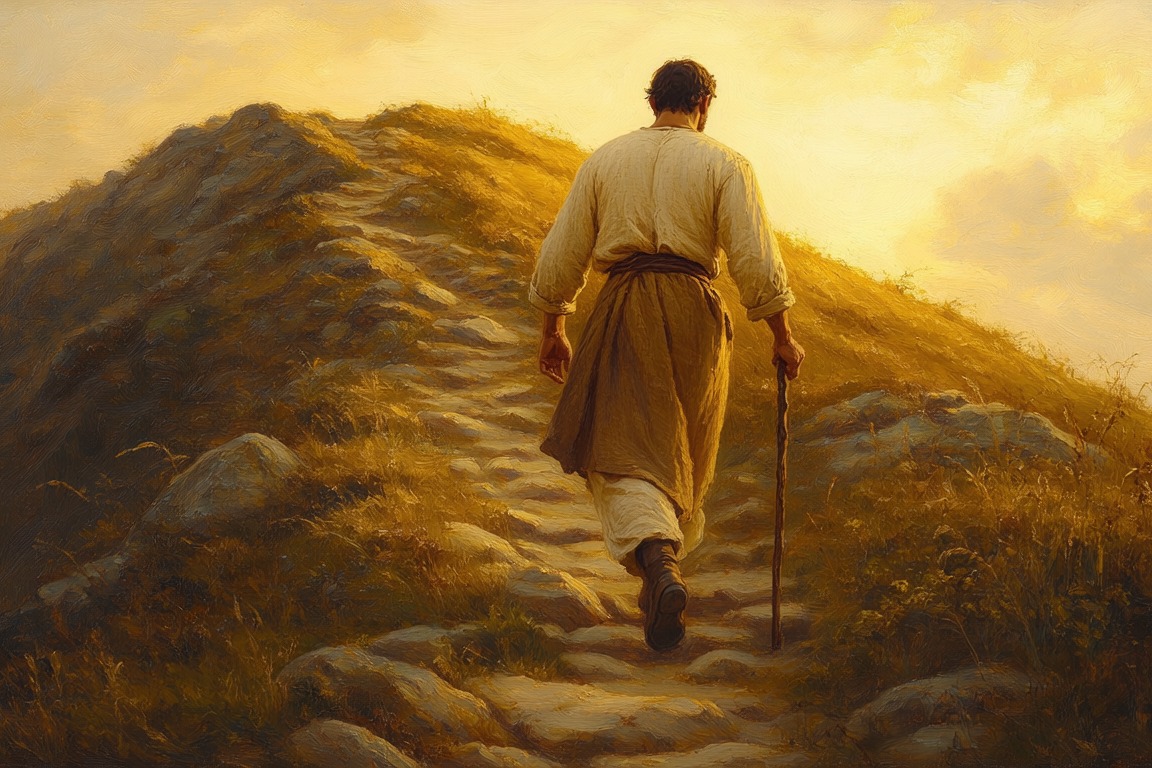
Ask yourself: which quality have you been calling missing (the patience, the courage, the discipline) that has simply never been asked for often enough to show?
The Fork, This Morning
So this is the whole lesson, and it fits in a sentence: the crossroads is not a place you passed. It is a place you live. Somewhere in this ordinary week, probably before Tuesday is out, the two voices will make you their two offers over something small. You will know the moment when it comes; you have always known it. All I would invite you to do, this week, is notice it. Name the fork when you are standing at it, quietly, to yourself: here it is again. And then, just once more than you did last week, take the road that asks something of you. Not heroically. Not perfectly. Once.
And in the evening, when you sit with your day for a few quiet minutes, ask it the parable’s question: where was my fork today, and which voice did I obey? No verdicts, no flogging. Just the honest noticing, which is where every remade life begins.
Heracles chose the hill. Twelve Labours, a lifetime of storms, and three thousand years of remembrance followed from that one quiet decision at the split in the road, and the same decision, in your size, is waiting for you this week. Feel the crossroads. The door is open. No one will chase you through it.
Excellence revealed by storms.
For the Young Ones
The same truth, made small enough to hold. To be read aloud.
A long, long time ago, a young hero called Heracles came to a place where the road split in two. And standing there were two guides, one at each road.
The first one smiled a big easy smile and said: “Come my way! My road is soft and downhill all the way. You will never have to try hard, never feel tired, never do anything you don’t feel like doing.” And her road did look very comfortable indeed.
The second guide was quieter. She said: “My road is uphill, and I will not pretend it isn’t. Some days it will be hard. But on my road you will become strong, and brave, and kind, and true, you will become everything you are meant to be. Nothing wonderful was ever grown on the easy road.” Her name was Arete, which is an old, old word for becoming your very best self.
Heracles chose the uphill road. That is why we still tell stories about him three thousand years later. And this is the secret: that same fork in the road visits you nearly every day, in little ways. Do my reading, or give up? Tell the truth, or the easy fib? Help, or walk past? Every time you choose the little uphill road, you grow a little bit more into the hero you are becoming.
A Practice (and the Grown-Up Goes First)
Tonight at the table, play “The Two Roads”, and grown-ups, you go first. Tell them about one fork in your road today: the easy path you were offered, and the uphill one. Tell them truthfully which one you took, and how it felt. Then ask them: where was your fork today? Which road did you take? No lectures, just the noticing. You are teaching them the oldest lesson there is: heroes are not born at the top of the hill. They are made by choosing it.
About the author
Marcus J Emsley · The Guide
Marcus spent seventeen years as a welfare officer in the Royal Australian Air Force, at home and on operations overseas, sitting with people in grief, trauma and the mornings they did not want to rise. He is the founder of Arete Estate in the Barossa Valley, South Australia, the creator of The Sculptor's Journey and Wisdom & Wonder, and the author of the debut novel Wisdom & Wine. He is the son of a primary school teacher who coached footy, cricket and life, and a palliative care nurse who showed him what kindness at the hardest door looks like. He has stood in the dark himself, and he writes from the far side of it.
What we are building at Arete Estate
Arete is excellence becoming. It is the highest expression of who you were always meant to be, not the finished version, but the version that keeps reaching. It is not built. It is revealed.
Arete Estate exists to help people reveal, not construct, the highest version of themselves. We do this through six virtues drawn from the world's wisdom traditions, taught through stories, walked through daily practice, and offered to anyone who is ready to begin: the parent raising a child, the leader carrying a team, the soldier returning from service, the school shaping the next generation, the person sitting alone in the early hours of the morning wondering if there is a path through.
Our work is to make that path visible. To stand as a lighthouse for the seekers, the grieving, and the broken. To remind every person we reach that excellence is not built, it is revealed by storms, and that they are not alone in the storm.
We do not chase. We shine. The Sculptor's Journey (The Doorway, The Walked Path, The Guided Path), An Hour with the Guide, Meditate with Arete, Wisdom & Wonder and The Sculptor's Library are the rooms of that house.
Six virtues. One journey. Your highest self.
www.areteestate.com.au · info@areteestate.com.au · Instagram @areteestate
If this essay touched something raw
Some of what is written here is heavy. If it has stirred something you are carrying, please do not carry it alone tonight.
Lifeline 13 11 14 · Open Arms (veterans and families) 1800 011 046 · 1800RESPECT 1800 737 732 · Kids Helpline 1800 55 1800 · In an emergency, call 000.
Reaching out is not weakness. It is all six virtues at once: the Fortitude to stay, the Wisdom to know you need a hand, the Love to let someone in, the Courage to ask, the Temperance to set the weight down, and the Gratitude for the one who answers.

Responses