What an ancient Cambodian tattoo taught us about Temperance, protection, and the marks we choose to carry.
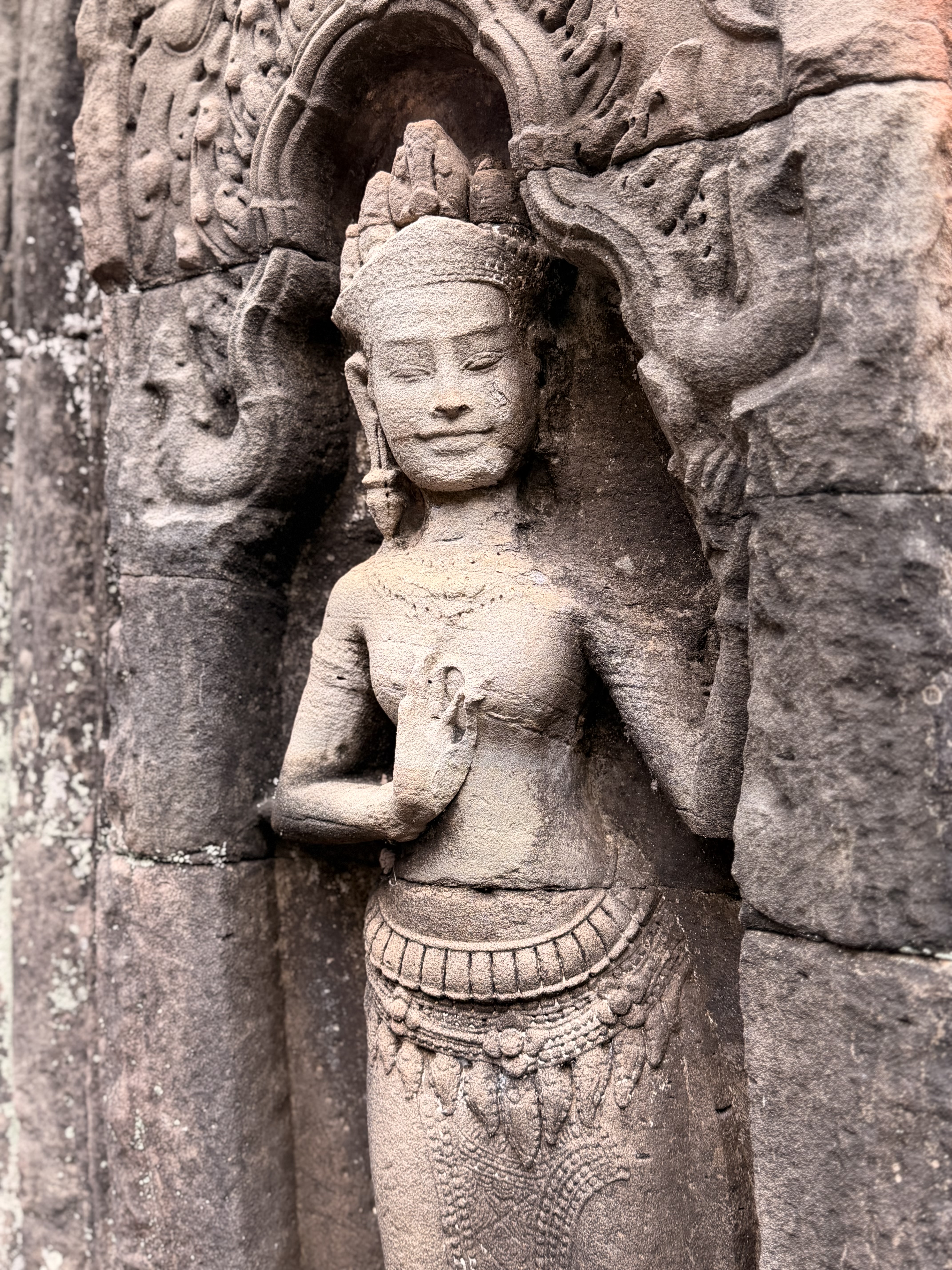
She had wanted this for years.
Not a tattoo. A permanent blessing.
My wife had read about Sak Yant — the sacred tattoo tradition of Southeast Asia — long before we ever planned to visit Cambodia. She was drawn not to the aesthetic, though the geometric designs are stunning, but to the philosophy underneath.
The idea that a mark on the body could be more than decoration. That pain, intentionally entered, could become protection. That ink, when applied with prayer and presence, could carry meaning into the skin and stay there — long after the sting fades.
She wanted that. And when we found ourselves in Siem Reap, in the shadow of Angkor Wat, she walked through the door.
What Is Sak Yant?
Sak Yant — from the Khmer words sak (to tattoo) and yant (sacred design) — is an ancient tradition stretching back over two thousand years. It originated in Cambodia under the Khmer empire, spreading through Thailand, Laos, and Myanmar, carried by monks, warriors, and spiritual masters who believed that certain symbols, inscribed with intention, could protect and transform the bearer.
These aren’t tattoos you choose from a catalogue.
In the traditional practice, the design is selected through consultation with a kru (master) or monk. They listen to what you need. What you’re seeking. What’s missing. Then they choose the yantra — the sacred geometric pattern — that aligns with your path.
The process is done by hand. A long steel needle or bamboo, dipped in ink, tapped repeatedly into the skin. No machine. No hum. Just the rhythm of metal meeting flesh, and — in the authentic tradition — the low chant of prayers being spoken over you as the design takes shape.
It is, by all accounts, significantly more painful than a modern tattoo.
And that’s part of the point.
The Day She Walked Through
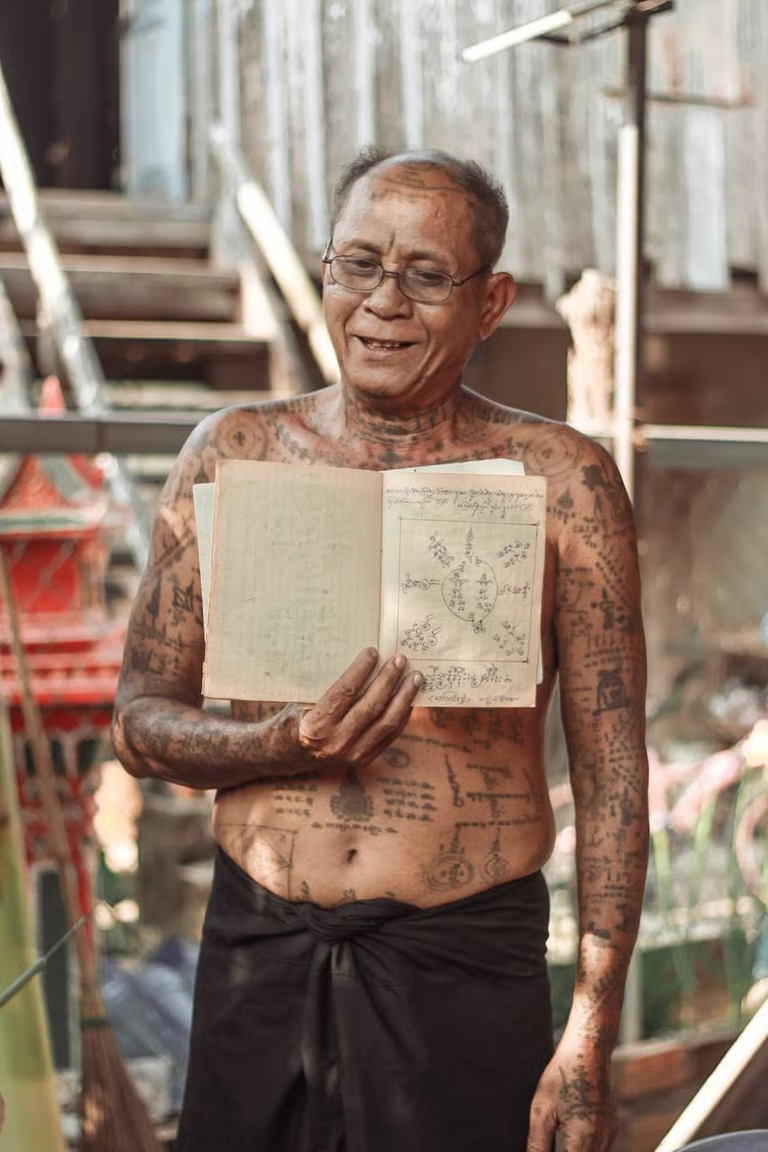
We found an ancient environment in Siem Reap that honoured the Khmer tradition. Not a tourist shop. A place where the lineage had been preserved, where the masters had trained for years learning the ancient scripts, the meanings behind each symbol, the prayers that activate the blessing, handed down from master to student.
She sat with the master. Told him what she was seeking: protection, kindness, temperance, peace — qualities she wanted etched not just into her skin, but into her character. A reminder she would carry always.
He listened. He chose.
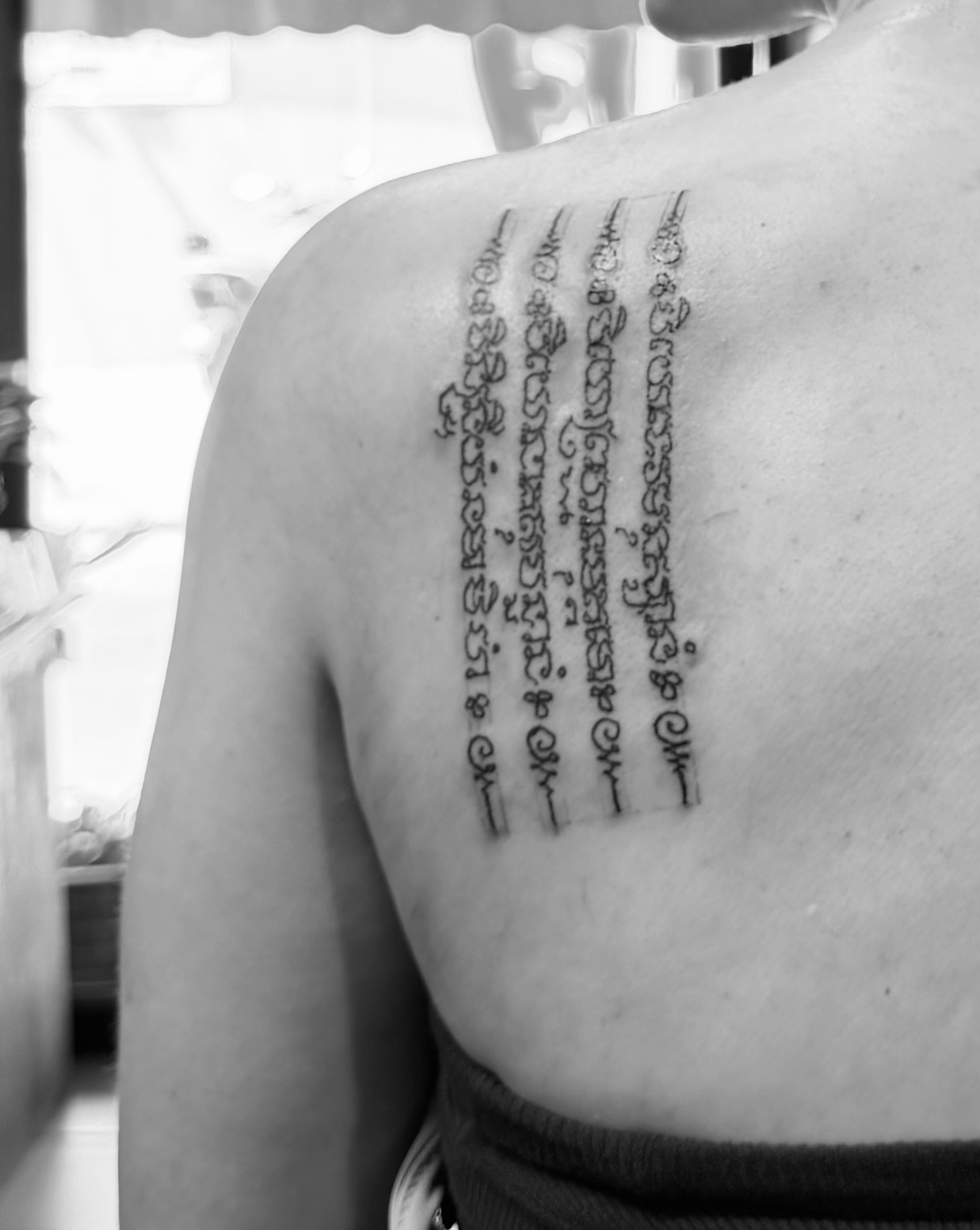
The Hah Taew.
Four lines of ancient Khom script — the sacred language of Khmer Buddhist texts, older than the temples of Angkor. Each line a separate blessing, a distinct spell, stacked horizontally on her shoulder blade like armour for the soul.
Line One: Protection and Cleansing. To prevent unjust punishment. To cleanse unwanted spirits. To shield the home and the heart from what shouldn’t enter.
Line Two: Karma and Fortune. To reverse bad karma. To protect against ill-fated stars. To convert misfortune into luck — the alchemist’s line.
Line Three: Defence Against Darkness. Protection from black magic, curses, and malicious intent. A ward against those who wish harm.
Line Four: Success and Blessing. To enhance good fortune. To open doors. To bring prosperity to future ambitions and daily life alike.
Four lines. Four blessings. A complete system of spiritual protection, written in a script most people can’t read but everyone can feel.
The design went on her shoulder blade — close to the heart but behind her, like a guardian watching her back.
Then the tapping began.
I watched her face. The first few moments were shock — the sharp, insistent rhythm of the needle finding its way. Her breath changed. Her knuckles whitened. I could see her fighting the instinct to pull away.
But she didn’t.
She stayed. Echoing the Khmer chants as they were spoken to her.
Tap. Tap. Tap. The master’s voice low, chanting words neither of us understood but both of us felt. The room thick with incense and something else — something ancient and alive.
Twenty minutes? Thirty? Time stopped meaning much.
And then it was finished. The master spoke a final blessing, pressed his palm to the design, and it was done.
She cried. Not from the pain — that was already fading. But from something deeper. Something had shifted.
Pain Heals. The Message Stays.
Here’s what the Sak Yant tradition understands that most of us have forgotten:
Pain is not the enemy. Pain is the doorway.
The needle hurts. The body resists. Every instinct screams stop, protect, withdraw. But if you stay — if you breathe through it, if you let the pain do its work — something changes. The resistance softens. The body surrenders. And the blessing finds its way in.
The pain heals within days. The skin closes over. You forget the sting.
But the message remains.
Etched into the body. Carried everywhere you go. A permanent reminder of what you chose to receive, and what you were willing to endure to receive it.
Pain heals. The message is forever.
This is Temperance in action.
The Conductor and the Ceremony
In The Sculptor’s Journey, I teach Temperance through the metaphor of The Conductor.
Imagine an orchestra. Every emotion, every impulse, every voice inside you is an instrument. Fear is the timpani. Grief is the cello. Joy is the strings. Anger is the brass.
None of them are enemies. But when one plays so loud that it drowns the others — when fear takes over, or anger runs the show — that’s not music anymore. That’s noise.
Temperance isn’t about silencing the instruments. It’s about bringing them into harmony. Knowing when to let the grief play, and when to bring in the hope. Knowing how to hold space for pain without letting pain become the only voice.
The Sak Yant ceremony embodies this.
The pain is present. Loud. Demanding. Your entire body wants to make it stop. But the master keeps tapping. The prayer keeps flowing. And your job — your only job — is to conduct yourself through it.
To let the pain play without letting it take over. To stay present. To breathe. To trust that the pain is doing necessary work, and that it will pass.
This is the discipline of the conductor. Not suppression. Not denial. Harmony under pressure.
What She Carries Now
The Hah Taew on her shoulder blade is beautiful — four horizontal lines of ancient Khom script, stacked like verses of a prayer. Sacred geometry. A language most of the world has forgotten, preserved in ink on her skin.
But the real beauty isn’t visible.
It’s in what she knows now. What her body knows.
That she can stay present through pain. That she can choose what marks her. That protection isn’t about avoiding difficulty — it’s about carrying the right blessings through difficulty.
Four lines. Four shields.
Protection from what shouldn’t touch her. Transformation of what tries to harm her. Defence against darkness. Doors opened toward light.
Every morning, when she catches a glimpse of it in the mirror, she remembers:
I chose this. I endured this. I carry this.
The precepts that keep the magic alive aren’t burdens — they’re The Sculptor’s Journey by another name: don’t steal, don’t kill, don’t misuse what clouds the mind, respect those who came before. Live with integrity, and the blessing remains strong.
Kindness. Protection. Temperance.
Not as abstract ideas, but as marks in the flesh.
The Wisdom in the Wound
There’s a reason ancient traditions across cultures used painful initiations to mark transitions. The vision quest. The walkabout. The scarification rites of a dozen peoples.
Not because they were cruel. Because they understood something we’ve largely forgotten:
Some lessons don’t stick unless they cost you something.
Information is cheap. Wisdom requires sacrifice.
You can read about Courage in a book. Or you can face your Nemean Lion and carry the memory in your bones.
You can understand Temperance intellectually. Or you can sit in a room in Cambodia, breath ragged, body screaming, and choose to stay — to let the pain do its work, to trust the process, to emerge on the other side transformed.
The Sak Yant master knows this. The needle is the teacher. The pain is the tuition.
And the blessing is what remains when the pain is gone.
What We’re Building
This is what The Sculptor’s Journey is about.
Not avoiding pain. Not numbing ourselves to difficulty. But learning to move through it with intention. Letting the hard things mark us in ways we choose, rather than in ways we don’t.
Fortitude: standing firm when the needle finds the nerve. Wisdom: knowing which marks to carry and which to leave behind. Love: choosing blessings for kindness and protection, not power and revenge. Courage: sitting down for the process when everything in you wants to run. Temperance: conducting the orchestra when one instrument screams. Gratitude: emerging on the other side with something permanent and beautiful.
My wife carries her yantra on her shoulder blade. I carry the six virtues in my work, in my writing, in the path I’m building for others.
Different marks. Same principle.
Choose what shapes you. Stay through the pain. Let the blessing remain.
The Invitation
If you’ve read this far, you’re not just looking for content. You’re looking for something that lands. Something that marks you.
That’s what I’m building with Arete Estate.
A novel about three generations learning to live well — and die well. A podcast walking through the Twelve Labours of Heracles. A school curriculum teaching these virtues to young people before life’s needle finds them unprepared.
All of it rooted in one belief:
Pain heals. The message is forever.
The question is whether you’ll choose the messages you carry — or let life choose them for you.
This is a door. Will you walk through it?
Written by Marcus J Emsley, The Guide, at Arete Estate in the Barossa Valley. First published 27 January 2026.
Excellence revealed by storms.

Responses