
On respect, Vicki Cleary, and the Carlton Respects round
“The standard you walk past, is the standard you accept.”

She was twenty-five.
She was a kindergarten teacher in Coburg, Melbourne. She painted. She made the people around her laugh. Her younger sister Lizzie — eleven years her junior — called her a second mum and best friend. Her older brother Phil was a Coburg football legend, captain and coach, who had just played his two-hundredth game eleven weeks earlier. The Clearys were a family.
Her name was Vicki Cleary.
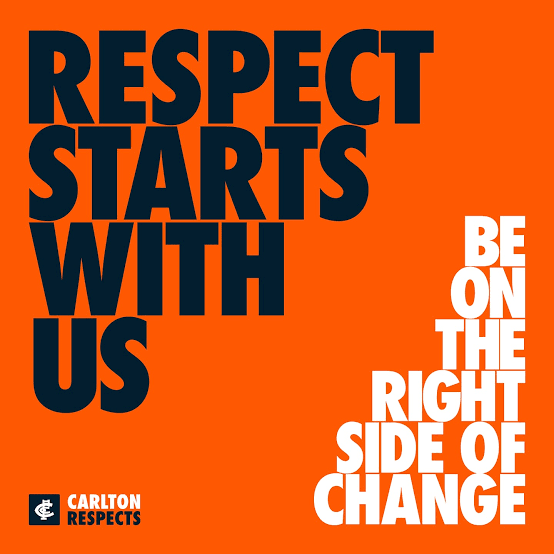
Tonight under the lights at the Melbourne Cricket Ground, Carlton plays Geelong in the tenth annual AFL Carlton Respects game. The Blues will run out in orange socks and a specially designed guernsey. The theme of the round, in its decade year, is Respect, it’s up to us.
Most of the people watching will not know who Vicki Cleary was.
That is what this essay is for.
On the morning of 26 August 1987, Vicki arrived at work at the kindergarten where she taught. Her former partner, Peter Keogh, was waiting for her. He had been to the kindergarten before. He had threatened her at her workplace, more than once. He had been told to stay away.
He attacked her there. He stabbed her, repeatedly.
She died on the floor of the place where she had loved small children into reading.
She was twenty-five years old.
Her killer was tried. His defence argued, in court, in front of a jury, in the Australia of 1989, that Vicki had provoked him. The argument was accepted. Keogh was acquitted of murder. He was convicted only of manslaughter.
He served less than four years.
This is what the law in Australia permitted. The provocation defence — which functionally argued that a man could not be held to full account for what a woman had made him do — was not abolished in Victoria until 2005.
Eighteen years after Vicki was killed.
Eighteen years in which a man, in this country, could kill the woman he claimed to love, and have the state stand beside him at the bar of judgment and reduce the sentence because of what she did to provoke him.
That is the cold air you walk through when you tell this story honestly. That is what we are still walking out of. That is what the orange socks are for.
“What we have once enjoyed deeply we can never lose. All that we love deeply becomes a part of us.” — Helen Keller
Vicki had a brother.
His name is Phil Cleary. He played two hundred games for the Coburg Football Club. He coached them to a premiership. He served as an independent member of the Australian Parliament. He has written three books — Cleary Independent, Just Another Little Murder and Getting Away With Murder. He has campaigned, almost without rest, for thirty-nine years.
He has done it for one reason.
Because his sister was killed, and the law treated her as though she had earned it.
Phil Cleary led the campaign that ended the provocation defence. It took him eighteen years to drag that law from the statutes. He served on the Victorian government’s Victim Survivors’ Advisory Council. He has appeared in royal commissions, in documentaries, on stages, in classrooms, in football clubs, in any room that would have him. He has not stopped.
In 2021 he wrote to the then-Premier of Victoria seeking a formal state apology for Vicki — not from the man who killed her, but from the state that did not protect her, and that did not call what was done to her by its true name.
He has not received that apology.
He is still asking.
In 2017, Phil and the Coburg Football Club hosted the first Vicki Cleary Day — an annual VFL match held in Vicki’s memory and in memory of every woman taken by the violence of a man who said he loved her. Last Sunday, Carlton’s reserves played in this year’s match. Tonight, the entire club runs out for her.
Thirty-nine years and counting.
This is what love looks like, when love is a verb.
I want to tell you what respect actually is. Because the word has been worn smooth by misuse, and the thing it points to is sharper than we have been letting on.
Respect is not a feeling.
It is not the warmth you feel in the same room as someone you love. It is not the way you speak to her in front of her parents. It is not the photograph of the two of you on your kitchen wall.
Respect is what you do when nothing is forcing you to do it.
It is the man in the locker room who says that is enough when his teammates start in on a woman who is not in the room. It is the husband who chooses his words on the hard day, in the small kitchen, when no one is filming. It is the father whose daughter watches him speak to her mother, and learns, in those silent transmissions she will not remember consciously, what to expect from the men in her future. It is the coach whose under-fourteen girls learn what a man with power treats them like. It is the boss who notices the woman on his team being talked over, and quietly hands her the floor. It is the brother who hears his mate say something at the bar and does not laugh.
It is the man who, in private, in the half-light, with no one watching, has become the man his daughter would be proud of.
Respect is a verb. The longest verb in the language. It is not a thing you have. It is a thing you do — today, again tomorrow, again the day after that, again on the Tuesday afternoon when you are tired and angry and nobody would blame you for not doing it.
The Greeks had a word for the kind of life respect, sustained, builds. Aretê. Excellence of character. The thing in you that does not depend on anyone seeing it. Aristotle wrote it down two and a half thousand years ago — we are what we repeatedly do. Excellence, then, is not an act, but a habit.
This is what we have known for two and a half thousand years.
And still, in 1987, a man stabbed a woman in a kindergarten in Coburg, and the law did not call it what it was.
In my work I name six virtues that build that excellence into a man.
Fortitude — to stand firm and shine, even when the storm is inside you. To hold the line when your friends are crossing it. To speak when silence would be easier. To be the lighthouse, not the wreck.
Temperance — to conduct your life with balance. To know that the daily restraint of a man over his own anger, his own ego, his own appetites is the architecture of every relationship he will ever have. Most violence does not arrive without warning. Most of it has been practised, in smaller forms, for years before it becomes visible. Temperance is the man who interrupts that pattern in himself before it ever interrupts someone else’s life.
Wisdom — to acknowledge the mud, record the gold, and choose what to carry forward. To look honestly at what men have done — what we, collectively, are still doing — and to look just as honestly at what we can also be. Not to drown in shame. Not to deny the truth. To learn. To carry forward only what should be carried.
Love — and this is the one Phil Cleary has been teaching us, with every step of his thirty-nine years.
“You don’t fall in love. You choose it. The fall is choosing it again tomorrow.” — The Sculptor’s Journey
Love is not the day you met her. Love is the day after she dies. Love is what you do every morning for thirty-nine years to make sure a young woman murdered at her workplace in 1987 is not forgotten. Love is a verb. The longest verb in the language. Phil Cleary has been conjugating it longer than most of us have been alive.
Courage — fear tells you the stakes. Courage says noted — and begins anyway. The courage to be the man in the conversation who changes the temperature. The courage to call a friend on what he just said. The courage to be uncomfortable in the room, so that someone smaller than you can be safe in it. The courage to ask, of yourself, the question men have spent centuries refusing to ask of themselves.
Gratitude — to plant what you will not harvest, and tend what you did not plant. To fight for the daughter you may not have. To honour the sister you never met. Phil Cleary has been planting trees he will never sit under. Tonight at the MCG, every Carlton player who pulls up an orange sock is sitting under one.
These are the six things that build respect into a man. They are not what you feel. They are what you do.
The man who builds them does not need a round to remind him.
But a round helps.

“It is easier to build strong children than to repair broken men.” — Frederick Douglass
If you are a man reading this — I am writing to you.
I spent seventeen years in the Defence Force as a welfare specialist. I sat in rooms where grief had no script, where loss had not yet been named, where the people across from me were trying to live with things they could not change. I do not approach this topic from above it. I approach it as someone who has spent a great many quiet hours listening to what people carry, and what they do with it.
What I learned, more than anything else, is this.
Most men who do harm are not monsters. They are ordinary men whose lives have not been shaped by anybody who taught them what respect actually was. They were raised on jokes that said women were less. They were raised in silences about what their fathers had done. They were raised in locker rooms where the only acceptable response to a man crossing the line was to laugh, or to look away, or to do worse. They were not given anything better to be.
You have something better to be.
You were given it by your mother, or by your sister, or by the woman who loved you when you did not yet deserve to be loved. You were given it by the daughter who stood next to you at the bathroom sink and brushed her teeth the way you brushed yours, learning, in that small moment, what men do in the morning. You have something better to be.
The only question is whether you will be it.
Tonight at the MCG, twenty-three Carlton men will run out wearing orange because a young woman named Vicki Cleary was killed in 1987 and her brother refused to let her be forgotten. They will run out for her, and for every woman whose name we do not know because no club ever wore her colour.
What you do tomorrow morning will count more than what they do tonight.
It will count in the locker room you walk into. It will count in the group chat you scroll. It will count in the sentence you finish, and the one you do not. It will count in your kitchen, and your bedroom, and the car ride home from the school you drive your daughter to. It will count when nobody is watching.
Respect is what you do when nothing is forcing you to do it.
It is, as the round says — and as Phil Cleary has been saying for thirty-nine years —
up to us.
I will not close this essay with anything to sell you.
Tonight the lights are on at the MCG. The orange socks are on the grass. Phil Cleary, somewhere in a stand or a living room, is watching a club he loves wear his sister’s colour. The match will end. The lights will go off. The work continues anyway.
If this essay has moved you, the gift is not for me. It is for the woman at the table you will sit at this weekend. It is for the daughter you will drop at school on Monday. It is for the colleague you will hear talked over in a meeting on Wednesday. It is for the friend who has been quiet about her husband for a year and who is waiting to see whether you have noticed.
It is for Vicki, who was twenty-five.
It is for Phil, who will not stop.
It is for the men we have been, the men we are, and — if we choose it tomorrow morning, and the morning after that, and the Tuesday afternoon when nobody is watching — the men we can yet be.
I am here. I am not chasing. I am shining.
Stand with us.
Marcus
Barossa Valley, Australia
With deep respect to Phil Cleary, Lizzie Cleary, Donna Cleary, and the Vicki Cleary Day Committee for their thirty-nine years of work. To learn about Vicki, or to support the campaign, visit vickiclearyday.com.au. To support the Carlton Respects programme, visit carltonfc.com.au.
If you or someone you love is at risk, contact 1800RESPECT (1800 737 732) — twenty-four hours, every day.
Written by Marcus J Emsley, The Guide, at Arete Estate in the Barossa Valley. First published 29 May 2026.
Excellence revealed by storms.

Responses