
Wisdom · Three thousand years ago, a young man came to a fork in the road. Every child still does. This is about who is waiting there to meet them, and who is not.
The Two Roads
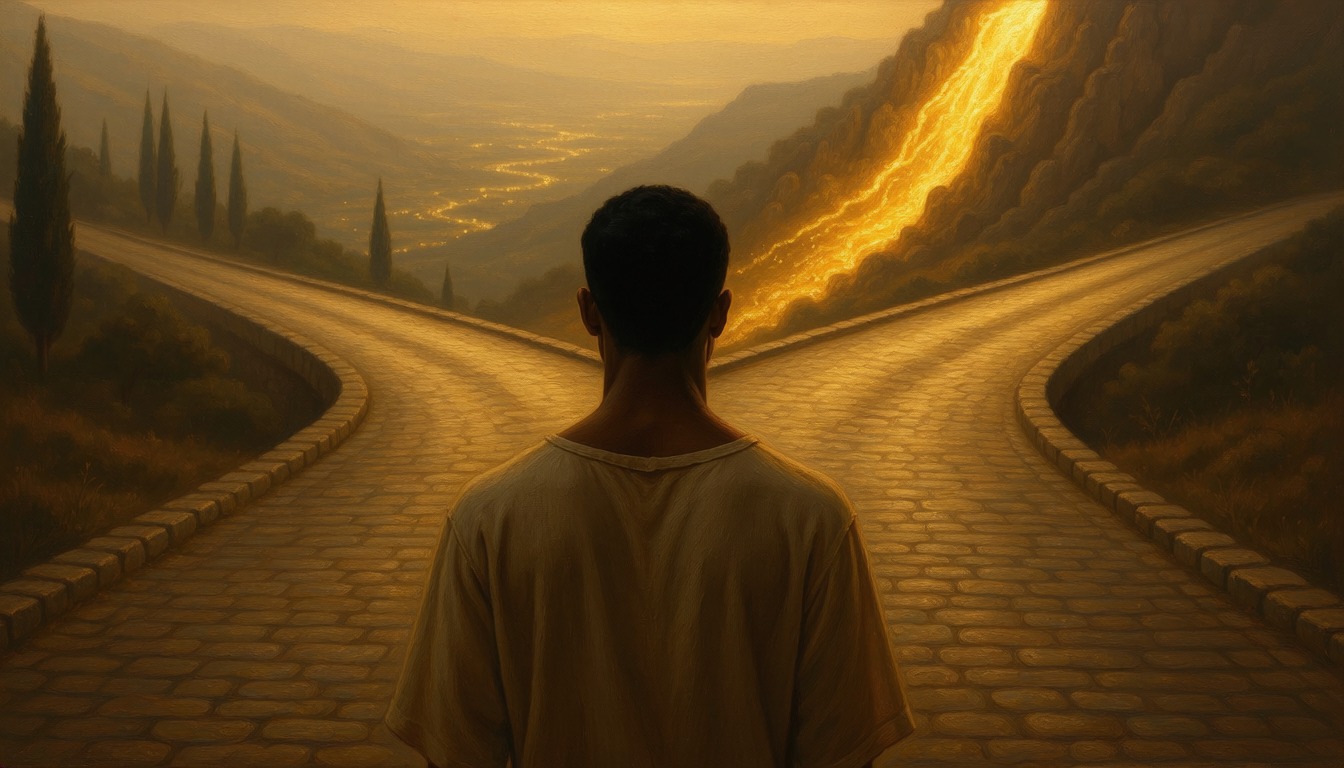
Three thousand years ago, in a story the Greeks told to explain what they meant by a life well lived, a young man came to a fork in the road. You may know him as Heracles. Long before the famous labours, the story goes, he walked out alone to a still place because he had reached the age where a person has to decide what kind of life to live, and two women approached him. The first promised the easy road: no hardship, every desire met the moment it rose. Her friends called her Happiness; her enemies called her Vice. The second promised the opposite, a long and hard road, because the gods give nothing truly good to human beings without struggle, and at the end of it not comfort but the chance to become excellent, worthy of his own respect. Her name was Arete. It is the word this estate is named for, and I have written about that crossroads in full elsewhere in this Library, in “The Choice of Heracles”. Heracles chose the hard road, and the hard road is what made him.
I tell you this because every child who has ever lived comes, sooner or later, to that same fork. Your children will. Mine will. The thirteen-year-old at the dinner table tonight is closer to it than we think.
And this is what should stop us cold. In our time, of those two women at the crossroads, only one still reliably shows up.
Vice has never been better resourced. She has a screen and an algorithm and an endless supply of the easy, frictionless road, and she reaches our children in their bedrooms at one in the morning, promising exactly what she promised Heracles: every pleasure, no toil, every hard thing avoided. She is relentless, and she is extraordinarily good at her work.
And Arete? We have, quietly and without ever quite deciding to, stopped sending her. We have stopped introducing our children to the very idea that there is a second road, a harder and better one, and that they are capable of walking it.
This essay is about how we lost her. And how we send her back.
The Measure of a Child
Consider that thirteen-year-old at the table.
We can tell you her reading age to the month. We can rank her school, score her tests, track her attendance and her grades and the precise number of hours she spends on a screen. Over a century we have built an extraordinary machinery for measuring children.
And we can tell you almost nothing about the things that will actually decide whether her life goes well. Whether she will keep her word when it costs her. Whether she will hold her nerve when it would be easier to fold. Whether she can sit with someone else’s pain without looking away. Whether, when the storm comes, and it always comes, she will have anything inside her to stand on.
We measure what is easy to count, and we have quietly decided to leave the rest to chance. It is, I think, the most dangerous decision our culture has made. And I say that not as a critic standing outside it, but as a father and a coach standing in the middle of it, watching it happen to children I love.
I did not arrive at this belief from a comfortable distance. I spent seventeen years as a welfare officer in the Royal Australian Air Force, a great deal of it sitting with people in the worst hours of their lives: grief, trauma, the wreckage left when everything comes apart. And I watched, over and over, what it costs a person to arrive at the storm unformed: no inner architecture, no bearings, nothing to hold. A line usually attributed to Frederick Douglass puts it in a single sentence, and I have never heard it bettered: “It is easier to build strong children than to repair broken men.”
I spent seventeen years on the repair. This work, all of it, is my attempt to move upstream, to reach children while they are still being built.
The Fence at the Top
For almost the whole of human history, the forming of a child’s character was not left to chance. It was the most deliberate work a community did.
A young person has always needed something to lean against while they work out who they are. A frame. A set of bearings. Stories about people worth becoming. Adults who had walked on ahead and turned around to say, this way. Rituals that marked the passage from one stage of life to the next and said, plainly: you are not a child anymore; more is being asked of you now. Every culture that has ever lasted built this scaffolding around its young, on purpose, and tended it carefully.
We have spent two generations quietly dismantling that scaffolding, and we built nothing to replace it. And into the empty space where a frame used to stand, we handed our children a device.
I want to be careful here, because it is easy to sound like a man shaking his fist at a phone, and that is not the argument. The argument is this: a thirteen-year-old’s sense of who they are used to be formed by people who loved them and would still be there in the morning. It is now formed, to a frightening degree, by strangers and algorithms whose only interest is the next thirty seconds of their attention. The device did not merely take time away from formation. It moved into the house where formation used to live. It became the first woman at the crossroads who never stops talking.
We have responded to all of this, to our great credit, with care. There are more counsellors, more wellbeing programmes, more honest conversations about mental health than at any point in my lifetime, and I would not undo a single one of them. But almost all of it meets a young person after the storm has already broken over them. It is the ambulance at the bottom of the cliff. It is essential. It is also not the fence at the top.
Formation is the fence at the top. It is the work of building, inside a child, the inner architecture they will need before the difficulty arrives, so that when it does, and it will, they are not standing on nothing.
Character Can Be Taught
The belief at the centre of everything I do is far more controversial than it ought to be: character can be taught.
We have half-convinced ourselves of two comfortable lies. The first is that character is fixed, that some children are simply good and others are not, and little can be done about it. The second is subtler, and more common among thoughtful people: that character is caught, not taught. That if you simply love your children and model decency, virtue will pass to them by osmosis, and any attempt to teach it directly is somehow artificial, or preachy, or not our place.
Both of these let us off the hook. And both are wrong.
Character is not fixed. It is formed, the way every important thing is formed: on purpose. Through story, because a child becomes what they have seen far more than what they have been told. Through practice, because a virtue is a habit long before it is a value, a thing you do, repeatedly, until it quietly becomes a thing you are. Aristotle understood this twenty-three centuries ago: we become brave, he wrote, by doing brave acts, and just by doing just ones. And it is formed through adults willing to go first, to walk on ahead and turn around and say this way, knowing they will sometimes get it wrong in front of the very children they are trying to lead, and choosing to lead anyway.
I learned the heart of it in those seventeen years. I went into that work believing, as most of us do, that hardship breaks people. I came out of it believing something close to the opposite. Hardship did not, on the whole, break the people I sat with. It clarified them. It stripped away everything that was performance and posture and left whatever was actually there underneath. Michelangelo is said to have described his sculptures not as built but found, already waiting inside the marble, his only task to remove everything that was not them. I watched a version of that happen in human beings, over and over. The storm did not add anything. It revealed what the years had quietly been forming all along.
“Character is destiny.” Heraclitus
This is why the labours mattered in the old story, and why they still do. The hard road Arete promised was not a punishment laid on Heracles. It was the forming. Each trial revealed a little more of the man, until what was left was worthy of the name we still remember. Excellence is revealed by the storm, not despite it. But what the storm reveals was put there, long before, by someone who bothered to do the forming. The only question, the entire question, is what the storm finds in our children when it arrives.
Sending Arete Back
A few years ago I went looking for the programme that did this work, that took the timeless virtues and made them real and teachable in the life of an ordinary thirteen-year-old on an ordinary Tuesday, and when I could not find it, I built it: Wisdom & Wonder, six virtues taught through story first and practice second, because I have never once seen a young person formed by a lecture, and I have seen a great many formed by a story that found them at the right time. That is how we send Arete back to the crossroads: so that when a child reaches the fork in the road, the second woman is standing there too, telling them what no algorithm ever will, that there is a harder and better road, and that they are capable of walking it.
The Trees We Will Never Sit Under
There is an old line, usually handed to us from the Greeks, that I have never been able to shake: a society grows great when old men plant trees in whose shade they know they shall never sit.
That is the whole of it, really. That is the work.
When a fourteen-year-old learns, in a classroom, what Fortitude actually means, not the word, but the lived thing, the capacity to stand firm and shine when the storm is inside you, she does not simply pass a unit of work. She carries it into the rest of her life. Into her twenties, when things become hard in the way they always do. Into the way she one day speaks to her own children. She becomes, without ever naming it, a person who forms character in others, simply by having had hers formed.
We will not see most of that. The teacher who plants Gratitude in a Year 7 student today will almost never meet the grown adult that student becomes in twenty years, or the children that adult raises, or the storms those children weather because someone, decades earlier, bothered to give them something to stand on. The harvest of this work falls in a season most of us will not be here to see.
We do it anyway. That is what it means to plant a tree you will never sit beneath. It is what it means to love a future that does not yet carry your face.
I believe this is the most important work of our generation, and I do not say so for effect. Novels will move people. Coaching will change individual lives. The writing and the conversations will find those searching for something with substance. All of it matters. But none of it reaches the child who has not met me yet, the one sitting in a classroom right now, being formed, whether we are paying attention or not, into the adult who will run our towns, raise our grandchildren, and decide what kind of country this becomes.
That child is being formed today. The only question is by whom, and towards what.
What I Am Asking of You
So this is the part where I ask something of you.
Not because I have built a programme and would like you to buy it; forget the programme for a moment. I am asking something larger and older than that. I am asking you to take the forming of the next generation’s character seriously again, as seriously as your grandparents took it, as seriously as every flourishing culture in history has taken it, and to do one thing this week that you were not otherwise going to do.
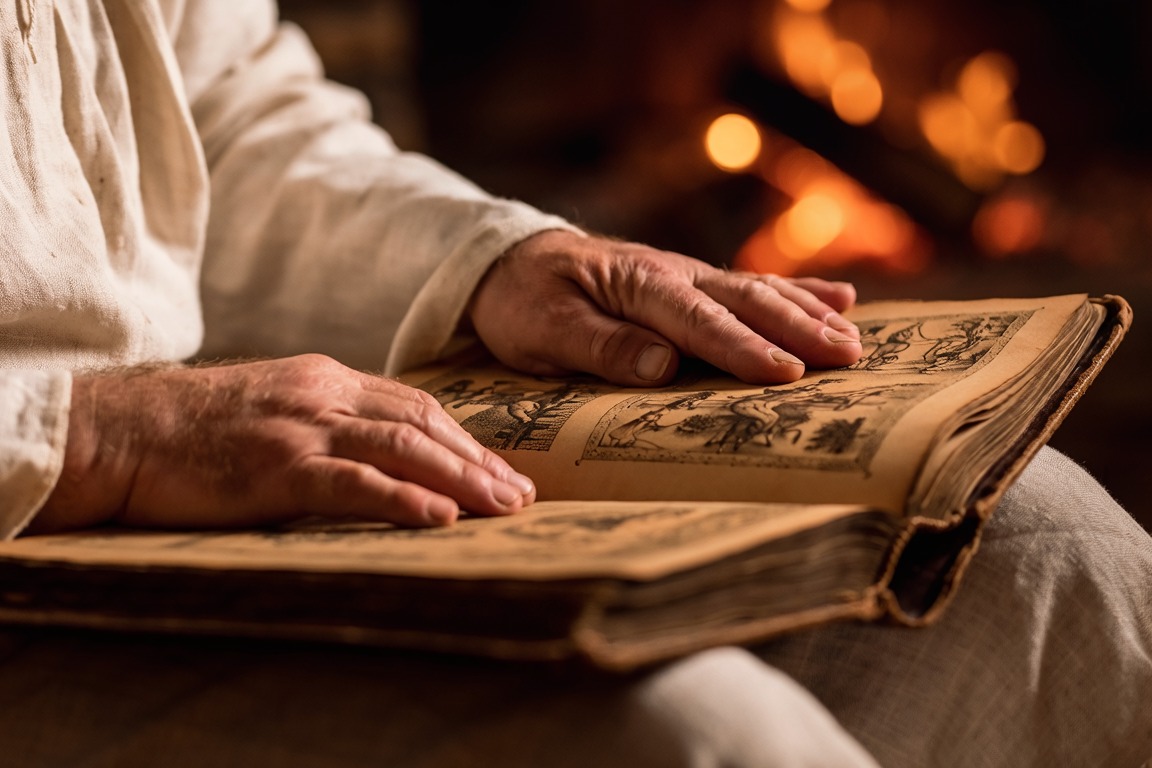
If you are a parent, sit down at that quiet table and begin a conversation the algorithm cannot have on your behalf. Tell your child a story about a person worth becoming. Go first.
If you are a teacher or a coach, you already know, you see it in the room every day, that the young people in front of you are hungry for exactly this, and that no one has handed you the tools. Look for them. Build them. Bring this work, or work like it, into your classroom, courtside, wherever you inspire the next generation.
If you lead a school, understand that you are holding one of the last places in our culture where character can still be formed on purpose, at scale, in the years that matter most. That is not a small responsibility. It may be the most important one you carry.
And if you are simply someone who has read this far and feels something stirring, share it. Send it to the teacher you respect, the principal you know, the parent who is worried. The single most powerful force in the forming of character has always been one person turning to another and saying: this matters, we have stopped acting as though it does, and it is time we began again.
You would not be walking through that doorway alone. There is a growing number of us now: parents who have begun the conversations again at their own tables, teachers quietly carrying this into their rooms, schools choosing the harder road for the children in their care. This is not a campaign with my name on it; it is older and larger than that. It is simply people who have decided, each in their own corner, to stop leaving the most important thing to chance. To stand with them is not to begin something alone. It is to take your place in something already moving.
The Fork in Your Child’s Road
We have spent a long time measuring our children, because what we measure, we manage. It is time we remembered the older and harder truth that stands beside it: what we form, we live. The character we build into a child today is the world we will all live inside tomorrow.
I cannot tell you whether the work we do now will be harvested in five years or in fifty, or whether we will be here to see it. The one who plants an orchard rarely is. But the planting is not made less worth doing by the long wait for the fruit. It is made more so.
One day, sooner than you think, the child you love will walk out to their own fork in the road. The first woman will be there. She always is. The only question that matters, the question this whole essay has been asking, is whether anyone will be standing on the other road to meet them: whether someone, somewhere along the way, will have looked them in the eye and told them that the harder road exists, that it has a name, and that they were always capable of walking it.
Let us be the ones who tell them. Let us plant the trees. Let us form these children as carefully, as deliberately, and as lovingly as if everything depended on it, because it does.
Children are one hundred per cent of our future. Let us form them as if it were true.
About the author
Marcus J Emsley · The Guide
Marcus spent seventeen years as a welfare officer in the Royal Australian Air Force, at home and on operations overseas, sitting with people in grief, trauma and the mornings they did not want to rise. He is the founder of Arete Estate in the Barossa Valley, South Australia, the creator of The Sculptor's Journey and Wisdom & Wonder, and the author of the debut novel Wisdom & Wine. He is the son of a primary school teacher who coached footy, cricket and life, and a palliative care nurse who showed him what kindness at the hardest door looks like. He has stood in the dark himself, and he writes from the far side of it.
What we are building at Arete Estate
Arete is excellence becoming. It is the highest expression of who you were always meant to be, not the finished version, but the version that keeps reaching. It is not built. It is revealed.
Arete Estate exists to help people reveal, not construct, the highest version of themselves. We do this through six virtues drawn from the world's wisdom traditions, taught through stories, walked through daily practice, and offered to anyone who is ready to begin: the parent raising a child, the leader carrying a team, the soldier returning from service, the school shaping the next generation, the person sitting alone in the early hours of the morning wondering if there is a path through.
Our work is to make that path visible. To stand as a lighthouse for the seekers, the grieving, and the broken. To remind every person we reach that excellence is not built, it is revealed by storms, and that they are not alone in the storm.
We do not chase. We shine. The Sculptor's Journey (The Doorway, The Walked Path, The Guided Path), An Hour with the Guide, Meditate with Arete, Wisdom & Wonder and The Sculptor's Library are the rooms of that house.
Six virtues. One journey. Your highest self.
www.areteestate.com.au · info@areteestate.com.au · Instagram @areteestate
If this essay touched something raw
Some of what is written here is heavy. If it has stirred something you are carrying, please do not carry it alone tonight.
Lifeline 13 11 14 · Open Arms (veterans and families) 1800 011 046 · 1800RESPECT 1800 737 732 · Kids Helpline 1800 55 1800 · In an emergency, call 000.
Reaching out is not weakness. It is all six virtues at once: the Fortitude to stay, the Wisdom to know you need a hand, the Love to let someone in, the Courage to ask, the Temperance to set the weight down, and the Gratitude for the one who answers.

Responses