
Gratitude · The Virtue Series, Part Six
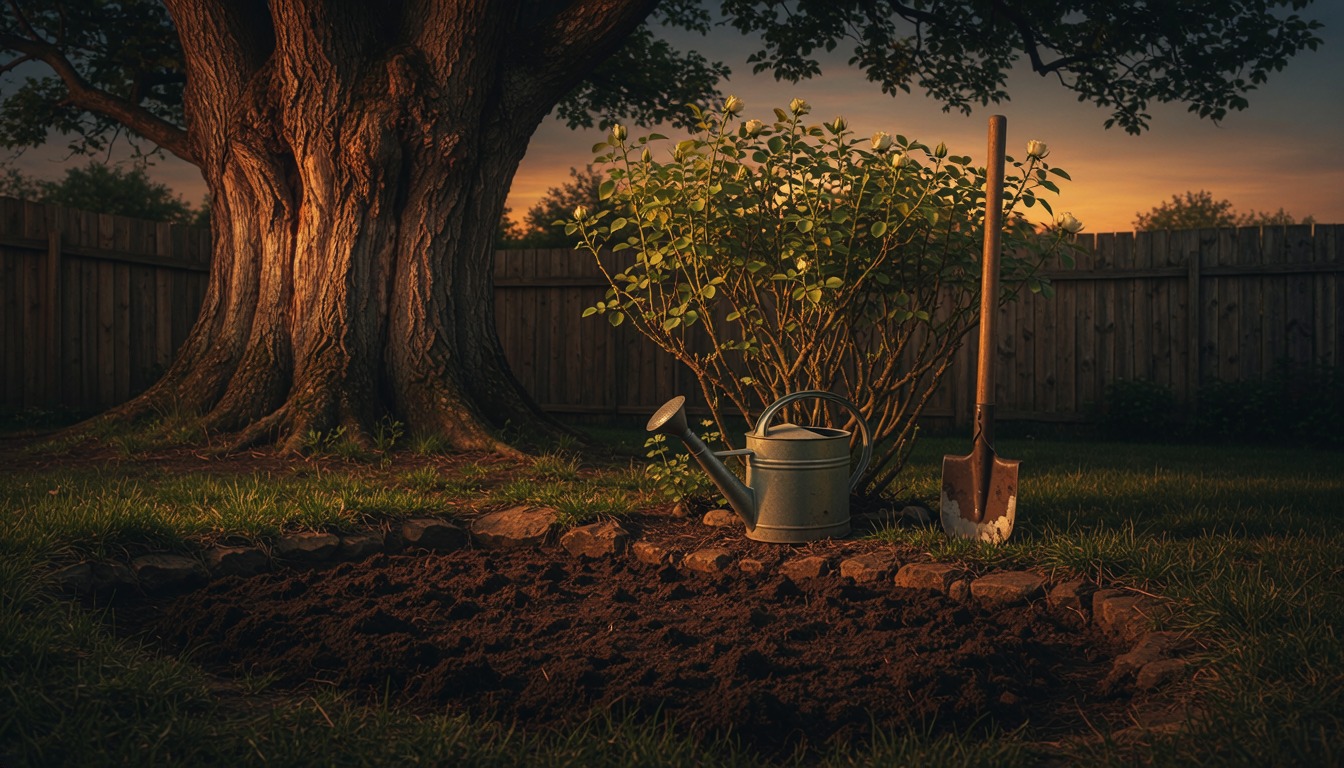
There is a garden.
Not a grand one. Not the kind with gates and groundskeepers and a name on a plaque. The kind at the back of a house, the kind someone built with their own hands over years, on weekends, in the early mornings before work, in the fading light of summer evenings when the rest of the world had gone inside.
The soil here is not perfect. It never was. There is clay in it, heavy and stubborn, the kind that resists the spade and holds water in all the wrong places. There are stones. There are patches where nothing will grow no matter what you plant, and patches where things grow that you never planted at all (volunteers, the gardeners call them), the flowers that arrive uninvited and decide to stay.
You are standing in this garden right now. Look around.
Over there is the rose that nearly died last winter. You cut it back so hard that your neighbour thought you’d killed it. But you hadn’t killed it. You had trusted it. And now, months later, new growth is pushing through, not from the old branches, but from the base, from a place deeper than the frost could reach. It is not the rose you planned. It is the rose that survived. And it is, in a way you didn’t expect, more beautiful for the cutting.
Over here is the tree your grandfather planted. Or your mother. Or someone whose name you’ve forgotten but whose hands are in the soil of this garden whether you know it or not. You didn’t plant it. You don’t fully understand it. But you water it. You tend it. You sit beneath it on hot days and you never once think about the person who put it here, and yet their gift is the shade you are sitting in.
And there, at the edge, the patch you’ve been working on for two seasons. The one that hasn’t produced anything yet. The soil is turned. The seeds are in. The watering has been faithful. But the ground is quiet. Nothing is showing. And every time you walk past it, a voice in your head says: maybe this one isn’t going to work. Maybe you planted in the wrong spot. Maybe the seed was bad.
But you water it anyway. Because you have learned, from the rose, from the tree, from every garden you have ever watched or tended or lost, that some things grow on a timeline you cannot see. And the act of tending something that hasn’t shown you any evidence of success is one of the purest forms of faith a human being can practise.
That is Gratitude.
Not the thank-you card. Not the Instagram post about being blessed. Not the forced positivity that plasters a smile over a hard season and pretends the soil isn’t full of clay.
Gratitude is the way you see the garden. The whole garden: the roses that survived, the trees you didn’t plant, the patch that hasn’t bloomed yet. All of it. At once. Without pretending the difficult parts aren’t there, and without letting the difficult parts be the only thing you see.
Gratitude is not pretending hard things aren’t hard. It is the discipline of seeing what is also true, the seed growing inside the difficult season, the gold that exists alongside the mud.
The Lie About Positivity
We need to clear something away before we go further, because the lie about gratitude is the most dangerous one of all six virtues, and it has caused more harm than any of the others.
The lie is this: gratitude means looking on the bright side.
It sounds harmless. It sounds healthy. It sounds like something a well-meaning person would cross-stitch on a cushion and put in the living room. But in practice, in the real, lived experience of people who are in pain, it is one of the cruellest things you can say.
Because when you tell someone who is grieving to look on the bright side, you are not comforting them. You are silencing them. You are saying: your pain is making me uncomfortable, so could you please rearrange your face and tell me something hopeful. You are asking them to perform gratitude, which is not gratitude at all. It is a mask.
When you tell someone who has lost their job to be grateful they have their health, you are not helping them see the bigger picture. You are minimising the picture they are actually standing in. You are telling them that their grief is the wrong size, that it should be smaller, tidier, more convenient for the people around them.
When you tell a mother who has just miscarried that everything happens for a reason, you are not offering wisdom. You are offering violence dressed as comfort. And she will smile and nod and say thank you because that is what the world requires of her, and she will go home and sit in a room alone with a pain that has just been told, by someone who claims to love her, that it doesn’t have permission to exist.
That is not gratitude. That is toxic positivity. And it is the enemy of the real thing.
Dietrich Bonhoeffer, who wrote about gratitude from inside a Nazi prison, knowing he would likely die there, understood the difference:
“Gratitude changes the pangs of memory into a tranquil joy.” (Dietrich Bonhoeffer)
Read that carefully. He does not say gratitude removes the pangs. He does not say gratitude replaces the memory. He says it changes them, transforms them, slowly, into something that can be held without being destroyed by it. The pain is still there. The memory is still there. But gratitude, real gratitude, the kind that has earned its place through honest reckoning with the hard thing, changes the way you carry it. Not the weight. The grip.
What It Actually Is
Real gratitude is not a feeling. It is a discipline. A way of seeing. A practice you return to daily, not because the world is good, but because the world is complicated, and inside the complication there is always more than one thing happening.
The season is hard, and your daughter laughed at dinner last night in a way that sounded exactly like your mother. Both of those things are true. Both of them are happening at the same time. Gratitude is the discipline of holding both.
The job is gone, and the sunset tonight was the kind that makes you pull the car over. The bank account is frightening, and the friend who called this morning didn’t ask how you were doing because she could hear it in your voice, and she just talked, about nothing, for twenty minutes, and when she hung up, something in your chest had loosened. The diagnosis is real, and the hand your partner put on your back last night, in the dark, without a word, was the most honest thing anyone has said to you in weeks.
Gratitude is not choosing the good over the bad. It is refusing to let the bad be the only thing in the room.
Brother David Steindl-Rast, a Benedictine monk who has spent decades studying gratitude as a spiritual practice, said something that reframed the entire concept for me:
“It is not happiness that makes us grateful. It is gratefulness that makes us happy.” (Brother David Steindl-Rast)
Read that again. It is not the good circumstances that produce gratitude. It is the practice of gratitude that produces the capacity to see good, even inside circumstances that are anything but.
That is a radical claim. It says that gratitude is not a response to life going well. It is a way of engaging with life regardless of how it is going. It is a lens, not a mood. You can pick it up on the worst day of your life and look through it, and you will see things, small things, quiet things, things that were always there, that the pain alone would never have shown you.
What It Actually Looks Like
Gratitude, lived, is quieter than a prayer and louder than a sermon. It is the thing you notice when you finally stop long enough to see what has been in front of you the whole time.
It looks like a man driving home from his father’s funeral. The road is long. The car is quiet. The suit is uncomfortable. He has spent three days receiving condolences from people who didn’t know his father the way he did, the difficult version, the complicated version, the version that was not always kind and not always present and not always the father he needed. And he is tired, tired in the way that grief makes you tired, which is tired of everything, all at once, including yourself.
And then, on a straight stretch of highway, with the afternoon sun coming through the windscreen at an angle that turns the dashboard golden, he remembers something. His father, thirty years ago, teaching him to ride a bike. Not the crash. Not the lecture about trying harder. The moment after, when his father knelt down on the footpath, looked him in the eye, and said: you’re alright, mate. We’ll go again tomorrow.
That’s all. A single sentence from a complicated man on an ordinary afternoon three decades ago. And it breaks something open in the car. Not the grief; that was already open. Something else. A small, warm recognition that inside the difficulty of his father, inside the silences and the distance and the things that were never said, there was also this. This moment. This knees-on-the-footpath, you’re-alright-mate moment that nobody filmed and nobody wrote down and that he had forgotten until this exact second on this exact stretch of highway.
That is gratitude. Not the erasure of the hard parts. The discovery of the gold that was hiding inside them.
It looks like a woman sitting in a hospital bed, two days after a surgery that saved her life and took something from her in the process. The room smells of antiseptic. The gown is humiliating. The body she woke up in is not the body she went to sleep in. And she is grieving, for the thing she lost, for the version of herself that walked into this hospital and will not walk out.
Her daughter arrives. Seventeen years old. Carrying a paper bag with a muffin in it, the kind from the bakery down the road, the one they used to go to on Saturday mornings when the daughter was small enough to sit on the counter. The daughter puts the bag on the bed. She doesn’t say anything profound. She says: I got you the blueberry one. And she sits down.
And the woman in the hospital bed, who has every reason to be consumed by what she has lost, looks at this girl, this fierce, awkward, beautiful girl who brought a muffin and sat down, and feels something that the grief had been covering like cloud cover. A warmth. A recognition. A quiet, unannounced arrival of something that does not cancel the pain but sits beside it, equal in weight:
I am still here. And she is here. And there is a blueberry muffin on this bed. And that is not nothing. That is not a small thing. That is everything.
It looks like a retired teacher receiving a letter. Years after the classroom. Years after the daily grind of lesson plans and difficult students and the quiet suspicion that none of it was making any difference. The letter is from a student she barely remembers, a quiet kid, middle of the class, the kind who never gave trouble and never stood out. And the letter says: you changed my life. You probably don’t know it. You probably don’t remember me. But something you said in Year 9, I don’t even remember the exact words, stayed with me. And it’s still with me. And I wanted you to know.
She sits at her kitchen table and reads the letter twice. And what she feels is not pride. It is something much deeper and much more humbling than pride. It is the gratitude of the gardener who planted something she never saw grow, and just learned, decades later, that it bloomed.
Gratitude rarely arrives with fanfare. It arrives in a muffin on a hospital bed, a letter from a student you forgot, a memory on a highway at the exact moment the sun hits the dashboard. It arrives when you stop looking for the grand and start noticing what was always there.
Planting What You Won’t Harvest
This is the part of gratitude that most people never reach, and the part that, once you feel it, changes the way you live.
Gratitude is not only about receiving. It is about giving, in a very specific and very demanding way.
Think about the tree your grandfather planted. He put it in the ground knowing, whether he said it aloud or not, that he would not sit in its shade. The canopy he imagined was decades away. The fruit it would bear belonged to people he might never meet. And he planted it anyway. Not for himself. For the future. For you.
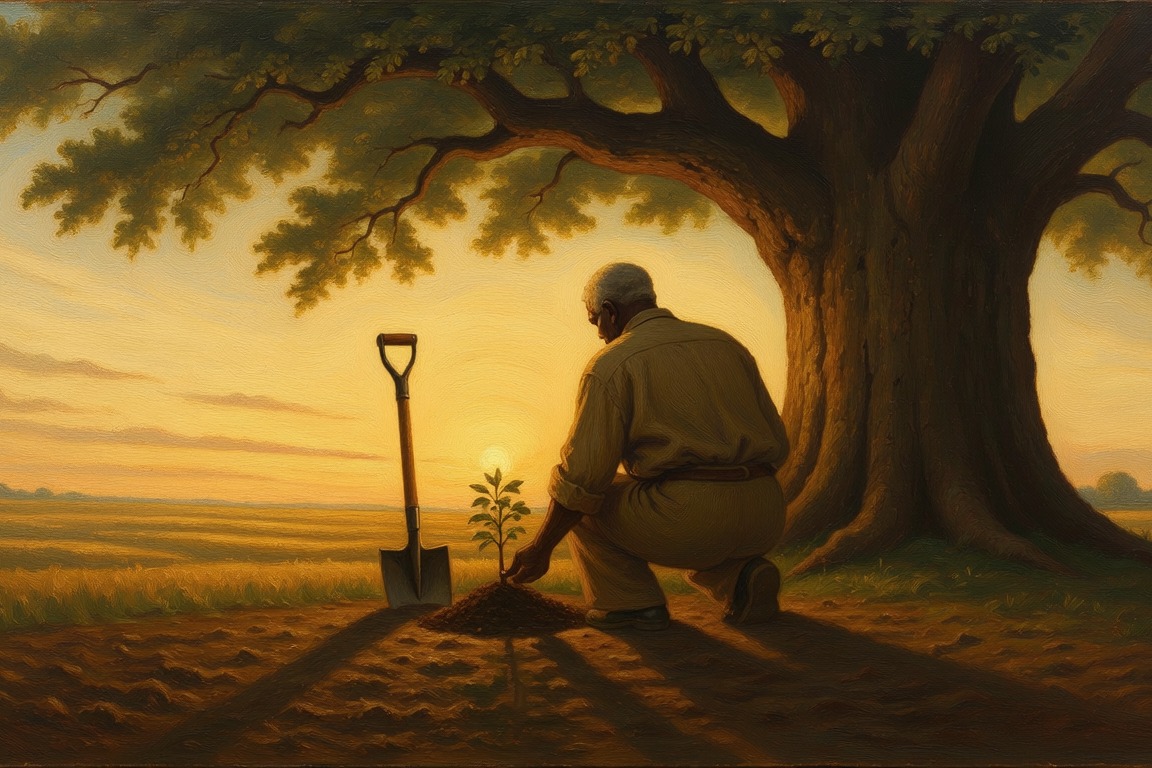
That is a kind of generosity that the modern world barely understands. We live in a culture of immediate return. Plant the seed, harvest the crop, post the results. We want to see the fruit of our labour while our hands are still dirty. And when the fruit doesn’t come quickly, when the garden is quiet, when the seeds are in the ground but the soil shows nothing, we lose faith. We pull up the seedlings. We move on to something faster.
But the gardener knows better. The gardener knows that some of the most important things you will ever plant, the values you teach your children, the kindness you show a stranger, the steady presence you offer a friend in their worst season, will not produce visible fruit in your lifetime. And the act of planting them anyway, without guarantee, without receipt, without a single shred of evidence that it’s working, is the deepest expression of gratitude there is.
Because it says: I received something. Someone planted for me. Someone tended soil I grew in. Someone watered ground I never thanked them for. And the most honest way I can say thank you is not a card, not a speech, not a social media post. It is to do the same thing for someone else. To plant what I won’t harvest. To tend what I didn’t plant. To trust the timeline of the garden rather than the timeline of my ego.
An old Greek proverb captures this with devastating simplicity:
“A society grows great when old men plant trees in whose shade they shall never sit.” (Greek proverb)
That is not a metaphor for retirement planning. That is a philosophy of life. It says that the measure of a person, the real measure, the one that matters after everything else has been forgotten, is not what they harvested. It is what they planted.
And this is the second half of the teaching, the part that is even harder:
Tending what you didn’t plant.
Because you did not choose the soil you were given. You did not choose the climate. You did not choose the stones in the ground or the clay that resists the spade or the patch where nothing grows. Some of what is in your garden was placed there by other people’s decisions, their generosity, their neglect, their love, their damage. And gratitude, real, mature, hard-won gratitude, is the willingness to tend it all. To pull the weeds you didn’t sow. To water the trees you didn’t plant. To work the soil you inherited, with all its imperfections, and say: this is my garden. I did not design it. But I will tend it. And I will leave it better than I found it.
Planting what you won’t harvest, and tending what you didn’t plant. That is gratitude lived. That is the gardener’s creed. That is the final virtue, and it changes everything.
Gratitude in the Hard Season
Every virtue is tested in the storm. And gratitude’s test is perhaps the most brutal of all, because the storm asks you to be grateful while you are in pain. And that sounds, on the surface, like cruelty.
It is not. It is an invitation to depth.
Viktor Frankl, who understood suffering from the inside of Auschwitz, wrote something about gratitude that should be read slowly, with care, because it comes from a place most of us will never visit:
“Everything can be taken from a man but one thing: the last of the human freedoms, to choose one’s attitude in any given set of circumstances.” (Viktor Frankl, Man’s Search for Meaning)
To choose one’s attitude. Not to choose one’s circumstances. Not to choose whether the storm comes. But to choose, in the hospital bed, at the funeral, on the highway, in the empty house, in the quiet garden where nothing is growing, what you will see. What you will notice. What you will let into the room alongside the pain.
That is not toxic positivity. That is the hardest form of agency a human being possesses. It is the final freedom, the one that remains when every other freedom has been removed.
Meister Eckhart, the medieval mystic, boiled the entirety of prayer, and perhaps the entirety of the spiritual life, down to two words:
“If the only prayer you ever say in your entire life is ‘thank you,’ that would suffice.” (attributed to Meister Eckhart)
Thank you. Not please. Not help. Not why. Thank you. Spoken into the dark. Spoken into the pain. Spoken into the garden that hasn’t bloomed yet and the soil that resists and the season that will not end. Thank you, not because everything is good, but because you are still here, still tending, still planting, still able to see the blueberry muffin and the letter from the student and the memory on the highway.
Thank you is not a conclusion. It is a beginning. Every time you say it and mean it, every time you notice something that the pain was trying to hide, you change. Not the circumstances. You. The lens shifts. The garden looks different. Not because anything grew overnight. Because you learned to see what was already growing.
What Gratitude Needs Beneath It
Gratitude is the sixth virtue. The last. And it needs every one of the others, because without them, gratitude becomes performance. A word said without weight. A card sent without meaning. A prayer recited without the life behind it.
It needs Fortitude, because being grateful in the storm requires roots. It needs Temperance, because gratitude is not about seeing only the good but about seeing everything in proportion: the grief and the grace, the loss and the gain, the hard and the holy. It needs Wisdom, because gratitude without reflection notices the muffin but forgets to ask what it means. It needs Love, because the deepest gratitude is always relational: the hand on your back, the daughter with the muffin, the grandfather who planted the tree. Gratitude without love is a list. Gratitude with love is a garden. And it needs Courage, because sometimes the most grateful thing you can do is also the most frightening: forgiving someone, letting go of the version of events that has kept you safe but also kept you stuck, saying thank you to a season of suffering, not for the suffering, but for what it grew in you.
Gratitude is not a single virtue. It is the soil in which all the others grow.
Tonight
You have walked a long path to get here.
Six virtues. Six invitations to look at your life through a lens you may not have used before. Fortitude asked you to find your roots. Temperance asked you to find your rhythm. Wisdom asked you to find the gold. Love asked you to make the choice. Courage asked you to face the wind. And now, here, at the end, in the garden, Gratitude asks you the simplest and the hardest question of all:
What is growing in your life right now that you haven’t noticed?
Not the big things. Not the achievements or the milestones or the things that go on the highlight reel. The small things. The things that were there this morning and will be there tomorrow and have been there so long you stopped seeing them.
The person who makes the coffee. The child who still reaches for your hand, even though they are getting too old for it and one day, one day soon, they will stop. The friend who hasn’t given up on you, even though you’ve cancelled three times. The body that carried you through another day, imperfect and complaining and miraculous. The roof. The breath. The fact that you are here, reading this, alive, on a planet that is spinning through space at a thousand miles an hour and somehow, against all probability, holding you steady.
Tonight, I am not going to ask you to be grateful for the hard things. I am not going to ask you to find the silver lining or look on the bright side or perform thankfulness for someone else’s comfort.
I am going to ask you to do one thing.
Go into your garden.
Not a real garden, though if you have one, by all means. Your garden. The life you have been building, tending, neglecting, grieving, celebrating, surviving. Stand in it. Look around. See the roses that survived the cutting. See the trees you didn’t plant. See the patch that hasn’t bloomed yet. See it all: the weeds and the flowers, the clay and the gold, the grief and the grace.
And say, to yourself, to the garden, to nobody in particular, two words.
Thank you.
Not because everything is good.
Because you are still here. Still tending. Still planting.
And something is growing. You may not be able to see it yet, but it is there. I promise you it is there.
The Path
These six virtues are not a checklist. They are not a programme. They are not something you achieve and then possess. They are a path, walked daily, returned to often, practised imperfectly and completely, for the rest of your life. And the path is always here. The lighthouse is lit. The conductor is waiting. The river has gold. The lavender is growing. The wind is blowing. And the garden, your garden, the one you’ve been tending all along, whether you knew it or not, is ready for you.
Excellence revealed by storms. You have been walking this path longer than you think.
Meditate with Arete
A Sculptor's Pause Before the next thing, rest here a while. Meditate with Arete is a quiet room: a two-minute sitting, one breath at a time, with nothing asked of you. Sit with Arete
About the author
Marcus J Emsley · The Guide
Marcus spent seventeen years as a welfare officer in the Royal Australian Air Force, at home and on operations overseas, sitting with people in grief, trauma and the mornings they did not want to rise. He is the founder of Arete Estate in the Barossa Valley, South Australia, the creator of The Sculptor's Journey and Wisdom & Wonder, and the author of the debut novel Wisdom & Wine. He is the son of a primary school teacher who coached footy, cricket and life, and a palliative care nurse who showed him what kindness at the hardest door looks like. He has stood in the dark himself, and he writes from the far side of it.
What we are building at Arete Estate
Arete is excellence becoming. It is the highest expression of who you were always meant to be, not the finished version, but the version that keeps reaching. It is not built. It is revealed.
Arete Estate exists to help people reveal, not construct, the highest version of themselves. We do this through six virtues drawn from the world's wisdom traditions, taught through stories, walked through daily practice, and offered to anyone who is ready to begin: the parent raising a child, the leader carrying a team, the soldier returning from service, the school shaping the next generation, the person sitting alone in the early hours of the morning wondering if there is a path through.
Our work is to make that path visible. To stand as a lighthouse for the seekers, the grieving, and the broken. To remind every person we reach that excellence is not built, it is revealed by storms, and that they are not alone in the storm.
We do not chase. We shine. The Sculptor's Journey (The Doorway, The Walked Path, The Guided Path), An Hour with the Guide, Meditate with Arete, Wisdom & Wonder and The Sculptor's Library are the rooms of that house.
Six virtues. One journey. Your highest self.
www.areteestate.com.au · info@areteestate.com.au · Instagram @areteestate
If this essay touched something raw
Some of what is written here is heavy. If it has stirred something you are carrying, please do not carry it alone tonight.
Lifeline 13 11 14 · Open Arms (veterans and families) 1800 011 046 · 1800RESPECT 1800 737 732 · Kids Helpline 1800 55 1800 · In an emergency, call 000.
Reaching out is not weakness. It is all six virtues at once: the Fortitude to stay, the Wisdom to know you need a hand, the Love to let someone in, the Courage to ask, the Temperance to set the weight down, and the Gratitude for the one who answers.

Responses