
Fortitude · The Virtue Series, Part One. Fortitude is roots, not hardness.
Close your eyes for a moment. I want to take you somewhere.
There is a headland. You can feel the wind before you see the water, cold and salt-heavy, pressing against your chest like an open hand. The grass under your feet is short and coarse, beaten flat by years of weather that never learned to be gentle. Behind you, the town has gone dark. The last window light flickered out an hour ago. Ahead of you, there is nothing but ocean and sky and the sound of water breaking on rock far below.
And there, at the very edge, where the land gives up and the darkness begins, stands a lighthouse.
It is old. Not in the way museums are old, curated and kept behind glass. Old in the way that working things are old. Salt-stained stone. Rust-surrendered railings. Glass thick with decades of airborne grit. Nothing about this lighthouse is polished. Nothing about it is performing.
But the light is on.
It was on last night, when the sea was a mirror and the ships passed easily. It was on the night before, when the storm turned the water into something unrecognisable and the rocks below vanished under walls of white foam. It was on the night the power failed in the town behind it, and the keeper climbed the stairs in the dark, one hundred and forty-seven of them, spiralling upward through stone that smelled of damp and oil and something older, and lit the lamp by hand.
Because the light is not optional. The light is the point.
The keeper’s knees ached on the stairs. The keeper’s hands were numb with cold. The keeper did not feel heroic. Did not feel inspired. Did not feel like the subject of an essay about virtue. The keeper simply climbed. Because someone might be out there. Because the dark does not wait for you to feel ready. Because this is what the lighthouse was built for: not to stand in good weather and look impressive, but to send light into the worst night of someone’s life and ask for nothing in return.
Hold that image. Feel the wind. Smell the salt.
Now ask yourself: when did I last climb the stairs when no one was watching?
The Lie We Were Sold
Somewhere along the way, someone sold us a lie about what it means to be strong.
They sold it to boys first. Don’t cry. Toughen up. Be a man. As though tears were a structural failure rather than a pressure valve doing exactly what it was designed to do. They sold it to girls, too, just with different packaging. Don’t make a fuss. Keep smiling. Hold it all together. As though asking for help was a confession of inadequacy rather than an act of intelligence.
They sold it to soldiers. To nurses. To first responders. To single parents and grieving widows and anyone who carried weight for other people. They said: absorb the impact. Show no bruise. Lock the door. Swallow it. Keep going.
And they called it fortitude.
It wasn’t.
It was a costume. Hardness dressed up as strength. And it was quietly, invisibly, breaking people in rooms nobody checked on, over timelines nobody measured.
I know this because I sat in those rooms for seventeen years. In the Australian Defence Force, in welfare offices that smelled like instant coffee and unspoken grief, I sat across from men and women who had done everything the world told them fortitude required. They had not flinched. They had not complained. They had carried things that would buckle most of us, and they had carried them alone, jaws clenched, doors locked, exactly as instructed.
And now they were sitting in front of me for the first time in their lives, sometimes with their hands shaking, sometimes with a steadiness that was more frightening than the shaking, and they were all asking the same question:
Why is everything cracking when I did everything right?
Because the map was wrong. The whole map was wrong. They had been given a definition of strength that was designed to look impressive from the outside and was hollowing them out from within.
Real fortitude, the kind the ancient Greeks built philosophies around, the kind that holds families together across generations, the kind that lets a person walk into the same fire twice and still recognise themselves on the other side, has never been hardness.
Think of a wall in a storm. Concrete. Massive. Rigid. It takes the full force of the wind head-on, refusing to give an inch. And for a while, it looks invincible. It looks like exactly what strength should be. Until one gust, not even the strongest, just the one that finds the crack that was always there, and the whole thing comes apart. Concrete into rubble. Because rigid things do not bend. They break.
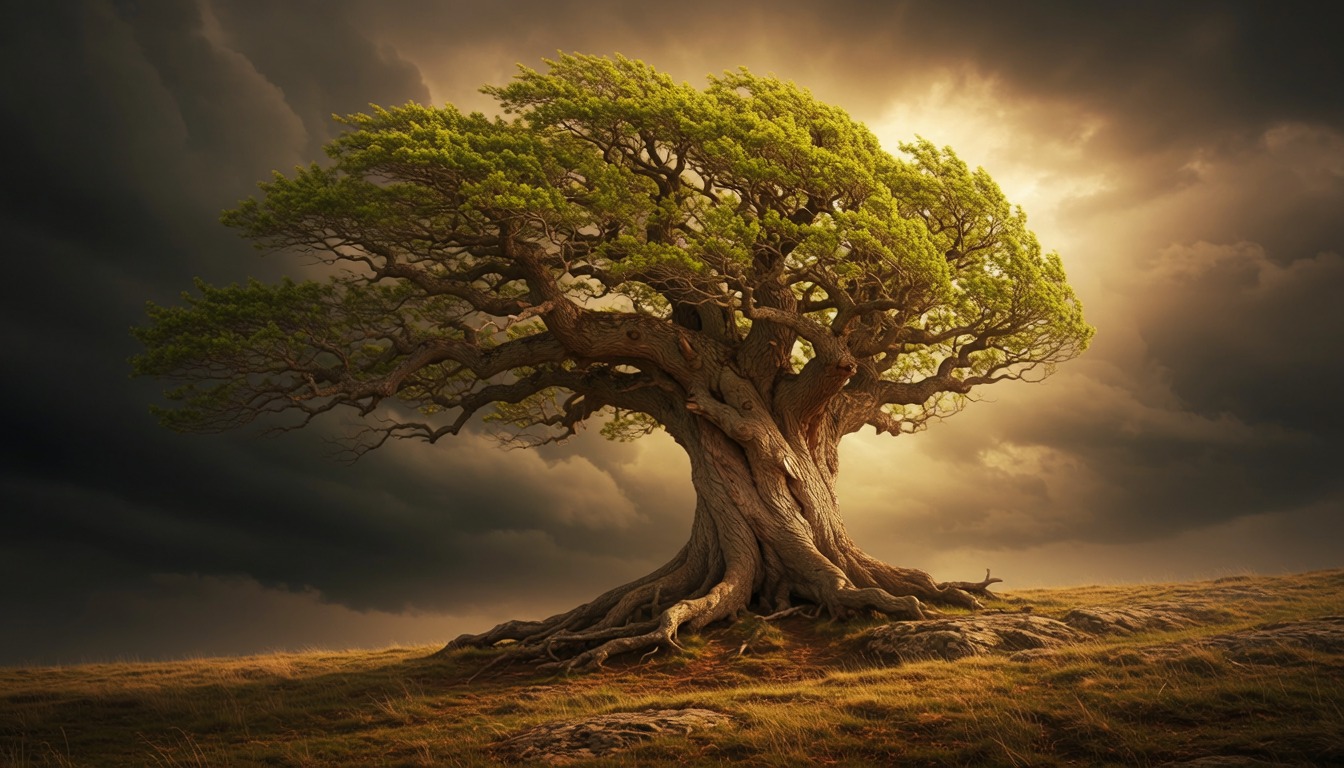
Now think of a tree.
An old one. The kind that has stood on the same hillside for a hundred years, through droughts that turned the earth to powder and winds that stripped every leaf from its branches. The kind that has looked, more than once, like it was finished. But it wasn’t finished. Because while the world was watching the branches, the visible part, the part that thrashes and cracks and looks like losing, something else was happening underground.
The roots were deepening.
Every storm that hit the canopy sent a signal to the roots: go further. Hold tighter. Find water the surface doesn’t know about. Reach for rock the topsoil has never touched. And when the storm passed, the tree was still standing. Not because it resisted the wind; it didn’t. The branches bent. Some of them broke. Leaves scattered across the valley. But the roots held. The roots always held.
Fortitude is not the wall that refuses to move. It is the roots beneath the tree, deepening in the dark, holding fast while the branches bend.
That is the difference the lie obscured. Hardness resists everything and eventually shatters. Rootedness absorbs everything and grows stronger in the deep.
You were never meant to be the wall. You were always meant to be the tree.
An Old Fire, Still Burning
This understanding is not new. It is ancient. And the fact that it has survived two thousand years of noise, reinterpretation and cultural forgetting tells you something about how deeply true it is.
Marcus Aurelius governed the Roman Empire through plague, war and the betrayal of people he had loved and trusted. He did not write his Meditations for publication. He wrote them in military camps, by candlelight, as private notes to himself, a man trying to stay human inside circumstances that were trying to make him otherwise. And this is what he wrote, alone, in the dark, with the weight of the known world on his shoulders:
“Be like the rocky headland on which the waves constantly break. It stands firm, and round it the frothing waters are laid to rest.” Marcus Aurelius, Meditations
The waves break on it constantly. Not occasionally. Constantly. And the headland remains. Not untouched (the salt eats at it, the wind shapes it, the water has carved it into something it was not before) but it remains. Because somewhere beneath the waterline, beneath the surface the world can see, there is rock. That is what fortitude felt like to a man who had every reason to break and didn’t. Not because he was hard. Because he was connected to something the waves couldn’t reach.
Epictetus came to the same truth from a place that would silence most of us. He was born into slavery. His leg was broken and never healed straight. And the man who could not control his own body built one of the most influential philosophical schools in history. Not despite the suffering. Through it. His teaching, in its plainest form, is that it is not what happens to you, but how you meet it, that matters. From any other mouth that sentence belongs on a coffee mug. From his, from a man whose freedom was stolen and whose body was broken, it is the sound of roots hitting bedrock.
And from the East, the same fire, burning in different light. The Buddhist tradition teaches that suffering arises not from the storm, but from our war with the storm, from the clenched resistance that says this should not be happening. The invitation is not to stop feeling. It is to stop fighting the feeling. To let the branches bend. To trust the roots.
The storm is not the enemy. Your relationship with it is. And fortitude is not the art of fighting the storm. It is the art of growing roots deep enough that the storm becomes weather.
What It Actually Looks Like
Forget the movie version. Forget the clenched fist and the battle cry and the slow-motion walk through fire. Those moments exist, but they are the exception. Fortitude, lived, is quieter than that. Smaller. More ordinary. And infinitely harder to sustain.
It is 5:47am and a single mother’s alarm is going off. Her body is begging for another hour. The house is cold. The lunches need packing. The school uniforms are in the dryer because she forgot to fold them last night and there is a specific kind of guilt that lives in that sentence (I forgot, again) that only parents who are running on empty understand. She can hear one child awake already, singing to nobody, and she knows the other one will start crying in about ninety seconds. Nobody will thank her for the next fourteen hours. Nobody will look at her tonight, when the kitchen is finally clean and the house is finally quiet and she is finally sitting down with cold tea and sore feet, and say: what you did today was one of the bravest things a human being can do.
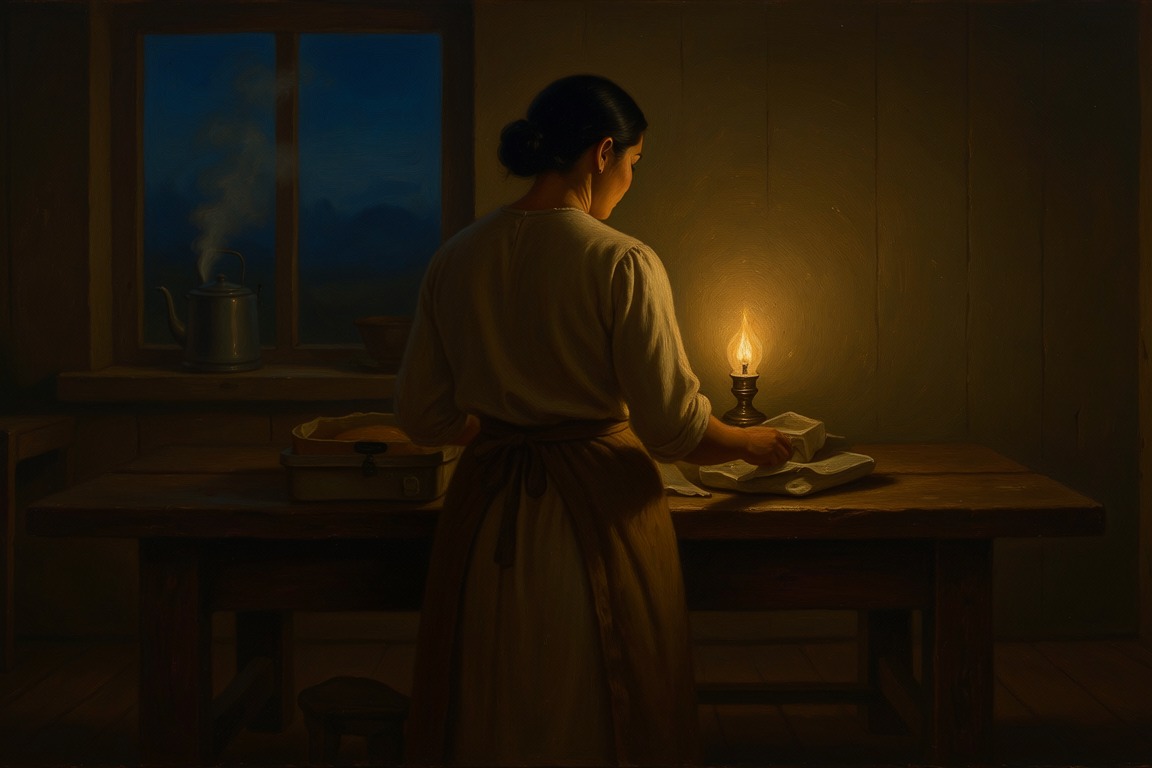
But it was. It was fortitude. And it deserves to be called that.
It is 8:14am and a man in his fifties is sitting in his car outside his office, both hands on the steering wheel, engine off. He has been here for eleven minutes. Inside that building is a job that has slowly drained every drop of meaning from his days. Not dramatically; there was no single moment of crisis, no betrayal, no disaster. Just the slow, grey erosion of purpose that happens when you spend years doing something that no longer aligns with who you are becoming. He opens the car door. He goes in. Not because he is passionate. Not because he is inspired. Because people depend on him, and the light is not optional, even when the keeper can barely see the stairs.
It is a Tuesday afternoon in October and a woman is standing in a cemetery. The grass is wet. It has soaked through her shoes and she hasn’t noticed. She is talking to a headstone, softly, the way you talk to someone who is in the next room and might be sleeping. Six months ago, this place was full of people. Flowers covered the ground. Now the flowers are gone. The casseroles stopped arriving weeks ago. The phone calls have thinned to a trickle. The world has moved on because the world always moves on, and she is here, alone, in the rain, because grief does not follow the schedule the world allots for it. Standing here is not moving on. It is not letting go. It is something harder than both: it is showing up, again, when the showing up itself is all that’s left.
It is day forty-three. Not day one; day one gets the applause, the encouragement, the text messages, the brave label. Day forty-three gets nothing. Day forty-three is just another morning where the recovering addict wakes up and the craving is quieter but still there, still humming beneath the surface like a frequency only they can hear. And they choose, again, without ceremony, without anyone marking it in their calendar, to stay on the path. Nobody will call this heroic. It is. It is fortitude in its most pure and unwitnessed form, the repetition of a good decision that no one sees.
It is you. Right now. Carrying something you haven’t fully named to anyone. Getting up tomorrow. Doing the next thing. Not because you feel strong.
Because you have roots.
And the roots hold, even when you’ve forgotten they’re there.
Fortitude rarely looks like the headline. It looks like the Tuesday. It looks like the 5:47am alarm, the parked car, the wet cemetery grass, day forty-three. It looks like you, doing the next right thing in the quiet.
The Storm Nobody Sees
There is one more thing, and I need to say it carefully because it might be the most important part of this essay.
Everything I’ve described so far, the lighthouse, the tree, the single mother, the man in the car, involves a storm that other people can see. A visible difficulty. Something the world can name and, in its limited way, acknowledge.
But there is another storm. The one that lives only inside you. And it is harder.
It arrives at 4am. Not with a crash. With a settling. A weight on the chest that has no address. A tightness you cannot explain to anyone because there is nothing to point at, nothing that happened, nothing that changed. Just a humming dread that sits behind your sternum and refuses to leave. You lie in the dark and try to breathe through it. The breathing helps, and then it doesn’t. The clock says 4:23 and then 4:41 and then 5:07 and then the alarm goes off and you get up and make the coffee and answer the emails and smile at the right moments and nobody, not one person in your entire day, knows you have been fighting a battle since before dawn.
Or it comes slower. A lowering. Not a crash, but a ceiling that drops, inch by inch, over weeks, until you are living in a corridor where the things that used to light you up, music, laughter, the face of someone you love, arrive muffled, wrapped in cloth. You can see everything. You can feel almost nothing. And the effort of pretending otherwise, for the people who need you, is a form of endurance that should come with its own medal but never will.
Or it is the grief that won’t finish. Not new grief, old grief, wearing a disguise. The loss that ambushes you in a supermarket when a song plays. The smell of a perfume that belongs to someone who is gone. The world has decided you should be done with this by now. You have exceeded the approved timeline. And so you carry it in silence, because you know people are tired of hearing about it, and the room is still lit, and the power is still draining, and nobody knows.
Seneca, a man who wrestled privately with fear, contradiction and the knowledge of his own imperfection while the world saw only his eloquence, wrote a line that still drops the floor out from under me every time I read it:
“Sometimes even to live is an act of courage.” Seneca, Letters to Lucilius
Sometimes even to live. Not to conquer. Not to triumph. Not to post the inspirational quote or hit the milestone or stand on the stage and be celebrated. Just to live. To open your eyes. To put your feet on the cold floor. To make the coffee. To get through the morning. To show up for another day in a body that doesn’t always feel like home, in a mind that doesn’t always cooperate, in a world that doesn’t always make sense.
If that is where you are tonight, if the storm is inside you, and it has been for a while, and you are not sure how much longer the lamp has fuel, then hear this:
You are not failing. You are not broken.
You are the keeper on the one hundred and forty-seventh step. Knees aching. Hands cold. Climbing not because you feel heroic but because the light will not light itself and someone might be out there in the dark who needs it.
That someone might be you.
If the storm is inside you and the light is still on, you are the lighthouse.
Why This One Comes First
There are six virtues on The Arete Path. None is more important than the others. But Fortitude comes first, and it must, for a reason you will feel in your body if you sit with it.
Without the capacity to hold firm when the weather changes, every other virtue you possess becomes a fair-weather friend. You can practise Temperance beautifully on a calm day, until the phone rings with news that rearranges everything and the conductor drops the baton. You can practise Wisdom as long as the mud is hypothetical; it takes roots to stand in real mud and still see the gold. You can practise Love until the person you love slams the door; love without fortitude crumbles into rage or retreat, and love with roots says, through clenched teeth if necessary: I am not going anywhere. Courage without fortitude is a firework, brilliant, brief, and then dark. Gratitude without fortitude becomes a mask, a smile plastered over a wound.
Fortitude does not replace the other virtues. It holds the ground they stand on. Pull it away, and everything built on top of it falls.
The Teaching
Each virtue on The Arete Path carries a teaching: a single line, spoken quietly, meant to be held like a stone in the palm of your hand. Not a commandment. Not a rule. An invitation.
The teaching of Fortitude is this:
Stand firm and shine, even when the storm is inside you.
Stand firm. Not rigid. Not clenched. Rooted. Connected to something beneath the surface that holds you when everything above ground is in chaos. Your values. Your purpose. The people you love. The work that matters. The truth of who you are when everything decorative has been stripped away.
And shine, because standing firm without shining is just a tower. Endurance without warmth, without service, without the willingness to send something of yourself into the darkness for the sake of someone else, that is survival, not fortitude. The shining is the point. The moment your steadiness becomes visible to someone who is searching, that is when the lighthouse fulfils its purpose.
Even when the storm is inside you, especially then. Anyone can shine on a calm night. The lighthouse earns its name in the storm. When the windows rattle. When the keeper’s knees ache on the stairs. When the lamp must be lit by hand in the dark. That is when fortitude stops being a word and becomes the most human thing there is.
Tonight
There is a storm somewhere in your life right now.
You know the one. You have been carrying it. Maybe for days, maybe for years. It might be the kind other people can see. Or it might be the kind that lives behind your ribs, battering you from the inside while the world sees calm water.
Either way, and this is the part I want you to feel, not just read, you have already survived every storm that has ever hit you. Every single one. The evidence is that you are here, reading this, still looking for light. That is not a small thing. That is the tree still standing. That is one hundred and forty-seven steps climbed in the dark.
So tonight, I am not going to ask you to be stronger. I am not going to give you a five-step plan or a framework for resilience or a motivational speech about enduring.
I am going to ask you one thing.
Will you keep the light on?
Not for the world. Not for applause. Not for anyone else’s timeline or expectation or measurement of what strength should look like.
For the ship you cannot see. The one out there in the dark right now, searching for exactly the kind of steady, imperfect, unglamorous light that you carry. They don’t need you to be fixed. They don’t need you to be finished. They need you to be burning.
And for yourself. For the version of you that climbed the stairs tonight when no one was watching and lit the lamp by hand because the dark does not wait and the light is not optional.
I will keep the light on.
The lighthouse does not argue with the storm. It does not negotiate with the waves. It does not compare its weather to the weather of other lighthouses on other headlands.
It stands. It shines. And the ships that need it, find it.
That is Fortitude. The first virtue. The foundation. The root system that holds every other virtue in place.
Stand firm and shine.
Even when the storm is inside you.
Especially when the storm is inside you.
A Sculptor's Pause
Before the next thing, rest here a while. Meditate with Arete is a quiet room: a two-minute sitting, one breath at a time, with nothing asked of you. Sit with Arete
About the author
Marcus J Emsley · The Guide
Marcus spent seventeen years as a welfare officer in the Royal Australian Air Force, at home and on operations overseas, sitting with people in grief, trauma and the mornings they did not want to rise. He is the founder of Arete Estate in the Barossa Valley, South Australia, the creator of The Sculptor's Journey and Wisdom & Wonder, and the author of the debut novel Wisdom & Wine. He is the son of a primary school teacher who coached footy, cricket and life, and a palliative care nurse who showed him what kindness at the hardest door looks like. He has stood in the dark himself, and he writes from the far side of it.
What we are building at Arete Estate
Arete is excellence becoming. It is the highest expression of who you were always meant to be, not the finished version, but the version that keeps reaching. It is not built. It is revealed.
Arete Estate exists to help people reveal, not construct, the highest version of themselves. We do this through six virtues drawn from the world's wisdom traditions, taught through stories, walked through daily practice, and offered to anyone who is ready to begin: the parent raising a child, the leader carrying a team, the soldier returning from service, the school shaping the next generation, the person sitting alone in the early hours of the morning wondering if there is a path through.
Our work is to make that path visible. To stand as a lighthouse for the seekers, the grieving, and the broken. To remind every person we reach that excellence is not built, it is revealed by storms, and that they are not alone in the storm.
We do not chase. We shine. The Sculptor's Journey (The Doorway, The Walked Path, The Guided Path), An Hour with the Guide, Meditate with Arete, Wisdom & Wonder and The Sculptor's Library are the rooms of that house.
Six virtues. One journey. Your highest self.
www.areteestate.com.au · info@areteestate.com.au · Instagram @areteestate
If this essay touched something raw
Some of what is written here is heavy. If it has stirred something you are carrying, please do not carry it alone tonight.
Lifeline 13 11 14 · Open Arms (veterans and families) 1800 011 046 · 1800RESPECT 1800 737 732 · Kids Helpline 1800 55 1800 · In an emergency, call 000.
Reaching out is not weakness. It is all six virtues at once: the Fortitude to stay, the Wisdom to know you need a hand, the Love to let someone in, the Courage to ask, the Temperance to set the weight down, and the Gratitude for the one who answers.

Responses