
Love · The Tuesday, not the wedding, is the love story.
We photograph the beginning.
The ring. The vows. The confetti. The first kiss, caught mid-laugh, backlit by golden hour. The moment two people say yes while everyone who loves them watches.
We celebrate the beginning because the beginning is luminous. It should be celebrated. That first recognition, the moment you see someone clearly and something inside you says there you are, is one of the most beautiful experiences a human being can have.
But I want to tell you about something even more beautiful.
I want to tell you about year twelve. Year twenty-seven. Year forty-six. About the ordinary Tuesday night when nobody is watching and nobody is photographing and the only audience is the two of you, and one of you chooses, quietly, deliberately, to stay present. To listen when it would be easier not to. To reach across the distance that accumulates between any two people who share a life, and say, without words or sometimes with them: I’m still here. I still choose this.
That moment will never make it into a photo album. But it is the actual love story. And it is extraordinary.
A Richer Word Than Ours
The Greeks, who thought more carefully about the inner life than perhaps any civilisation before or since, had four words for love where we have one.
Eros: the spark. The desire. The lightning that strikes when you see someone across a room and the air changes.
Philia: the deep bond of friendship. Two people who see each other as equals and choose to walk side by side.
Storge: the quiet affection of family. Of shared meals and shared years. Of knowing how someone takes their tea without asking.
Agape: the highest form. Love as a deliberate, selfless, chosen act of will.
Four words. Four dimensions. We collapsed them all into one and then, understandably, gave most of our attention to the first. Eros is exhilarating. Eros fills cinemas and sells songs and launches a thousand first dates. And eros is real. The spark matters. I would never diminish it.
But eros is the beginning of the story, not the whole story. And the richest love, the kind that builds a life, that weathers seasons, that you can still feel the warmth of at eighty-four, is what happens when eros matures into something deeper. When the spark becomes a flame you tend. Not because it burns on its own, but because you’ve learned that the tending itself is beautiful.
The Greeks understood this. So did the psychiatrist M. Scott Peck, who wrote something that changed the way I think about love: “Love is not a feeling. It is an act of will: the willingness to extend yourself for the growth of another person.”
When I first read that, I thought it sounded cold. Clinical. Where was the romance?
It took me years to understand: it is the most romantic thing ever written. Because it means love is never out of your hands. It is never something that simply runs out, like fuel in a tank. It is available to you every morning. A choice you can make today, regardless of what yesterday felt like.
That is not the absence of romance. That is its deepest form.
The Lavender and the Book
In my novel, Wisdom & Wine, there is a moment I keep returning to. It’s the moment the whole book grows from, the way a vine grows from a single root.
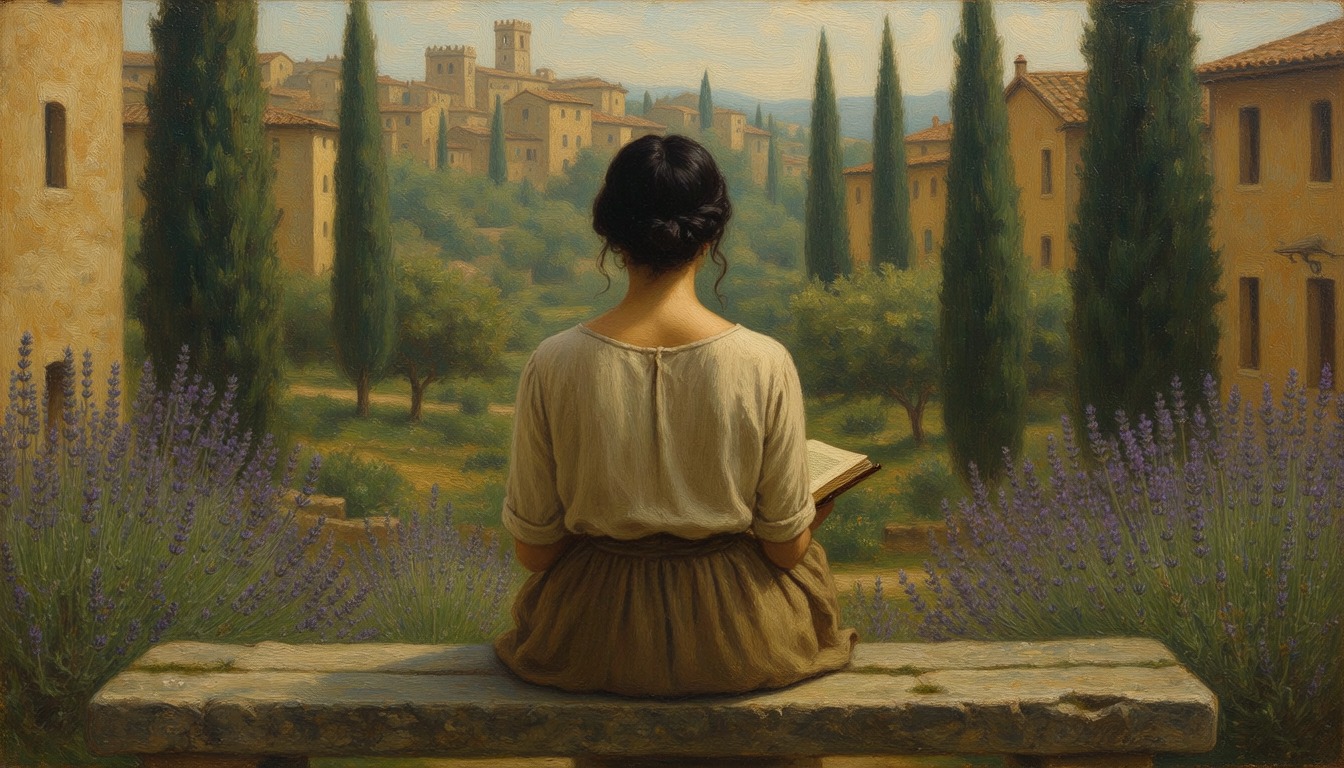
A young soldier named Donald is in Montepulciano, Italy. It is 1962. He is carrying the kind of quiet weight that young soldiers carry. He walks into a garden. And there, on a bench, a woman is reading. A book of philosophy in her lap. Lavender growing wild around her. She hasn’t seen him yet. The afternoon light catches her in a way that will stay with him for the rest of his life.
Her name is Sophia. It means wisdom.
That is the spark. And it is real and beautiful and I wrote it with everything I had.
But the love story, the one the novel is actually about, is the forty-six years that followed.
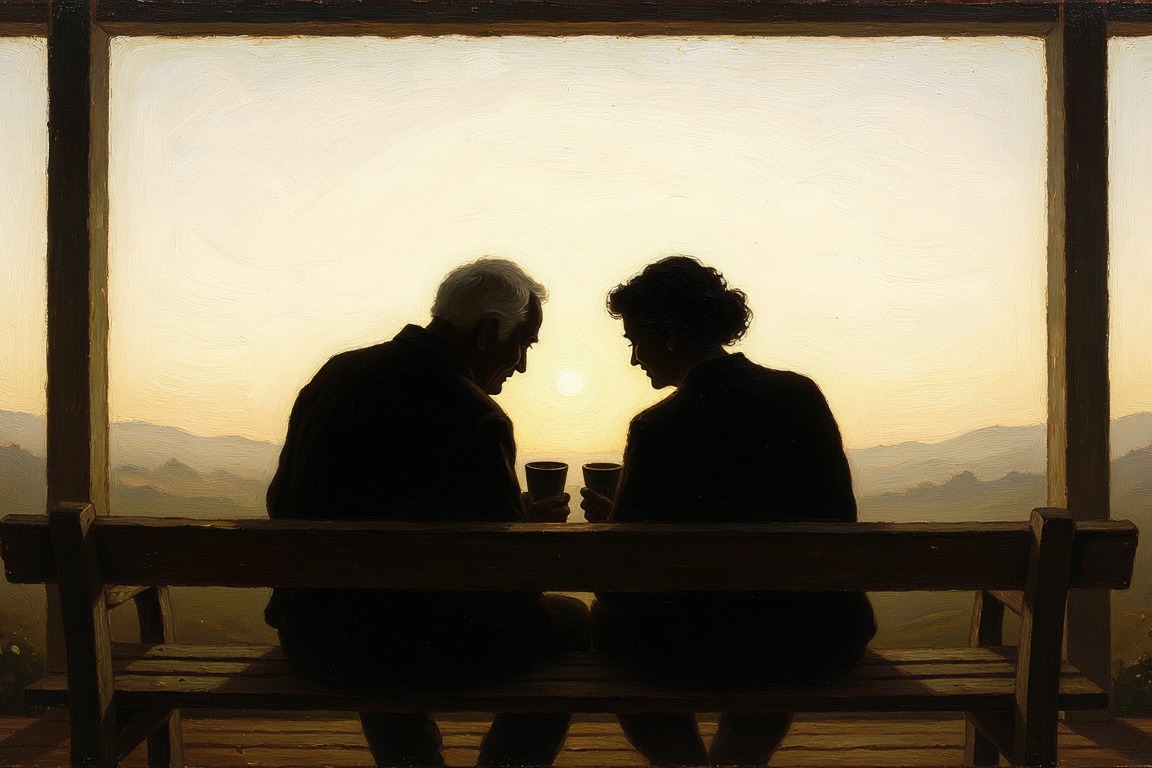
The choosing. Every day. Through distance and deployment. Through the raising of a daughter. Through the long, quiet years when love looked less like fireworks and more like passing the newspaper, refilling the coffee, remembering which side of the bed she needed to sleep on when her back was hurting. Through the illness that arrived without permission and the mornings he carried her tea and sat beside her and said nothing, because sometimes presence is the only honest language left.
Donald didn’t fall in love with Sophia once.
He chose her. Every morning. For forty-six years. And each choosing was its own small act of courage, its own quiet declaration: This. Still this. Again today.
Donald’s great-grandmother Mary Hanna understood this. She passed down a teaching that moved through the family like lavender pressed between the pages of a book, fragile, persistent, carrying its fragrance across decades:
You don’t fall in love. You choose it. The fall is choosing it again tomorrow.
Love as Virtue
In the six virtues at the heart of everything I teach, Love does not come first. That is deliberate.
You need the strength to stand before you can stand with someone. You need balance within yourself before you can hold space for another. You need to know what you carry before you can choose to share it.
Then Love arrives. Not as the gentle one. Not as the one that comes naturally and requires nothing of you. As the virtue that draws on everything the others have built, and asks for more.
Because love with fortitude can weather the storm together. Love with temperance knows when to speak and when to sit in the silence. Love with wisdom sees clearly, the beauty and the flaws, and chooses anyway. Not blindly. With open eyes. That’s the bravest kind of choosing there is.
I’ve seen this. Not just in my own life, but in the seventeen years I spent as a welfare officer in the military, sitting with people at the most difficult moments of their relationships and their lives. I saw what held and what didn’t. I saw what carried people through deployment, through grief, through the slow and unglamorous seasons that every long love passes through.
And the common thread, always, was the choosing. The couples who understood that love was a practice, not a feeling, were the ones who built something that lasted. Not because they never struggled. Because they had decided, somewhere deep in themselves, that this person was worth the practice. Worth the Tuesday. Worth the effort of showing up again when showing up was hard.
What I’m Still Learning
I want to be honest with you. I am not writing this from the summit. I am writing it from the path.
My wife, Skye, is extraordinary in ways that still surprise me. But the thing that teaches me the most about love is not the extraordinary. It’s the ordinary. The way she practises love like a musician practises scales: not because each repetition is beautiful, but because the repetitions, over time, become the music.
The text at 2pm on a Wednesday that says thinking of you. The decision to listen, truly listen, at the end of a long day when it would be easier to retreat. The grace extended after the argument, not because the argument was resolved, but because the relationship matters more than being right. A friend once taught me, you can choose to be right, or choose to be kind. I think in any relationship worth enduring, you always choose to be kind.
I am still learning this. Still practising. Still choosing, some days with ease, some days with effort, but always with the growing understanding that the choosing itself is the love.
Not a grand gesture. A daily one.
And there is something profoundly hopeful in that. Because it means love is never finished. Never fully arrived. Never something you can lose by accident. It is a practice, alive, ongoing, available to you in this very moment. The choice is always in front of you. Always fresh. Always yours.
The Invitation
I want to leave you with something simple. Not a lesson. An invitation.
Think of the person you love. Not the feeling you have for them, the person. Their face when they’re concentrating. Their hands around a morning cup. The sound of their laugh when it’s real, not the polite one, the real one.
Now ask yourself: When did I last choose them?
Not feel love for them. Choose them. Deliberately. With the full weight of your presence.
If the answer is today, beautiful. That’s gold. Hold it.
If the answer is longer ago than you’d like, that’s not something to feel bad about. That’s an invitation. A door opening. The choosing is available to you right now. In this moment. In whatever way feels true.
Send the text. Make the call. Put the phone down and look at them, really look. Or sit beside them in the silence, the way Donald sat beside Sophia, and let the silence say what words sometimes can’t.
Love is not what happened to you at the beginning.
Love is what you choose to do with the rest.
And the rest starts now.
About the author
Marcus J Emsley · The Guide
Marcus spent seventeen years as a welfare officer in the Royal Australian Air Force, at home and on operations overseas, sitting with people in grief, trauma and the mornings they did not want to rise. He is the founder of Arete Estate in the Barossa Valley, South Australia, the creator of The Sculptor's Journey and Wisdom & Wonder, and the author of the debut novel Wisdom & Wine. He is the son of a primary school teacher who coached footy, cricket and life, and a palliative care nurse who showed him what kindness at the hardest door looks like. He has stood in the dark himself, and he writes from the far side of it.
What we are building at Arete Estate
Arete is excellence becoming. It is the highest expression of who you were always meant to be, not the finished version, but the version that keeps reaching. It is not built. It is revealed.
Arete Estate exists to help people reveal, not construct, the highest version of themselves. We do this through six virtues drawn from the world's wisdom traditions, taught through stories, walked through daily practice, and offered to anyone who is ready to begin: the parent raising a child, the leader carrying a team, the soldier returning from service, the school shaping the next generation, the person sitting alone in the early hours of the morning wondering if there is a path through.
Our work is to make that path visible. To stand as a lighthouse for the seekers, the grieving, and the broken. To remind every person we reach that excellence is not built, it is revealed by storms, and that they are not alone in the storm.
We do not chase. We shine. The Sculptor's Journey (The Doorway, The Walked Path, The Guided Path), An Hour with the Guide, Meditate with Arete, Wisdom & Wonder and The Sculptor's Library are the rooms of that house.
Six virtues. One journey. Your highest self.
www.areteestate.com.au · info@areteestate.com.au · Instagram @areteestate
If this essay touched something raw
Some of what is written here is heavy. If it has stirred something you are carrying, please do not carry it alone tonight.
Lifeline 13 11 14 · Open Arms (veterans and families) 1800 011 046 · 1800RESPECT 1800 737 732 · Kids Helpline 1800 55 1800 · In an emergency, call 000.
Reaching out is not weakness. It is all six virtues at once: the Fortitude to stay, the Wisdom to know you need a hand, the Love to let someone in, the Courage to ask, the Temperance to set the weight down, and the Gratitude for the one who answers.

Responses