Fortitude · Dedicated to the silent heroes. What sitting with grief, trauma and transition teaches about character, and why what we give away is what saves us most.

There is a door that most people walk past without noticing.
It’s not locked. It doesn’t have a sign. But behind it, someone is sitting in a chair they didn’t choose, holding a grief they can’t yet name, wondering if anyone in the world knows they’re in this room.
For seventeen years, I walked through that door for a living.
I was a welfare officer in the military. If that title means nothing to you, good. It wasn’t supposed to mean anything to anyone. That was the point. We operated in the margins, between the mission and the human, between the uniform and the person inside it. When someone’s marriage collapsed, when the phone call came about a parent, when a colleague didn’t come home the way they left, when the weight of the years finally buckled a set of knees that had held firm for decades, we were the ones who sat down in the room.
No cameras. No citations. No campaign ribbons. Just the door, and the person behind it.
The Invisible Work
There is an entire class of people in this world whose most important work will never be seen. Not because it’s secret. Because nobody’s watching.
The nurse who sits with a patient after her shift has ended, not because the chart requires it, but because the patient’s eyes said please don’t go yet. The teacher who notices the kid who stopped laughing three weeks ago and quietly rearranges the seating plan so he’s closer to the front. The police officer who drives back past the house an hour later, just to check. The chaplain. The counsellor. The social worker who takes the call on a Sunday because the system doesn’t have a Sunday setting.
These people will not win awards for what they do. Their names will not appear in any headline. And most of them, if you asked, would tell you they’re just doing their job.
They’re not just doing their job. They are holding the line between someone’s worst day and the day after it. That’s not a job description. That’s a calling.
Marcus Aurelius, the Roman emperor who spent much of his reign not in a palace but in a military camp on the Danube, wrote something in his private journal that was never meant to be read: “Waste no more time arguing about what a good man should be. Just be one.”
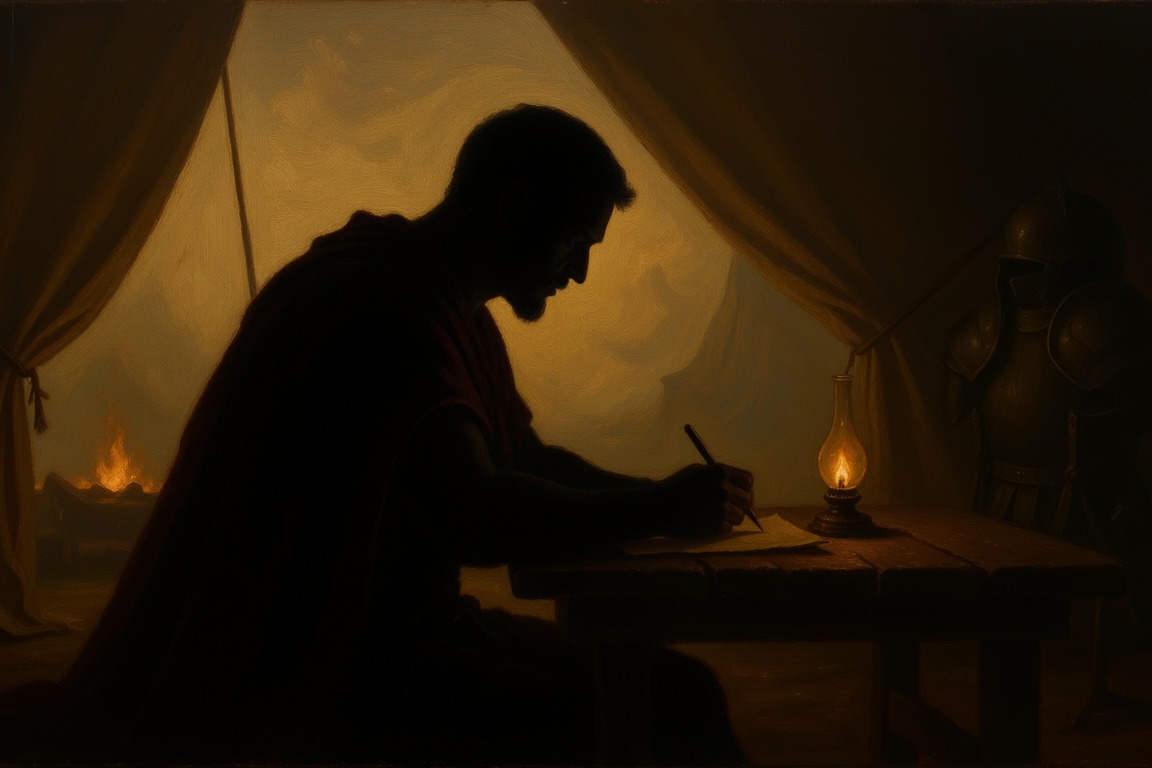
He didn’t write that for applause. He wrote it for himself, at night, in a tent, while the empire pressed in on all sides. That’s the work I’m talking about. The work done when no one is keeping score.
What the Shadows Teach
Seventeen years behind that door taught me things that no course, no textbook and no leadership seminar could. Four of them have stayed with me.
People don’t need answers. They need presence. The instinct, when someone is suffering, is to fix it. To offer advice. To find the right words. I spent years learning that the right words are almost always silence. Not empty silence, the kind that abandons. Full silence. The kind that says I am not going anywhere. Brené Brown calls it “holding space.” I call it the hardest thing a human being can learn to do: to sit with someone’s pain without trying to make it yours, solve it, or run from it.
Grief doesn’t follow a schedule. The models say there are stages. The models are useful in a classroom. In a room with a person whose hands are shaking, the models dissolve. Grief arrives sideways. It shows up six months late and announces itself as rage. It disguises itself as numbness and calls itself “coping.” It hides in busyness and control and alcohol and perfectly pressed uniforms. I learned to stop looking for the textbook version and start listening for the real one.
The uniform doesn’t protect you from being human. This was the lesson that took the longest. The culture of service, military, police, emergency, is built on competence and composure. You hold the line. You stay calm. You perform under pressure. These are admirable qualities. They are also, over time, a kind of armour that stops fitting properly. The person inside the uniform is still a person. They still carry their childhood. They still wake at 3am with a thought they can’t shake. They still need someone to ask, not “how’s the mission?” but “how are you?”
The people who help others are often the worst at helping themselves. This one cuts close. The helpers, the carers, the officers, the teachers, the ones who hold space for everyone else, are masters of deflection when the lens turns inward. We know the signs in others. We miss them in ourselves. Not because we’re unaware. Because we’ve built an identity around being the one who’s fine. Admitting otherwise feels like structural failure.
Epictetus, the Stoic philosopher who was born a slave and whose teachings shaped emperors, put it plainly: “It is not things that disturb us, but our judgements about things.” The judgement I carried for years was that needing help meant I had failed at giving it. That judgement was wrong. It took me longer than it should have to put it down.
The Cost Nobody Mentions
There is a term in the clinical literature: secondary traumatic stress. It describes the toll of sustained exposure to other people’s suffering. It is real. It is cumulative. And it is almost never discussed in the cultures where it is most prevalent.
But the clinical language never quite captured it. What I carried had a heavier name, PTSD, and it didn’t arrive the way people imagine. No single explosion. No defining incident. Just a heaviness that compounded. A bank account of other people’s worst moments that I’d been depositing into for nearly two decades without making a withdrawal. The phone that rang at midnight and the part of your brain that never fully switches off because somewhere, someone might need the door opened again.
Seneca wrote to his friend Lucilius: “We suffer more in imagination than in reality.” He was right about most suffering. But he’d never sat in a room where the suffering was not imagined. Where it was sitting across from you with bloodshot eyes and a voice that had stopped believing anyone was listening.
The cost is real. And the people who pay it, the nurses, the welfare officers, the first responders, the crisis counsellors, pay it quietly, because the culture they serve in rewards silence.
I’m not interested in rewarding silence anymore.
The Paradox That Changed Everything
Seventeen years behind the door revealed one truth that eventually became the foundation of everything I now teach: what you give away is what saves you.
Not in the sentimental way. Not the motivational poster version. In the hard, tested, philosophical sense.
Every time I sat with someone and offered presence instead of answers, I was practising Fortitude, the discipline of standing firm when the storm is not around you but inside you. Every time I listened without interrupting, without fixing, without flinching, I was practising Temperance, the balance of knowing when to speak and when to hold. Every time I helped someone sift through the rubble of their life to find the one thing still worth carrying, I was practising Wisdom, the gold pan, filtering mud from meaning.
I didn’t know those words then. I didn’t have the framework. But the practice was already there, forged in rooms that smelled of instant coffee and fluorescent lighting and the particular silence of a person deciding whether to trust you.
Most people who do the invisible work have never been asked why they do it. They just do it. And the reason, when you finally sit with it, is almost always the same: because someone did it for them once. Or because no one did, and they swore they’d be the person they needed.
That’s not martyrdom. That’s not burnout disguised as nobility. That’s the ancient Greek concept of Arete: the pursuit of excellence as a function of character, not achievement. The lighthouse doesn’t shine for recognition. It shines because that’s what it was built to do.
What the Door Became
I left the service after seventeen years. But I didn’t leave the door. I just opened it wider.
Everything I learned in those rooms, the presence, the patience, the slow and sacred work of sitting with someone while they find their own way through, became the foundation of something new. Not a departure from the work. An expansion of it.
The Stoics never meant their philosophy to be a set of clever quotes. It was a way of living: a daily practice of confronting reality with courage, treating others with compassion, and building a character that can withstand whatever comes. That’s what the door taught me. Not theory. Practice. Not quotes on marble. Hands on the table, eyes across from yours, the quiet question: What do you need right now?
The six virtues I now teach, Fortitude, Temperance, Wisdom, Love, Courage, Gratitude, weren’t invented at a desk. They were revealed in those rooms. Each one was tested before it was named. Each one earned its place not through philosophy but through the mud and gold of real human experience.
Excellence is revealed by storms, not despite them. I know this because I spent seventeen years watching people walk into storms they didn’t choose and come out carrying gold they didn’t expect.
For the Ones Still at the Door
If you’re reading this and you recognise the door, if your work is the kind that happens when no one is watching, the kind that earns no medals but saves lives, I want to say something to you that nobody said to me for a very long time.
The work you do matters more than you will ever be told. And the cost you carry is real. Don’t let anyone, including yourself, pretend otherwise.
The sculptor and the marble. You are both. Every life you’ve sat with, every crisis you’ve walked into, every silence you’ve held when the words wouldn’t come: these are strikes of the chisel. Not breaking you. Revealing you.
But it took me seventeen years to learn that you can’t pour from a vessel you never refill. The door doesn’t only open outward. Sooner or later, you have to walk through it yourself. Not because you’re failing. Because you’re human. And being human is not a weakness. It’s the whole point.
So pan for the gold. Acknowledge the mud: the cost, the weight, the things you carry home. Record the gold: the life that changed because you stayed, the voice that steadied because yours was calm, the person who is alive today because you opened the door. And carry that gold forward, into everything you do, into who you’re becoming.
Because the truth about service, real service, the kind done in shadows, is that it doesn’t just change the people you help. It changes you.
And if you let it, it becomes the most important thing you ever build.
About the author
Marcus J Emsley · The Guide
Marcus spent seventeen years as a welfare officer in the Royal Australian Air Force, at home and on operations overseas, sitting with people in grief, trauma and the mornings they did not want to rise. He is the founder of Arete Estate in the Barossa Valley, South Australia, the creator of The Sculptor's Journey and Wisdom & Wonder, and the author of the debut novel Wisdom & Wine. He is the son of a primary school teacher who coached footy, cricket and life, and a palliative care nurse who showed him what kindness at the hardest door looks like. He has stood in the dark himself, and he writes from the far side of it.
What we are building at Arete Estate
Arete is excellence becoming. It is the highest expression of who you were always meant to be, not the finished version, but the version that keeps reaching. It is not built. It is revealed.
Arete Estate exists to help people reveal, not construct, the highest version of themselves. We do this through six virtues drawn from the world's wisdom traditions, taught through stories, walked through daily practice, and offered to anyone who is ready to begin: the parent raising a child, the leader carrying a team, the soldier returning from service, the school shaping the next generation, the person sitting alone in the early hours of the morning wondering if there is a path through.
Our work is to make that path visible. To stand as a lighthouse for the seekers, the grieving, and the broken. To remind every person we reach that excellence is not built, it is revealed by storms, and that they are not alone in the storm.
We do not chase. We shine. The Sculptor's Journey (The Doorway, The Walked Path, The Guided Path), An Hour with the Guide, Meditate with Arete, Wisdom & Wonder and The Sculptor's Library are the rooms of that house.
Six virtues. One journey. Your highest self.
www.areteestate.com.au · info@areteestate.com.au · Instagram @areteestate
If this essay touched something raw
Some of what is written here is heavy. If it has stirred something you are carrying, please do not carry it alone tonight.
Lifeline 13 11 14 · Open Arms (veterans and families) 1800 011 046 · 1800RESPECT 1800 737 732 · Kids Helpline 1800 55 1800 · In an emergency, call 000.
Reaching out is not weakness. It is all six virtues at once: the Fortitude to stay, the Wisdom to know you need a hand, the Love to let someone in, the Courage to ask, the Temperance to set the weight down, and the Gratitude for the one who answers.

Responses